In a previous post concerning the Hindoo goddess Durga, or Durga Maa, which is to say Mother Durga, the present author offered an explanation of her cultus in terms of its soli-lunar symbolism. In popular understandings among Hindoostanis a more political symbolism prevails, whereby Durga represents the very soil of India herself, and so her festival in Calcutta, the Durga Puja, takes on more nationalistic signficances. Such lesser understands developed among the Calcutta intelligentsia during the 20th C. in their struggle against the British. It is one of the many ways in which the festival, and the cultus of the goddess, has been distorted over time. Sociology displaces cosmology. This is always a sure sign of religious decay. Principally, though – as noted in a previous post – there has been, in this case, a calendrical distortion. Once the Durga Puja was attached to the spring equinox. Since the 17th C. – a time coinciding with the arrival of the British – it was dislodged and has become attached to the autumn equinox. Instead of being a celebration of the restoration of order after the dark of winter, it now celebrates the end of the monsoon.

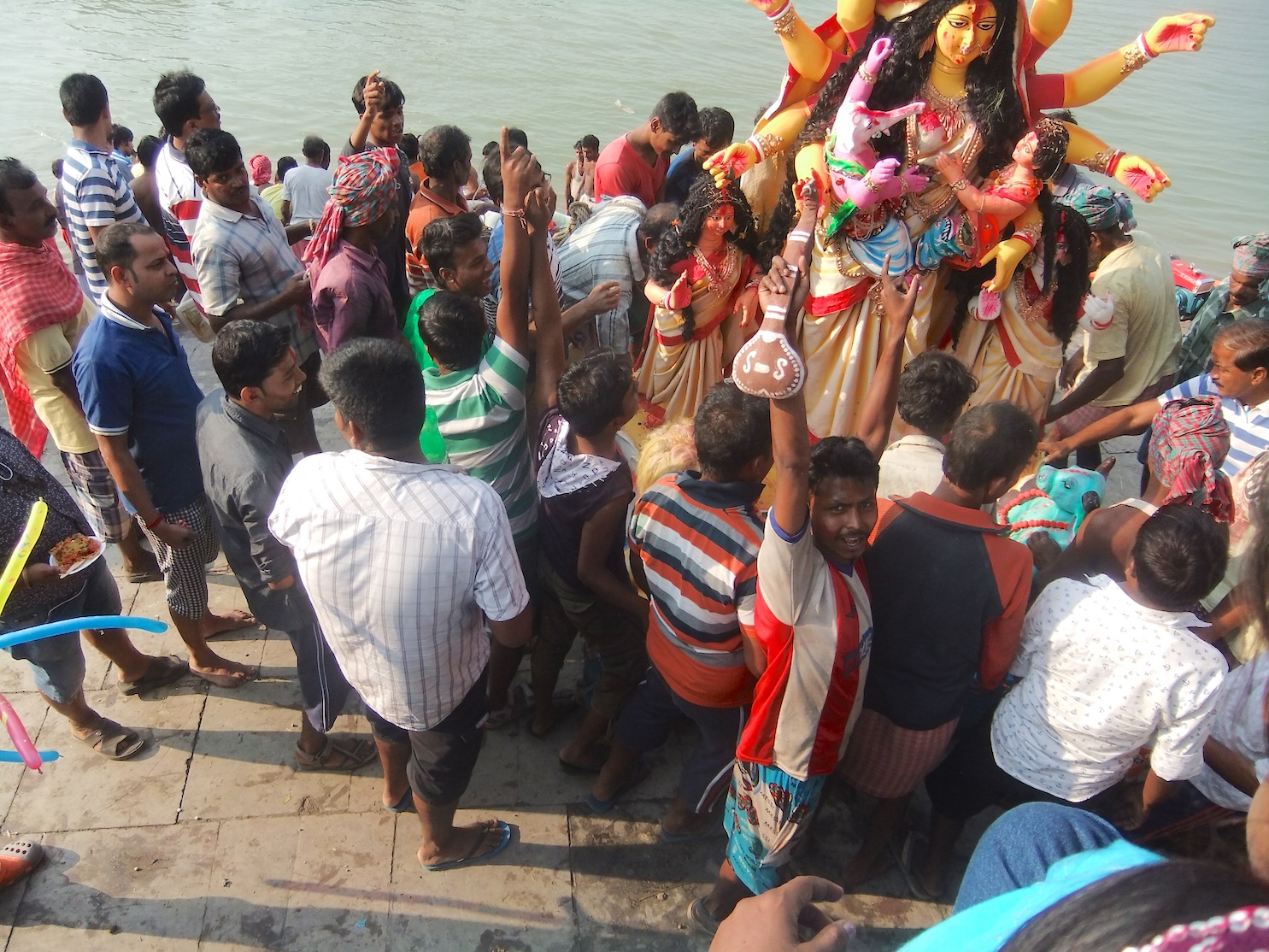
The present author was fortunate enough to witness the climax of the festival yesterday. It was a wild, noisy affair marked with drums and other festivities. The Durga idols are removed from their homes in “pandals” and hoisted into the back of trucks and lorries and, with much fanfare and hoopla, taken down to one of the ghats along the Ganges (i.e. the Hoogly River). They are then thrown into the river where they float downstream and out to sea, although, there being so many of them, the custom now is to clear the river of them with dredges before this happens so that only a few actually make the journey to the Bay of Bengal.
Witnessing this event revealed an important detail of cosmological symbolism of which this author was not previously aware and which is not mentioned in any of the written accounts he had previously read. Namely, that before the Durga idol is tossed into the waters of the river it is the custom for it to be spun around seven times. The Durga idols, readers will appreciate, are heavy, being constructed of straw and clay and wood. Teams of Hindoo men lift them from trucks, carry or drag them to the ghat, and then – with great effort, spin them around, once, twice… seven times. Then, when there is space and opportunity – guided by police and other officials who control the whole chaos, there being dozens of teams of Hindoos arriving with their idols all the afternoon, the statue is pushed into the water to shouts of joys and the splashing of water. The pious dive in with her or else run the sacred waters of the river through their hair.

The turning of the Durga seven times before she is dissolved in the river, surely, is a motif of cosmological significance. The river, readers must understand, is itself a terrestrial correlate of the celestial river (the Milky Way), and so the ocean is the terrestrial correlate of the great and infinite darkness of the sky. Durga herself represents the same. She is, as the conquering type of Kali Maa, as noted in a further previous post, that deity that the Greeks called Night. (Here, the conjunction of symbolisms between the darkness beyond the stars and the black soil of the earth is crucial, for Durga is both.) The seven turns prior to returning her to the river signify the seven planets and their courses. The symbolism is quite plain. There is certainly no political or sociological meaning to this custom. It points to a cosmological truth.
The impressive thing about this climax to the festival, too, is the theological fact that, finally, the idols are transient. It is a celebration of impermanence. The Durga statues are made by the potters of the city with great love and care. They are housed in beautiful, elaborate pandals (temporary temples) – typically placed at crossroads (a further cosmological motif, the crossroad being the terrestrial correlate of the points where the ecliptic and equator cross at the equinoxes.) It is a vastly elaborate business. The statues are clothed and painted and decorated with jewelry. But they only stand for a short while. Then they are taken to the river and destroyed. Next year they will be made all over again. The theological lesson of this is that the idols are impermanent and merely symbols or emblems. The Mohamedan will often chide the Hindoo for worshipping idols. Prophet Mohamed himself takes the title ‘Smasher of Idols’. But yesterday this present author witnessed the Hindoos smashing their own idols – to the point that the river was choked with them. And as they smashed them the Hindoos shouted with joy. The festival underlines the fact that these images of Mother Durga are merely clay and straw and the Hindoo does not worship the clay and straw but rather the divine reality represented by that image. Idolatry, of course, is a confusion of this point. There is no confusion in the Durga Puja. No one mistakes the image for the reality it represents. The image is dissolved in the consuming waters of the Ganges. Durga Maa is other than her image.
Yours,
Harper McAlpine Black