Wednesday, 25 April 2018

Old Roses Renamed - the Cis Binary Rosarian


Before the modern nonsense of naming hurricanes and tropical storms after men, when they are most obviously female phenomena, rose breeders succumbed to gender dysphoria and started giving roses - the most feminine of flowers - men's names. It's an absurdity. Let us be explicit on this matter from the outset lest there be any confusion: the entire symbolism of the rose (and by extension most if not all flowers, but certainly the rose!) alludes to the female part, the floral similacra of the female sexual anatomy. One would think that rose breeders and rose lovers would be conscious of this simple fact even where they are too polite to mention it. A rose by any other name. The rose, indeed, has a rich symbolism and a myriad of meanings, but behind them all is this one anatomical reality - the flower resembles the vulva, the cunnus. There is no escaping it. Anyone who has even a passing familiarity with both marvels of nature - roses and the sexual organs of women - should know this. It is therefore a travesty, a perversion, a grotesque malformation, to name a rose after a man. Do men have vulva? No. It is as simple as that. 


The rose vulva. How explicit do we need to be? 

The present writer, being an enthusiast of old (or so-called 'heritage') roses, and having once - in more halcyon days - had a large garden replete with them, has been offended by many of the masculine names in his collection over the years. Often we have a beautiful, deliciously feminine rose and yet tasteless - and no doubt sexless - rose breeders have blighted her with the name of some half-witted and undistinguished buffoon with a moustache. It is like naming a gorgeous girl 'Thomas' or 'John'. Why would they do this? On the whole, of course, our roses are named appropriately. The great majority of them have women's names, even if inelegant ones - 'Frau Dagmar Hastrup'. But some have been given men's names, and it is, frankly,  irksome. The present writer, at least, subscribes unashamedly to old fashioned "cis binary" (as they are called) gender categories and when it comes to roses of the equally old fashioned type will not abide by anything less.


The following is a short catalogue of lovely roses that were originally mislabelled with masculine names. The present author has taken it upon himself to rename them and hopes that rose breeders will in future take note and learn from their mistakes: 


MADEMOISELLE JOSEPHINE MARCUS


Americans, as we all know, are appallingly sentimental about their Presidents and often treat them as a cheap substitute for royalty. This very popular American rose, famed for its intense red colour and deep fragrance - a very image of feminine passion - was named 'Mister Lincoln', one of the great travesties of rosarian nomenclature. There is nothing about this rose that in any way suggests any aspect of the life or character of the drab and colourless and chaste Mr Lincoln. More happily, it has here been renamed Mademoiselle Josephine Marcus after the lover of Wyatt Earp.


* * *


IMPERIA LA DIVINA

This hybrid perpetual, circa 1868, - a brazen floosy - has formerly been known as the Duke of Edinburgh! A less rose-like appellation for such an exhibitionist can hardly be imagined. She has been been recast here as Imperia La Divina, Imperia the Divine, the title given to the famous XVth century Roman courtesan.


* * * 


QUEEN ZUBAYDA

The damasks are the most fragrant of the roses and evoke the sensuality of the mythic East. This rose, once called Baron Prevost, is in fact a hybrid perpetual, but has retained the intense oriental fragrance of her forebears. Accordingly we have chosen to bless her with an oriental and aristocratic name, Queen Zubayda, this famous woman being the wife of the great IXth century Caliph (of Arabian Nights fame) Harun Al-Rasheed.


* * * 

ASPASIA

Another fine old rose scarred with an ecclesiastical title. She has been known as 'The Bishop'. This shy creature, who flowers but once a year, and arrived on the scene some time in the late 1700s has he striking deep mauve coloured flowers with bright yellow stamens. She is one of the present writer's favourites, and he has renamed her Aspasia after the famed seductress of philosophers and lover of Pericles. 


* * * 

MARION HALL BEST

If there is one thing worse than naming roses after military men, it is naming them after clergy. It is a sheer act of perversity to name a flower that is emblematic of erotic love after a clergyman! This lovely semi-double rose of creamy white flowers with golden stamens, dated 1926, was blighted with the name 'Bishop Darlington'. She has now been relieved of this burden and renamed after the famous Australian interior designer Marion Hall Best, 1926 being the year she was married. 


* * * 

FRAULINE AMELIE BEESE


Introduced in 1886, this rose has large, fleshy loose petals of a bold pink colour that is often described as "tinged with copper" or as having "copper undertones" - a somewhat 'metallic' pink, in any case. It has formerly been known as Dr Grill. (Who Dr Grill was and why he deserved having such an overtly feminine flower named after him we may never know!) With hindsight, she has been renamed Frauline Amelie Beese after the German aviation pioneer - one of the first women to fly - who was born in 1886.


* * * 

NAOMI EISEN

Named 'Sir Thomas Lipton', purveyor of junk teas, this cross between R. rugosa alba and the polyantha 'Clotilde Soupert' is a scented bush rose ideal for hedges and dated 1900. She is now known as Naomi Eisen, named after a lovely young woman, gardener and tea drinker, of the present writer's acquaintance.


* * * 


LIANE DE POUGY

A double cupped bloom of pale blush flowers striped with crimson - what a sight! This sweet scented rose, originally misnamed as 'Ferdinand Pichard', is described as "the last of the Bourbons" but is technically speaking a hybrid perpetual. Introduced in 1921. She has been named after the notorious French courtesan Liane de Pougy, famed for her marriages, lesbian affairs and for the time Sarah Bernhardt  advised her that, when on stage, she ought to "keep her pretty mouth shut."


* * * 

PRINCESS ADELHEID

This light pink hybrid rugosa, introduced in 1899, is intensely fragrant but, for some reason, has been cursed with the name 'Conrad Ferdinand Meyer'. No longer. Henceforth she will be known as Princess Adelheid. 
Her Serene Highness Princess Adelheid of Schaumburg-Lippe, wife of Friedrich, Duke of Schleswig-Holstein-Sonderburg-Glücksburg died, aged 78, in the summer this charming and aristocratic rose was introduced.


* * * 

EVE


The introduction of the repeat blooming Tea roses in the first half of the XIXth century revolutionised roses forever: it is the line of demarcation between the modern roses and those of the ancien regime. This rose, of 1838, with salmon-pink blooms and a touch of apricot here and there, is regarded as the first of the modern breed, and therefore they named her 'Adam'. Good God! Gender dysphoria of Biblical proportions! We have here corrected that eschatological blunder and named her 'Eve' as she should of been from the start.


* * * 


MISS SALLY WHIPPLE

Rose catalogues will sometimes say that this rose, once called 'Henry Nevard', and introduced in 1924, has "masculine qualities". Hardly! (Some of the nonsense written in rose catalogues beggars belief.) As readers can see in the photograph below, she is all woman. She is described as a scarlet/crimson hybrid perpetual with cupped petals and a strong, heady fragrance. Masculine? We have chosen to call her Miss Sally Whipple after the name of the main character in the 1924 film An Average Woman, the name in this case being ironic (because this woman is far from average!) 


* * * 


MISS JESSICA MILROY

William Lobb is assuredly one of the ugliest names ever imposed upon a rose. We have rescued this moss rose from that infamy and renamed her Miss Jessica Milroy after a lady of the present writer's acquaintance. The moss roses are a special class; strange, mystical, unusual. This one features dark purple semi-double flowers that become darker with age. The flowers are perfumed but like all the mosses the 'moss' feature on the buds is deeply camphorous, almost like lavender oil. 1855.


* * * 


PHRYNE

Captain Thomas? What sort of name is that for a rose? This pale yellow climber, bred in 1935, with its dark stamens contrasting with its soft and delicate yellow single petals, tending to fade to white, was for some unfathomable reason named after a military man. Here, though, she has more deservedly been renamed Phryne, a nickname signifying "yellow" given to the famous Greek hetaera (whose real name was Mnesarete.)


* * * 

MARIE-SOPHIE


It ought to be a iron-clad rule - indeed, there ought to be a law - that no rose should be named after bumptious military figures. This very fine rose of 1853, first of the repeat flowering hybrid perpetuals, and historically speaking the very first long-stemmed cut rose, was unfortunately named 'General Jacqueminot'. The blooms are shapely and dark red, the fragrance sweet - surely not qualities for which the General was known. So why? We have renamed this fine flower Marie-Sophie 
after Mademoiselle Marie-Sophie Leroyer de Chantepie with whom Gustav Flaubert corresponded concerning the classic realist novel Madam Bovary.


Harper McAlpine Black

Saturday, 21 April 2018

Sydney Long and Australian Paganism


The spirit of the Australian bush landscape is notoriously illusive and has been especially so for artists trained in European traditions. Though many have tried very few have managed to capture the spirit of the land. Indeed, the history of Australian art might largely be characterized as a constant struggle to capture or define the spirit of the land and, by and large, it is a tradition – barely two hundred years old, admittedly – that is somewhat undistinguished in this regard. Other artists, despairing of this, have given up the quest and have instead turned back to more European or simply urban, cosmopolitan preoccupations without further pretense. Much the same is true of writers. One thinks of the poet Christopher Brennan who said, famously, “My poems could have been written in China” so unconcerned was he with any dreary requirement to be authentically “Australian”. It took a genius of the calibre of D. H. Lawrence – who was only in the country for a few brief months – to write anything profound about the place. There are passages in his tour de force novel Kangaroo that are unsurpassed as evocations of the Australian bush.

In the visual arts people typically refer to the so-called Heidelberg School – misse en plein impressionists - as the first real attempt to come to terms with the quality and true nature of both the light and the landscape. This may be so, and painters of the school are still loved, but it was a limited endeavour. As in Europe, impressionism was quickly exhausted and opened into the multivalent by-ways of post-impressionism and beyond. In Australia, modernism had a difficult and unhappy birth and, in fact, came to very little. Artists routinely travelled back to Britain or other European sojourns in order to escape the isolation and limitations of the great south land and its 'tyranny of distance'. In the best cases they brought back fertile currents of European culture to synthesize with local habits. 


A particularly interesting synthesis – although much maligned or neglected today – was what we might call Australian Paganism. This imposed elements of classical mythology upon the Australian landscape, sensing a deep pagan spirit (as opposed to the indigenous ‘primitivism’ which remained alien to Europeans) in the land. Several important artists worked in this vein, although their insights were not pursued after the rupture of the wars and even more so the recent rise of a cringing anti-Eurocentric bias in progressivist (politically correct) thinking. Accordingly much contemporary art is pseudo-aboriginal and actively shuns the European heritage. But such paganism was not at all unfounded. As evidence its truth and depth was reiterated profoundly in 1975 by Gheorghe Zamfir’s soundtrack to the celebrated Peter Weir movie Picnic at Hanging Rock. If the visual and literary engagement with the land has been problematic, the Australian musical heritage has been utterly undistinguished. Zamfir, a Romanian, captured it. He brought together the pan flute and the deep sonorous qualities of the organ framed by the realisation that the organ is nothing but a pan flute writ large. In this, he brought out both notes that resound in the Australian bush: a crisp, strange whimsicality with a forbidding mysterious vast 'geological' antiquity. The pan flute – in its two extreme registers – was exactly the instrument to evoke a true music of the land. 


Similarly, the figure of Pan featured in visual evocations of the landscape among Australian Paganist painters. By far the greatest of these was Sydney Long. His paintings and etchings are regularly described as “incongruous” now because he places Pan and nymphs and other pagan mythological elements into Australian bush settings. But why not? Like others, he travelled to England and Europe to live and study and brought back with him new sensibilities and techniques; in his case he started as an impressionist of the Heidelberg School but with the sundering of impressionism thereafter took up the concerns of the so-called ‘Symbolists’ and much of the aesthetics of Art Nouveau. Indeed, he must be counted as Australia’s foremost representative of the Symbolist movement broadly defined. His solution to the problem of engagement with the land found little support, however. One of his earliest paintings – By Tranquil Waters – already shows his concerns as well as the difficulties he would have. It is a painting done more or less in the Heidelberg impressionist style, but he adds to the landscape a paganesque eroticism which his contemporaries found scandalous. Here already we see the haunting playfulness of Pan. It becomes explicit in his later work. 


He was himself a difficult character. As time went on he became more and more in conflict with younger Australian avante garde artists. As modernism descended into the depravity of abstract expressionism and the barren anti-art of conceptualism his work was deemed more and more 'old fashioned'. He did not take this well. Those who knew him described him as a lonely and bitter figure who resented the many ways in which he was snubbed by the art establishment. Although he won several prizes, he felt passed over and neglected. This was on top of his personal insecurities. A very short man - indeed elf-like - he often wore a tall top hat to give himself extra stature, and in his later years he habitually claimed to be much younger than he in fact was. He resented a younger generation of modernists who increasingly regarded his work as irrelevant to their concerns.


Perhaps his most famous painting - certainly the most often reproduced - is the one below, entitled The Spirit of the Land:


It is not "aboriginal" enough for contemporary progressive tastes (and no doubt it will be deemed 'sexist' and all the rest as well nowadays?) but it remains one of the truest renderings of the anima of the Australian land. It is an image of the soul of place. It does not pretend to be 'authentic'. It does not valorize the "rugged Australian" or anything of the sort. It is, it is true, an amalgam of the European and the native, but, again, why not? It demonstrates how Mr Long brought an Art Nouveau sense of line to the task of capturing the spirit of the great southern continent- and indeed his line is superb. The present writer, at least, (himself an Australian) regards it as one of the few truly successfully spiritual evocations to be found in Australian art. It is one of the finest examples of Australian Paganism.

* * *


The paintings and etchings below give readers of these pages a representative sample of Mr Long's work; both his more conventional landscapes (the gum trees etcetera one expects of Australian landscapes) and his explicitly pagan impositions. Sydney Long
(1871–1955)is a major Australian artist whose solution to the problem of rendering the Australian landscape through the vehicle of a European artistic vocabulary was not misconceived. The other artist of this persuasion - now thoroughly out of favor - was Norman Lindsay - Australian Pagans of the first half of the XXth century.


Harper McAlpine Black

Saturday, 14 April 2018

Lord Peter Death Wimsey


It rhymes with “stairs”. At least, this is how Dorothy L. Sayers preferred it. And she also preferred to be considered not as a writer of light crime fiction but as a serious scholar, with her translation of Dante her masterwork. Readers will perhaps know her in both these guises but might never have made the connection. This was the case with the present author, anyway. Her rendering of the Divine Comedy in the Penguin Classics series has been on his bookshelf for decades, and at a later point he became acquainted with her novels and stories, but without at first realising that these were the work of the same author. Indeed, the two undertakings are, on the face of it, very different: a serious, elegant, scholarly translation of Dante, and curious detective tales set in 1920s England. One can appreciate that Professor Tolkien, a northern European philologist, was the author of Lord of the Rings – the two undertakings are clearly related – but in the case of Miss Sayers there is no such obvious relation. It takes a stretch to see any connection. One might be inclined to dismiss her crime fiction as a mere hobby. 


Yet there is some connection to be made. Her medievalist concerns are not entirely remote from her contemporary tales. This is especially true regarding her most famous literary creation, the unlikely sleuth Lord Wimsey. The connection, in a word, is chivalry. It is with predictable tiresomeness that critics – that over-rated snob George Orwell being the most notable of them - have attacked this character in terms of popular sociology. They say, apart from his name being “embarrassing”, that his “classist pretensions” are ”appalling.” They dismiss Miss Sayers hero as a “caricature” of the British upper class. Certainly, he is not for democratic tastes, and those who are irredeemably poisoned with disdain for the British aristocracy will despise him without a second thought. Lord Wimsey, with his side-kick man servant Bunter, is a toff, an upper class twit, an anachronism, an unwelcome representative of a dying class system from another era. For many readers this is enough to doom Miss Sayer’s stories from the outset. The Lord Wimsey mysteries have been and continue to be analysed and understood – or misunderstood - through this narrow and claustrophobically modern lens.

But let us remember that the character’s creator was steeped in medieval literature, the medieval romances, tales of knight-errantry. Aside from her life-long dedication to Dante, Miss Sayers wrote extensively of the Song of Roland, the Arthurian cycle, Chaucer and more. Just as we need to understand Professor Tolkien’s tales of hobbitry through the lens of his dedication to Norse saga and northern European epic, so we need to understand Miss Sayer’s fictive creations through the lens of her immersion in medieval romance. For Lord Wimsey – eccentric and resoundingly British and modern though he might be in other respects - is assuredly a deeply medieval character. It is obvious especially in his relation to the heroine Harriet Vane. We see it at once in the foundation story ‘Strong Poison’. Lord Wimsey – as per the conventions of courtly love, and very much reminiscent of Dante’s entrancement by Beatrice – falls madly in love with Miss Vane on merely glimpsing her photograph in a newspaper. She has been accused of murder and is set to be tried and hanged. Instantly, like a medieval knight, he determines that she could not possibly be guilty and sets out to rescue her. This is the whole premise of the tale. The novel concerns Lord Wimsy’s efforts to find the true murderer and to save his beloved from the gallows.

Moreover, like Dante’s love for Beatrice, this is an enduring, instant, eternal love, not a mere infatuation. Lord Wimsey seeks an audience with Miss Vane in prison and proposes marriage to her two minutes after their first meeting. She, being a modern woman – she has had a long and “irregular” affair with the lover she is accused of murdering – declines. Thereafter, Whimsy persists with uncommon patience. He proposes marriage again and again, throughout these novels, for a period of over five years, never once wavering. This constancy is again deeply medieval. In terms of any realistic characterisation of British aristocracy his character might seem overblown (this is what irked Orwell, whose real name was the working class name of "Blair") but in fact what we see in his character is an elaborate, chaste, transcendent chivalry shaped by the conventions of medieval courtship, suitable recast in a modern form. Such a character could only have been created by a medievalist. Lord Wimsey’s gallantry is medieval through and through. This is what makes him such a wonderful creation – and also what makes him so despicable to modernists who are constitutionally unsympathetic to the whole medieval mode. 


This, at least, is one useful way to approach the crime fiction of Miss Sayers. Critics similarly despise Miss Sayer’s Christian themes and are inclined to find them in her stories. But again, her Christianity is thoroughly medieval – as we see in her scholarly work on the Divine Comedy especially – and it is wrong to cast it as excessively or exclusively modern. There is not much of it in Lord Wimsey, in any case. He is not an overtly Christian character, except that his virtues are transmuted by courtly manners in the way of the medieval knight. He has been damaged (psychologically) by service in the First World War. He is thus like the knight who has returned from the Crusades. And his bond with Bunter – a splendid character indeed! – is entirely akin to the knight’s feudal bond with his servant. Modernists and Marxists will hate it, for sure. The great thing about Dorothy L. Sayers, though, is that she recasts these medieval themes into faithfully modern forms. There is no nostalgia or moralism. Harriet Vane – a portrait of Miss Sayers herself, surely – is an altogether modern woman. Yet a medieval lady too. 


One is always reminded of Barbara Tuchman’s parallels between the calamitous XIVth century and the early XXth in the celebrated study A Distant Mirror, and similar observations in the work of the Dutchman Johann Huizinga. Miss Sayers, on these grounds, should be placed in this same company. It is remarkable that she has been able to draw such unstrained parallels and render them into the murder mystery genre. 


We are missing the keys to Lord Wimsey’s character if we overlook his deeply medieval background. The present author has remarked previously that the British were the last remaining chivalrous culture to extend into the barbarous chaos of modernity. No doubt, by Miss Sayer’s day it was all in tatters, and this is not by any means glossed over in her stories. Yet Lord Wimsey is a medieval man as much as he is modern. His creator provides many clues to this. Amongst his numerous hobbies, for instance, is his predilection for illuminated medieval manuscripts. He hones his skills as a sleuth on the puzzles presented by such documents. And then, perhaps best of all, we find that his middle name is “Death” – Lord Peter Death Bredon Wimsey. He remarks in one tale – “Murder Must Advertise” – that those afflicted with the name usually pronounce it “Deeth” but he thinks it is “rather more interesting if it rhymes with ‘breath’.” It is surely a medieval touch – the gallant hero, in pursuit of the distant damsel, marked with the momento mori. More generally - contrary to the critics - if Miss Sayers has anything to say about that most dreary of modern obsessions, gender, it is through the lens of her medievalism.


* * *

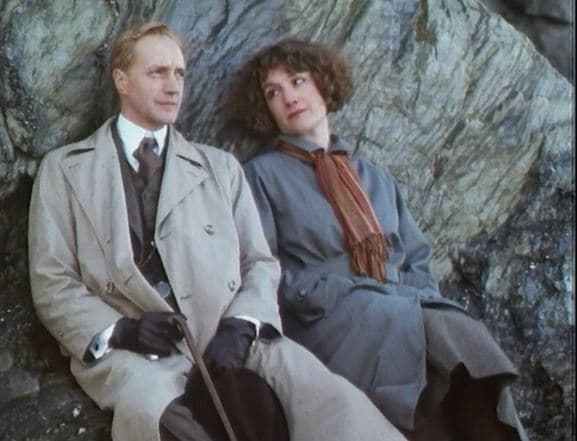
There have been two very different portrayals of Lord Peter Death Wimsey in popular culture. He was played ably by Ian Carmichael in the BBC’s Lord Wimsey series in the 1970s. Decades later he was played by Edward Petherbridge. For the tastes of the present author, the latter portrayal is the better. The earlier portrayal is too jolly. The latter captures better the knight-errantry remarked upon above. 


Lord Wimsey and Bunter

Sunday, 25 March 2018

Kenneth Denton Shoesmith - Madonna of the Tall Ships


There is a charming story concerning the naming of the 1930s ocean liner the HMS Queen Mary. Constructed by the Cunard Line to run services across the Atlantic during the great age of ocean travel, it was first proposed that the ship be named the Queen Victoria. This was in keeping with the Line’s previous policy of having all of their fleet take female names ending in the suffix –ia. It was necessary, however, to seek royal permission for the use of Queen Victoria’s name, and so Cunard dutifully approached the reigning sovereign King George V with this formal request. According to the story they posed the request as permission to name the vessel after “England’s greatest queen” and King George – on a misunderstanding? - responded that his wife and consort, Queen Mary, “would be delighted” to have the ship named after her. Cunard Line was then bound to name the ship the Queen Mary, and thus it was.


The story comes to mind because it is on the Queen Mary, now preserved and docked as a maritime museum, that we find the masterpieces of the very fine but much neglected English artist and illustrator Kenneth Denton Shoesmith. An appreciation of his work is today largely confined to the small band of connoisseurs of maritime art, but it is deserving of a much wider audience, and for the present purposes, in keeping with the preoccupations of these pages, it deserves to be appreciated for its many orientalist and religious themes. Mr Shoesmith was destined to go to sea from an early age. While still a teenager he enlisted to be trained as a merchant marine at the Conway College; he was a so-called 'Conway Cadet' who graduated from the college then located on the HMS Conway docked in Liverpool which served as a training institute for British merchant sailors. At the same time, however, he found a passion for painting and eventually this talent led him to become a full-time artist. Here is his early painting of the Conway:


As readers can see, it is very competent work for such a young man - he was entirely self-taught other than completing a brief correspondence course - but conventional, realistic and unremarkable in style. As he continued painting, though, and found employment producing poster illustrations for maritime companies, his style matured and he adopted the methods and manners of the so-called 'Symbolist' and Art Deco schools in vogue prior to the Second War. In this mature style he produced many truly worthy works, many featuring exotic lands, before he died at the age of forty-eight in 1939. His master work followed a commission by the Cunard Line to produce murals for the new Queen Mary. 

Here is another early work in his more realist style:


And another, this being a somewhat more impressionist watercolour rendering of the P & O steamer Strathmore:


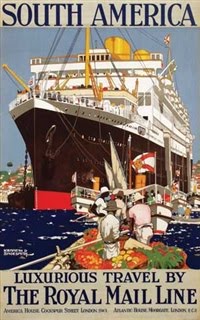
During the Edwardian age, of course, steamers of many great ocean lines - P & O (Pacific & Orient), Royal Mail, Blue Funnel, Cunard-White Star, Canadian Pacific and others - connected the many corners of the British Empire and east with west. As both a sailor and an artist Mr Shoesmith had the opportunity to travel the seven seas and never tired to sketching and painting both the ships that he loved and the distant lands to which they journeyed. His art is one of the most complete and lovely records of that regrettably by-gone age. As already mentioned, he made his living in the main producing images for travel posters such as the following:


Aside from, or incidental to, this commercial work he also produced paintings and illustrations for his own enjoyment. There are, for instance, such exceptional images as these of Egypt, North Africa and the Near East:


The most memorable images tend to be nocturnes; ships in exotic harbours at night seem to have been his forte. At best his style is as luminous, his colours as deep and as compelling, his subject as evocative as the work of his better known contemporary Nicholas Roerich. Three examples of Mr Shoesmith's nocturnes:


Also outstanding are the paintings he made of ships travelling the arctic passage, images of the midnight sun:


In the years 1934-36 he worked on murals for the Queen Mary. In these works we see him at the height of his powers. He produced a series of octagonal designs with literary themes and, for the first time, he turned to religious subject matter. Among the requirements for the Queen Mary were special installations for Catholic altars, altarpieces and reredos, provisions for the pious traveller. Mass was celebrated in the first class drawing room. He painted several images of the Virgin Mary for this location, as well as a screen that covered the altar when not in use. These are now regarded as his finest works. His most famous painting is that dubbed the 'Madonna of the Atlantic'. Here is a photograph of the artist working on it:


The prudish Cunard officials, however, took exception to the Christ child unclad (Good God! You can see His divine penis!) and demanded that Mr Shoesmith paint a drape over His nakedness. Thus the finished work appears as follows:


The folded panel covering the altar is a mediterranean sailing scene:


The work known as the 'Flower Market' in the first class cabin was a favourite of Winston Churchill. Below, the painting and a photograph of Mr Churchill giving a press conference in front of it:


The stand out work among the Queen Mary murals, however, is surely another Madonna, the so-called Madonna of the Tall Ships. It is the same Madonna as the Madonna of the Atlantic, this time giving a benediction, and the Christ Child is suitably attired, but in the background is an array of tall sailing ships - in the foreground (rich in symbolism) three anchors and a lantern:


To the mind of the present writer, at least this is a work that unites religious and maritime themes more successfully than the Madonna of the Atlantic and represents the pinnacle of Mr Shoesmith's art. It has perhaps received less attention because it was painted for the library of the second class (tourist) quarters. The colours are more brilliant and direct and as a painting it demonstrates better than the other work on the Queen Mary his full command of the technicalities of seafaring as well as his (self taught) command of the (Renaissance) European painting tradition. The serene majesty that he found and captured in the great ocean liners of that era is now matched by the serenity and majesty of the Blessed Virgin herself. 

* * * 


Yours,

Harper

Tuesday, 16 January 2018

Reciting the Hymn to Pan


The recitation of poetry - poetry as vocal presentation, live on the breath - is about as lost as a lost art can be. Poetry itself can be classified as "all but lost", but the proper, effective, artful presentation of poetic recitation is dismally lost - great recitation is very, very rare. No one knows how to deliver the spoken word anymore. This, at least, is the reluctant conclusion of the present author. With few exceptions (Tegan Gigante is one) it is devilishly hard to find people who know how to read poetry. It makes an interesting test, to ask a group of the poetically inclined to read a poem, say, Eliot's Prufrock, aloud. It is hard to find a single convincing reader. The art of reading aloud is as neglected today as the art of fine handwriting. 

Given that, here is a real test. Who can offer a convincing rendering of Aleister Crowley's celebrated and ecstatic 'Hymn to Pan'? Many try, and many fail. Frankly, it is a dreadful poem with very few redeeming features, which is true of nearly all Crowley's poetry. There may be grounds for reconsidering the character and importance of Mr Crowley, now that we are over one hundred years into the Aeon of Horus, but his poetry, surely, is beyond saving. His 'Hymn to Pan' is widely known because it was anthologized in the Oxford Book of Mystical Verse, and it caused a public stir about "paganism" when it was read at Crowley's funeral. Crowleyphiles make inflated and unwarranted claims for it - "the greatest poem in the English language!" - when in fact it reads like it was written by a man addled on cocaine, and it probably was, although not even cocaine excuses the lame rhymes that it bumps against from start to finish. There's not a decent, original rhyme in the whole thing... or maybe "fetter/all-begetter", just. At best, we might admire its energy. 

Crowley was a fine - well, entertaining - prose writer, but his verse is tiresome and derivative (and usually obscene. He is at his most poetic when he is being scatological). The Hymn to Pan is arguably among his better poems, all the same. We might even call it a signature poem - in style and content it is pure Crowley. What we have here is a bad poet drunk on transgression. 

(A point: his poetry is Victorian and rooted in the conventions of nineteenth century verse. He never embraced modernism. Yet, this is not true of his paintings, whereby he embraced expressionism; his is a modern art. And a further aside, he never embraced film either. The Prophet of the New Aeon was often stuck in nineteenth century modes.)

But how to recite 'Hymn to Pan'? That is the question. All those exclamation marks!!!

Here is the poem:

HYMN TO PAN

Thrill with lissome lust of the light,
O man! My man!
Come careering out of the night
Of Pan! Io Pan!
Io Pan! Io Pan! Come over the sea
From Sicily and from Arcady!
Roaming as Bacchus, with fauns and pards
And nymphs and satyrs for thy guards,
On a milk-white ass, come over the sea
To me, to me,
Come with Apollo in bridal dress
(Shepherdess and pythoness)
Come with Artemis, silken shod,
And wash thy white thigh, beautiful God,
In the moon of the woods, on the marble mount,
The dimpled dawn of the amber fount!
Dip the purple of passionate prayer
In the crimson shrine, the scarlet snare,
The soul that startles in eyes of blue
To watch thy wantonness weeping through
The tangled grove, the gnarled bole
Of the living tree that is spirit and soul
And body and brain — come over the sea,
(Io Pan! Io Pan!)
Devil or god, to me, to me,
My man! my man!
Come with trumpets sounding shrill
Over the hill!
Come with drums low muttering
From the spring!
Come with flute and come with pipe!
Am I not ripe?
I, who wait and writhe and wrestle
With air that hath no boughs to nestle
My body, weary of empty clasp,
Strong as a lion and sharp as an asp —
Come, O come!
I am numb
With the lonely lust of devildom.
Thrust the sword through the galling fetter,
All-devourer, all-begetter;
Give me the sign of the Open Eye,
And the token erect of thorny thigh,
And the word of madness and mystery,
O Pan! Io Pan!
Io Pan! Io Pan Pan! Pan Pan! Pan,
I am a man:
Do as thou wilt, as a great god can,
O Pan! Io Pan!
Io Pan! Io Pan Pan! I am awake
In the grip of the snake.
The eagle slashes with beak and claw;
The gods withdraw:
The great beasts come, Io Pan! I am borne
To death on the horn
Of the Unicorn.
I am Pan! Io Pan! Io Pan Pan! Pan!
I am thy mate, I am thy man,
Goat of thy flock, I am gold, I am god,
Flesh to thy bone, flower to thy rod.
With hoofs of steel I race on the rocks
Through solstice stubborn to equinox.
And I rave; and I rape and I rip and I rend
Everlasting, world without end,
Mannikin, maiden, Maenad, man,
In the might of Pan.
Io Pan! Io Pan Pan! Pan! Io Pan!


Readers are invited to put it to the test. Try reciting it, and ask your friends to try. How is this poem to be recited? 

FOURTEEN VERSIONS

Below are various attempts, mainly offered from the swelling ranks of contemporary Crowley pretenders. Some of them have merit, but most of them are limp. Only the last of them (Version Fourteen), below, even attempts to capture the poem's ecstatic qualities (and its author's beastliness.)Version Seven, recited in the ruins of the Abbey of Thelema in Sicily, at least has atmosphere.

Version One


Version Two


Version Three


Version Four


Version Five


Version Six


Version Seven


Version Eight


Version Nine


Version Ten


Version Eleven


Version Twelve


Version Thirteen


Version Fourteen