Wednesday, 27 June 2018

Musician Painters (and some reflections on jazz)


Django Rhinehardt painting in a suit.


On several occasions these pages have featured paintings done by persons who were not, first and foremost, painters. For good or for bad many writers, actors, musicians - plumbers and politicians - and many others, like to try their hand at painting. The present writer is no exception. Not having the good grace to stick to the written word he sometimes takes up a paint brush and inflicts visual images upon the world. Arguably, painting is the worse for it. Other arts are not so infected with the pretensions of amateurs. Everyone thinks they can paint. In part, no doubt, this is a result of the manifest degeneracy of modern painting. Who has not wandered through an art gallery and said to themselves, very often, "I could do that!"? And very often it is true - modern painting is a field in which talented amateurs may very well put the professional painter to shame. 

In this post we will look at several musician painters: notable musicians who have turned to painting supplementary to their musical careers. It is an inherently interesting combination because music is itself often suggestive of elements of painting (colour, tone, etc.) and vice versa. There is a long and quite rich overlap between the two arts, music and painting. Of course, the visual arts are, by definition, silent. An art gallery is generally a silent space. Seeing is the mode. But in Western art, at least, there is an age-old preoccupation with the fact that the visual arts might well 'sing' and play a silent music. Think, for instance, of the wonderfully musical sculptures of Luca Della Robbia who took up the challenge of making stone sing:


In painting, it is the colourists who are most likely to attempt the musical image. This synaesthesia was explored formally in modern times by Kandinsky. His so-called 'abstractions' - some of the more interesting 'abstractions' in modern art, we must say - are explorations of the common ground of music and painting and are often quite successful in those terms. An example:


Musicians often describe "hearing" colours or else they find that their experience of music is imagistic. Kandinsky took this to profound depths. 

In other cases, though, what we have are dabblers and hobby painters and there is no deep or intrinsic connection between the music and the painting. Very often - as the present writer finds regarding the written word - the attraction of painting is that it is wholly unlike another art and so offers an escape from verbal modes of communication. So with musicians: painting may be an escape from sound. In the cases we will consider here there are two possibilities: painting is somehow related to the music and so is a music by another mode, or else it is a diversion and is embraced precisely because it is a silent art form.

Let us begin by saying that it may sometimes be better if musicians refrain from such dabbling and instead do what they do best. One thinks of the Beatles legend Paul McCartney for instance, whose tunes are felicitous but whose paintings are most definitely not. See the picture below:


There seem to be no redeeming features to Sir Paul's paintings and, worse, nor do their shortcomings reflect upon or tell us anything about his music. Neither are they a useful contrast to his music. This is a point of failure that makes them entirely uninteresting. The reason we might be interested in the art of famous amateurs is because it often illuminates or complements the other aspects of their life. Alas, this does not seem to be the case with Sir Paul. 

Consider, though, the paintings of the highly decorated Bob Dylan. These are really quite good and are conceivably a valid extension of his music. Two examples:   


Dylan began sketching at an early age and has continued to sketch, draw and paint throughout his musical career. Indeed, his music is often best regarded as 'sketching'. He lays out a song in words and music with bare instrumentation and rough charcoal vocals and leaves it for others to fill in. He paints in colour but these are still expressionistic sketches that seem a-piece with much of his music. They add to and illuminate his musical work. He also has a distinctive hand - we see it clearly in his early sketches and it persists - that is complementary to his equally unmistakable musical and vocal style. 

* * *

We now turn to the paintings of two jazz greats, Django Rinehardt and Miles Davis, who offer a strong contrast in approach that is revealing on many levels.  We will also use the occasion as a pretext for saying a few words about jazz. This is a music - more so than McCartney's pop or Dylan's folk - that lends itself to colourist and imagistic interpretation. Music rarely features as a topic on these pages because the present author is, by his own admission, musically illiterate, but of recent times he has received some expert instruction in the history of jazz by an accomplished saxophone player and jazz aficionado, and so this post will venture somewhat into that new terrain - hopefully the first of many subsequent posts on the subject. 

Firstly, Django Rinehardt. It is little known that the three-fingered French-gypsy master guitarist was an enthusiastic painter. In fact, towards the end of his life he devoted more and more of his time to painting. He was a genuine amateur and received no formal instruction in the visual arts at any time. He was not by any means a good painter, but he was a sincere one. Good reproductions of his work can be hard to find, but we can see from those available that his oeuvre consisted primarily of nudes (with a few landscapes included.) Here is a gallery of some of Monsieur Rhinehardt's canvases:


It would seem, then, that Django was a lover of women. One paints nudes either with a dispassionate concern for the high ideals of form or else as a means of prolonged meditations upon feminine beauty. His paintings suggest the latter. Here is a photograph of him with his guitar and one of the models he often painted:


The photograph reminds us of a pertinent fact: the guitar is a feminine instrument and it is no accident that its shapes and curves resemble those of the female form. This fact enables us to better understand his manifest preoccupation with nudes. The guitar is the great love of his life, but the female form is an extension of that. His landscapes, perhaps, are more interesting as paintings, per se, but the great number of nudes he painted is the most notable feature of his visual work and their resemblance to guitars tells us why.

This emphasis on the guitar reminds us that Rhinehardt was a pioneer of jazz in Europe - France, that is - and so was one of those responsible for carrying jazz away from its American roots. The guitar does not feature as an important instrument in American jazz. French jazz is characterised by quite different instrumentation (and different 'colours' and 'textures'). It was largely a creation of Rhinehardt, along with the violinist Stefan Grapelli. For the present writer this is a virtue. Jazz is very often enhanced when removed from its American context and given different flavours and interpretations. The American context, very often, is fetid with racial tensions and other sociological intrusions. For all its African-American roots (which are often exaggerated at the expense of a debt to white marching band music) jazz is often best when it is decidedly not African-American in character. 

Secondly, there is the trumpet genius Miles Davis, definitely an African-American and representative of the African-American tones in jazz. This is very clear in his paintings too. Like Rhinehardt he was an enthusiastic painter but, we must say, more accomplished and much less a hobby artist. There is surprisingly little music in Rhinehardt's paintings. They are more about the sensuality of the guitar. In the case of Davis we find paintings which are obviously an attempt to render a certain music in paint. Here is a gallery of some of his work:


We are somewhat closer to Kandinsky. In these paintings the painter is attempting to paint a visible music. There is a debt to African art, too, (masks etc.) while Rhinehardt's paintings, like his jazz, have no overtly African/primitivist elements at all. Rhinehardt used jazz (outside of its American context) to explore the musical legacy of his gypsy and European folk background. Miles Davis, musician and painter, explored very different (essentially African-American) terrain. The two painters - and their respective music - form a stark contrast. In some respects it is a contrast between 'tradition' and 'modernity'. The folkishness of gypsy jazz is 'traditional' compared to the increasingly experimental nature of Davis' "modern" jazz, and it shows in the paintings too.

The paintings of Miles Davis are more interesting for this reason, but at the same time less accessible. This is also true of his music. Davis was a jazz genius, certainly, but Django Rhinehardt's genius is more widely accessible. Here we must comment upon the trajectory of jazz. There came a point, post-war, when it diverged from its popular modes and veered into the wildly experimental forms of Be Bop and so-called Avante-Garde jazz with complex chord progressions, dissonances, changes of key and daring displays of instrumental virtuosity. Jazz artists like Miles Davis, Dizzie Gillespie, Charles Mingus, Theolonius Monk, et al, took jazz into new and unchartered waters. As with modern art, though, this virtuosity often left the general audience behind; the average listener was left scratching his head. As it happens, this was not always a wholesome outcome for jazz music. As it became more esoteric it lost its audience and it fell from its once unassailable place as the characteristic popular music of the modern era. It was replaced by rock, a music that rocks rather than swings. 

These deviations of jazz can be seen illustrated in the life and times of the clarinet legend Benny Goodman. At first he embraced Be Bop and the more experimental departures that had emerged, but later he rejected them and described them as a "betrayal" of jazz. Many 'white' jazz exponents felt the same. Certainly, jazz went wayward and ceased to be the dominant popular form of music in America and beyond. The general population could not follow the new music. It became not only experimental but self-indulgent and obscure, a musician's music. This left a void in popular music that was filled by rock n roll. And jazz has never recovered.

In any case, much of this might be seen as documented in the paintings of Miles Davis. They are good paintings, and a successful extension of his music (which is undoubtedly good) but this is also to say esoteric and modernist and not to everybody's taste.


Yours, Harper McAlpine Black


Monday, 25 June 2018

Mystery of the Marree Man


The world's second largest geoglyph had been slowly fading into nothing so in 2016 it was redefined by a large grader using GPS and has once more been immortalized into the ancient, barren soils of the Australian continent. By 2014 it had become barely visible from small aircraft and had all but disappeared from satellite images on google maps. There was the danger that in several years it would be entirely indistinguishable such that it had never existed at all. This is testimony to its modern origins. It is not an ancient land marking. It is not an aboriginal sacred site. It is not an image from the Dreamtime. It is a modern artefact made by persons unknown.


We refer to the so-called 'Marree Man', a geoglyph discovered by a chartered plane pilot in 1998. The figure is etched into the red sands of the Stuart desert - it is sometimes called the 'Stuart Giant' - not far from the remote South Australian town of Marree. In strange circumstances, a series of anonymous faxes sent to a publican at William Creek Hotel, some 200 km from Marree, described the figure and indicated its location in the months before it was discovered. The publican thought the faxes were a hoax and ignored them. Then, the pilot, flying over the region, caught sight of a huge human figure - presumably meant to show an indigenous man throwing a boomerang or other implement - etched into the landscape. The figure is some 4 km tall and the total perimeter of its outline is over 28km in length. Here are some views:


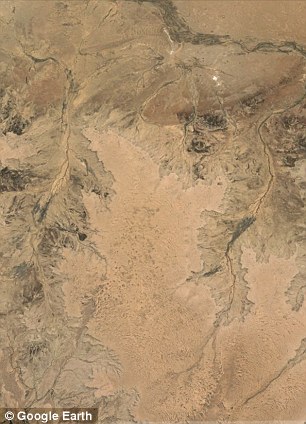
The image has been scratched into the landscape by unknown means and is on a vast scale. It now ranks as one of the great mysteries of the Australian outback. To this day no one knows who made it, how or why. The only certainty is that as time goes by erosion was gradually destroying it and that without active preservation it  will eventually be gone. Here, below, is a Google Earth from 2014 image of the site showing the extent to which it had faded:

The Marree Man is now missing from Google Earth

About seventy per cent of the configuration could still be discerned at ground level, but it had faded into nothing on satellite pictures after decades of being visible from space. 

Calls to the South Australian authorities to protect and preserve the image came late and were long unheeded. It should come as no surprise to readers - Australian readers certainly - that such a thing as the 'Marree Man' became hopelessly entangled in the cesspool of self-interest and the small-minded politics of resentment that characterizes Aboriginal land management. No sooner was the image discovered than Aboriginal elders claimed it as their own, and then when it was shown to be a modern fabrication demanded that the person or persons responsible be prosecuted for defacing aboriginal land. The Dieri Mitha tribe, who had made a disputed claim to the region, demanded that the image be erased. Others - predictably - tried to put a fence around it to keep people out and/or charge them to go in. It quickly became a fiasco. It is generally impossible to do anything when the conflicting interests of Aboriginal elders get in the way, and the proper management of the 'Marree Man' has been no exception. Suggestions to inscribe the image deeper into the earth, down to the chalk sub-soil, went unmet. Eventually, though, steps were taken and it has now been re-inscribed to the extent, at least, that it will not be entirely lost. 

The greater mystery of its origins, though, remains. Who made the image in the first place? The anonymous faxes offer some strange evidence. From their language and terminology it would seem they were sent by, or had been made to seem they were sent by, some non-Australian party. The FAX referred to "the local indigenous territories" and used other terms not typical of Australians. A further FAX made reference to the American geoglyph the 'Great Serpent in Ohio' and used the distinctly non-Australian term "your state of South Australia." This has led many to conjecture that the figure was the creation of some Americans who, it is suggested, had been posted at the nearby Woomera military base. Further to this, also in 1998, a glass jar was found at the location containing a satellite photograph of the freshly inscribed geoglyph along with a note sporting the American flag and, strangely, references to the "Branch Davidians" from the siege in Waco Texas in 1993. Then, in 1999, another anonymous fax reported that a dedication plaque had been buried on the nose of the figure. The authorities dug up the plaque which again sported an American flag, time time with the interlaced rings of the Olympic symbol and the inscription: In honour of the land they once knew. His attainments in these pursuits are extraordinary; a constant source of wonderment and admiration. This is a quote from H. H. Finlayson's book The Red Centre (1946). 

Some have concluded that this evidence is so brazen that it must have been planted at the site to reinforce the impression that Americans were responsible, and that this, along with the original faxes, are a red herring to deflect attention from the true origins of the figure.

If this is not all odd enough, subsequent studies of the figure revealed that not only is it a modern artefact but it is also entirely pseudo-aboriginal in design. The section of Finlayson's book from which the inscription on the plaque was taken concerns aboriginal hunting tools and one would think that the figure was based on such accounts - this is the impression that the plaque appears designed to give -, but in fact it was eventually discovered that the figure is made from the reversed outline of the famous classical Greek statue the Artemision Zeus, thus:


and bears no relation whatsoever to any authentic aboriginal image. It is comprehensively bogus. It is a pseudo-geoglyph of a pseudo-aboriginal design, an exercise in pseudo-archeology on a vast geo-physical scale. A hoax, perhaps, but a modern wonder. 

Extraordinarily, no one has ever claimed creating it and no one, it seems, witnessed its creation. We do not know how it was made, but it must have been quite a construction done over some period of time, a major undertaking of earthmoving. The desert soil is unyielding and the climate is hellish. The lines of the figure when freshly made were over a foot deep and over thirty metres wide. yet no one saw it. Not a single person has ever come forward offering any account of how and why it was done. This might not be surprising since the location is extremely remote, but at the same time one would think you could not move the necessary earthmoving equipment - or teams of people with spades! - in and out of the area without the people of Marree noticing, at least. Yet the people of Marree claim to know nothing about it. Nothing.

As readers might suppose, theories of the wildest kind soon gather around such a case. The UFOlogists are quickly on the scene. We can be sure, though, that the Marree Man is a human creation even if the identity of its creator and the motivation for its creation is unknown. At this stage, coming on twenty years since its discovery we may have to settle with the fact that we may never know. The most popular theory is that it was the handiwork of an artist (and Sean Connery look alike - see picture below) based in Alice Springs named Bardius Goldberg. Mr Goldberg is reported to have often said that his ambition was to create a sculptural work visible from outer space, and he later told friends - it is reported - that he was paid $10,000 to create the Marree Man (by whom, and for what purpose, it is not said, and why he would then lace the project with red herrings concerning Americans and Branch Davidians is unexplained.) 


Others familiar with Mr Goldberg, however, relate that this was likely an opportunistic boast on his part, and typical of his manner. He died in 2002, confirming nothing. His involvement with the Marree Man is based solely on rumour. According to the reports only a closed circle of four or five people knew that he was the culprit and they were sworn to secrecy until after his death. (Why this ruse is again unexplained.) In favour of the theory, though, is the fact that Mr Goldberg did engage in some large and eccentric earthwork projects. In the picture below, for example, he is seen in front of his 'Green Cross of Compassion' sculpture standing in a pit that was part of a scheme he had devised to bury a caravan in the ground in which to live (sheltered from the blistering Central Australian sun.) He dug this pit on his own by hand with a shovel! It was a folly, as it happened, because the walls of the caravan crumpled the minute he started backfilling the pit. (His imagination and appetite for digging holes was greater than his engineering skills.)


The desert very quickly devours all human contrivances. The evidence for Mr Goldberg's hand in the Marree Man is, in fact, circumstantial - he is the only likely candidate within 500 miles! - but there is much to contradict it. The faxes that preceded the discovery of the geoglyph seem unlikely to have been his work, for instance, and the people claiming to have been privy to the secret clearly know nothing about them or the plaque. Then of whom? Why? That aside, the Marree geoglyph must remain a mystery, and one that it is difficult to situate and categorize in the annals of modern mysteries. Are we to regard it as some type of hoax? If so, on whom is the hoax played? The Americans at Woomera? The public at large? The aboriginals of the desert? Or should be try to place the work in the context of modern sculptor, a work, somehow, of modern art?  There are so many questions unanswered. For a start, what on earth does this have to do with the Branch Davideans? 


Photograph of the Marree Man


Yours, Harper. 


Sunday, 24 June 2018

Orientalist themes in Ivan Aivazovsky


There is a simple reason why Edward Said's thesis Orientalism - one of the most destructive books of the later XXth century - does not include German and Russian orientalists - they do not suit his argument. Neither Germany nor Russia were engaged in the colonialist adventures that Said's Marxist framework wants to portray as the acme of human evil. And yet, according to the thesis, orientalism's sole purpose is to serve the needs of empire. Clearly, this could not have been the case for orientalists - such as the Germans and Russians - who were not part of such orientalizing empires. In other words, Said's entire thesis is 'cherry-picked' as they say. This is far from its only failing - it is animated by an ideology of grievance, victimhood and resentment, for instance - but it is a significant failing, and it leads us, therefore, to an appreciation of great orientalist artists who are outside of, and who blithely contradict, his argument. 

One of the greatest of such painters is the Russian/Armenian artist Ivan Aivazovsky. It is some time since these pages delved into Russian art, so let us correct that by making a feature of Aivazovsky here. He might well suit Said's arguments of Marxist resentment since he was a government sponsored artist with close affiliations to the Russian aristocracy; indeed, he was the official painter for the Russian navy. But Russia did not rule Tunisia or the Levant as did the French, and so his art could not have served the ideology of orientalist imperialism. Russian imperialism, perhaps, in other terms, but not - going by Said's account - the orientalist project. Yet his work is deeply orientalist and in this largely indistinguishable in its themes and motives to that of other orientalist artists, French, English and otherwise. First and foremost he was a marine painter, though. He is considered by some to be perhaps the greatest painter in that genre, and he is best known for his romantic marine paintings and seascapes. He brings the same romantic sense to scenes of oriental landscape and urban life. His work remains rightly popular in Russia and he is revered among his fellow Armenians. 

Firstly, the marine paintings. The most famed is called 'The Ninth Wave':


It is a painting of extraordinary atmosphere and drama. Like many of his works, it explores the romantic theme of man's epic struggle with the vast forces of nature. Aivazovsky was above all a romantic. This is surely one of the greatest, most breathtaking large canvas paintings in the art of romanticism.  


In contrast the 1856 painting Battle of Çesme at Night concerns the epic drama of human conflict at sea, the work of clashing navies. It too is a great painting. Like many of his commissioned works it concerns the meeting of Russian and Turkish forces - and let us not forget that it was the Turks (Ottomans) who, contra the Europe-hating Said, were the offending imperialists. One would think from post-colonial literature that only Europeans ever had empires! The Mahometans are the eternal victims in Mr Said's analysis. Many works of Aivazovsky are concerned with Turkish crimes against the Armenians and with the Russian response to Ottoman aggressions, and so they are in that sense anti-imperialist in themselves. 

Later in life he traveled to Italy, outside of the Russian/Turkish arena into which he was born and in which he lived most of his life. The painting below, of the Bay of Naples, is a serene nightscape - a very beautiful work - from that period of his life:


An outstanding painting from the Italy sojourn depicts the quintessential Romantic hero Byron in Venice:


His nocturnes are arguably the best ever painted and remain great favourites. There are shifts in colour in his paintings throughout his life but his themes and techniques remain stable. He did not succumb to shifting fashions and so his art seems to be a continuous, unified body of work, a sustained romantic meditation centred upon the sea. With some artists there are a few paintings that stand out and offer themselves as objects of value to posterity. In the case of Ivan Aivazovsky his entire ouevre is like a single object, a single work extended over a vast number of canvases. His production was extraordinary. He painted over 6000 canvases in a career of some sixty years. Some of his nocturnes:


* * * 

His directly orientalist paintings - he is the master of orientalist nocturnes - are no less sublime and well-crafted. There are many. Below are some that the present writer regards as the most representative and revealing, chiefly views of Constantinople and Cairo: 


Yours, Harper McAlpine Black


Saturday, 23 June 2018

Ivan Agueli - tradition and modernity


It is a little-known irony that one of the early instigators of what has become known as the 'Traditionalist' school of religious philosophy - a school of thought given some exposure on these pages - was also a pioneer of modern art. We refer to John Gustaf Agelii, or Ivan Agueli, who also became known, after his conversion to the Soofi mode of Mahometanism, as Shaykh Abdoo al-Hardy Aqeli. Born in Sweden in 1869, he was instrumental in the creation of 'Traditionalism' by way of introducing the French metaphysician Rene Guenon to Mahometan esotericism. Indeed, he initiated Monsieur Guenon into a particular North African Soofi Brotherhood and at the same time introduced him to the thought of the "Shaykh Al-Akbar" (Greatest Shaykh) Ibn Arabi, the real fountainhead of most 'traditionalist' thought. This was a formative, if not providential, event in Guenon's life. Subsequently, Soofism, especially in the form of Ibn Arabi's metaphysics, shaped the tenor and substance of Guenonian Traditionalism, a school of anti-modernist thought that has been, and continues to be, quietly influential in unexpected intellectual circles.


Yet, this same Swede (who we see in his Mahometan guise in the photograph below - that's him on the hind left) was also a pioneer of impressionist painting, the school of European art that first made a decisive break from the conventions and concerns of so-called Academic painting. The history of modern art more or less starts there. The impressionists - especially in France - led a revolt against the painters of the Academic establishment, and in a succession of rapid revolutions modernism was born. It is an intriguing irony. No one could be more comprehensively anti-modern than Guenon, and yet his teacher, Agueli, was at the forefront of the modernist revolt in that most characteristic of European art forms, oil painting. He is best known for this role in his native Sweden. To Swedes it comes as a surprise to find that he was instrumental in the rise of the traditionalist 'revolt against the modern world' as a recent book characterized it. For our purposes here at OUT OF PHASE both of these interests come under the banner of 'orientalism'. 'Traditionalism' and - surprisingly - modern art, both have roots in the Western encounter with the East. This is plainly the case in the life and work of Ivan Agueli. The conjunction is not nearly as ironic as it might appear.


Regarding his Soofi activities, he was instrumental, it seems, in the creation of a secret society that operated in Paris prior to the first World War. Due to its secretive character not much is known of it, but its members were called the Al Akbariyya (after the Shiekh al-akbar, i.e. Ibn Arabi) - or at least this is so according to a letter Agueli wrote in 1911, posted to an unknown address in Cairo, announcing its foundation. Agueli had been based in Paris and moved among a French bohemian class of artists and intellectuals. People in this class would often journey to the French North African colonies and in this way, through these avenues, Mahometan influences entered French intellectualism. The Al Akbariyya absorbed teachings and practices from the Shadhilli and Malamati Soofi schools. Much more of the Northern African background of this is revealed in the quite fine book, A Sufi Saint of the Twentieth Century, written by the English scholar Martin Lings. It is here that 'Traditionalism' had its inception although Agueli's role in this is rarely acknowledged.


Regarding art, the question of what led Agueli to impressionism is an open one, although we can be sure that in his mind it was entirely consistent with his other pursuits. This is to say, that it would seem that he regarded the impressionist mode of art as an expression of the same thought, spirit and metaphysics of Ibn Arabi. The connection is lost on us today. We regard modernism, and the artistic revolt against the canons of the Academy and the traditions of European painting, as essentially decadent and part of the very thing against which Guenon and his 'Traditionalists' have railed. And yet, it would appear - in this and in other cases - that the break with tradition that characterises modernity was often the result of an attempt to return to Tradition with an upper case T. Very often this involved appropriations into Europe of oriental traditions which were deemed more authentic and profound. Consider, for instance, the irony that it was exposure to traditional Japanese art that provided the impetus for much of post-impressionism in resoundingly modern artists such as Van Gogh. The irony is that contact with oriental traditions (felt to be more authentic) led not to a renewal of Tradition (with an upper case T) in Europe but to the disintegration of the European tradition into a corrosive modernism. The dichotomy Tradition/Modernity is not by any means simple and straightforward. In many ways Traditionalism and Modernism share the same roots. Agueli is a case in point. Our interest here, anyway, is in the penetration of oriental modes into European culture and the unexpected results.


Let us remind readers of some of the tenets of impressionism and how they differed from the conventions of Academic formalism. For a start, there is an attempt to capture the impression of a moment. The painter turns to the technique known as impasto. The painting is done quickly, usually out of doors, attempting to realise the effects of natural light. Indeed, light is the quintessence of impressionist painting. The painter is above all concerned with light - the effects of light upon an object, or in a place, is more important than the object or place itself. This brings the artist into a new relationship to shadow and colour. Colours are juxtaposed rather than mixed. The colours mix, rather, in the gaze of the beholder. Usually, black is avoided. Typically, natural light effects - such as blue shadows on snow, the blue of the sky reflecting into shadows - are used without the use of glazes and the other technical devices of traditional oil painting. Moreover, the line is regarded as an imposition, a solidification. The famous dictum is: there are no lines in nature. Typically, impressionist works have soft edges where bodies merge softly into one another. There are no sharp edges, no hard lines. Impressionist paintings are typically 'fuzzy' as opposed to the clarity of academic painting. The impressionists sought a new relation to the world, especially through a new relation to light.

One wonders in a case like Agueli how much of this follows from the metaphysics - or a certain reading of the metaphysics - of Ibn Arabi, especially his metaphysics of light. Above all, in Ibn Arabi there is the doctrine that God creates the entire universe anew at every single moment of existence, and thus God is supremely immanent and the Creation is sublimely fresh. Is there something of this in what the impressionists were doing, or thought they were doing? The present writer has not investigated this much further. Impressionism is a well-researched subject, and perhaps others have probed these issues already? Perhaps, very likely, there are studies in the Swedish tongue since Agueli is a well-loved and well-documented figure in the early history of modern Swedish art?

Agueli, it is well to know, churned through a chaotic quest for authentic identity on his path to becoming Shaykh Abdoo al-Hardy. His 'Traditionalism', if we can call it that, was the culmination of a restless search characterised by rebellion. He was involved with the anarchism of Kropotkin, for example, and then with animal rights. In 1894 he was arrested and tried for "criminal association" with anarchist agitators in the famous Trial of the Thirty. It was after that that he fled to Egypt, later traveling to Ceylon and other regions of the East in self-imposed exile. Arguably, his conversion to Mohometanism was another episode in this career of rebellion. These points in his biography again underline how odd it is that he played such a decisive role in the foundation of the Guenonian 'Traditionalist' school.

Below readers can view several paintings by Monsieur Agueli, most of them landscapes painted in North Africa. The paintings themselves are competent but, frankly, unmemorable. For a time he was a student of the Symbolist painter Emile Bernard, but there is little of Monsieur Bernard's strength and potency and impact here. Agueli's painting are insipid by comparison, just as they are notably serene, quiet, uneventuful, undramatic and lacking in adventure compared to Agueli's biography. To what extent were they, though, exercises in Al Akbaryyi metaphysics?


Yours, Harper McAlpine Black