Saturday, 17 October 2015

Tagore in Japan, 1916


The life and spirit of Calcutta are dominated by two towering figures: Mother Teresa, firstly, and secondly, Rabindranath Tagore. The latter, of course, was a native Bengali and his ancestral home, the great mansion of Jorasanko, is located in the northern suburbs of the city. It was quite by chance that the present author stumbled upon this location the other day and spent several hours wandering through the meticulously compiled and beautifully maintained museum there. He has always been somewhat ambivalent about Tagore, since some of the polymath’s political views do not always quite coincide with his own, and the literary merit of Tagore’s work is best appreciated in Bengali, and nor is he very keen on Tagore’s paintings, but there is no question that Tagore was a considerable figure in and beyond his historical context –  the Shakespeare of modern India - and a visit to Jorasanko reveals many aspects of his character and work that are not widely appreciated. Certainly, the author came away from the visit with an enhanced view of the poet and his ouvre.

One unexpected aspect of Tagore deserves particular mention, namely his connections with Japan. The present writer, at least, was wholly unaware of these until he chanced upon a series of displays at Jorasanko which had been sponsored by the Mitsubishi Corporation. These displays are lovingly assembled, very professional and entirely worthwhile. We learn there that Tagore, the internationalist, had an enduring fascination for Japan and Japanese culture and cultivated several deep friendships with Japanese artists. Indeed, we learn that he wrote some important essays on matters concerning Japan as part of his general concern for a united and revitalized Asiatic civilization. This revelation led the present author to download and read Tagore’s 1916 lecture, The Message of India to Japan, a wonderful and illuminating work. Find the link to it here.

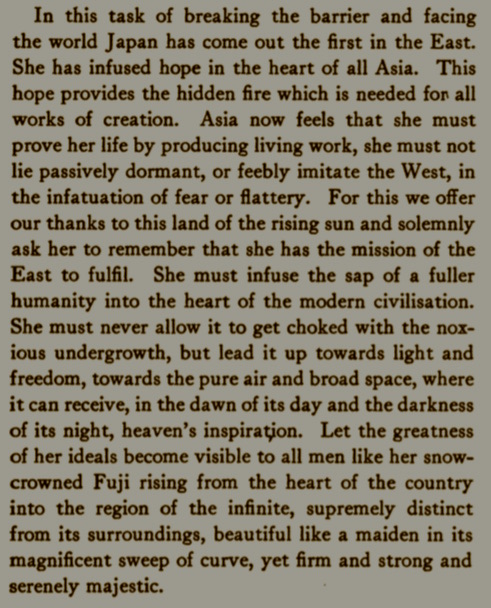
Travelling in India and in Japan one becomes aware of their kinship. Most obviously, there is the emblem of the swastika decorating both places, and the heritage of Buddhism. What begins in India is finished, culminates and is refined in Japan. The two countries are the start and finish of one great tide of human civilization. That is how Tagore saw it, anyway. And he was impressed – as was everyone – by the miraculous ability of the Japanese to modernize so rapidly and thus show, most abruptly, that the “East” (as Tagore calls it) is not retarded and backward, forever subservient to the conquering empires of the “West”. In 1916 the Japanese had just demonstrated that it was possible for Eastern civilization to leap into the modern era and claim its own modernity. Yet this presented certain dangers, Tagore thought, and it is on both the opportunities and the dangers of the revivification of the East that he dwells in this erudite and beautifully articulate lecture. He is especially concerned – with good reason - about the dangers of a belligerent nationalism in Japan and an accompanying militarism.

Readers of these current pages are encouraged to download and read the whole lecture for themselves. It is highly recommended. The issues of which it treats are as relevant today as when it first appeared, and it serves as an excellent introduction to an aspect of Tagore not often explored anymore. The quality of his thought, and the elegance of his expression, is impressive.

It is worth remembering that he died in 1941 and did not live to see the full tragedy of the Second World War.


Here are some representative excerpts from this insightful and prescient speech by the great poet of Calcutta at the Imperial University in Tokyo:


Yours,

Harper McAlpine Black


Friday, 16 October 2015

The Marble Palace

A decaying grandeur is the whole tenor of contemporary Calcutta. It is epitomized by the so-called 'Marble Palace', a private residence located at number 46 Muktaram Babu Street in the northern suburbs. Built in 1835 as the home of the wealthy Bengali trader, Mr. Raja Rajendra Mullick, it is one of the strangest surviving wonders of colonial era India. It is a large three storey neoclassical folly. It rarely features on the tourist rounds and is routinely overlooked by visitors to the city. Yet, it is an extraordinary thing, a relic of former glory, a vast nineteenth century palace almost entirely unmodernised and stuffed full – in room after room - of an eclectic, rambling collection of dusty Victoriana and objects d’art that includes, surprisingly, various masterpieces such as paintings by Rubens, Titian and Joshua Reynolds. Like the city itself, it was once magnificent. Now it is covered in dust and grime as the humidity and city air slowly takes its toll. This, though, lends it a melancholy charm that is typical of the city as a whole. The Marble Palace is Calcutta in microcosm.

The residence is still in the family of the original collector, Mr. Mullick. They live at the rear, and so portions of the building are closed off to the public. The closed off area includes a Hindoo Temple that was built prior to the palace itself and which is still used as the personal place of worship of the family. But open to the public – by free admission if you arrange it with the appropriate paperwork through a certain obscure office of the West Bengal Tourist Office – are the billiards room, the ballroom, extensive hallways and the central courtyard. The huge collection of classical statues lining the corridors is supplemented with a colourful collection of exotic parrots and other birdlife. By extension, in the grounds surrounding, are the remnants of what was once a large personal menagerie.

Photography is strictly forbidden; a rule enforced by an ever-watchful team of servants. Even photographing the entry gate from the street is forbidden. A man carrying a large stick will yell "No, sir! No photographs!" the moment he spots your camera. The picture below is the nearest you will get:


Beyond the front gate lies the palace set in plush lawns with statues of lions, pools, hedges, garden borders, palm trees, all roughly tended. Here is a photograph of the same as provided by the tourist authorities (since the present author was roundly rebuked for even taking his camera from his bag):


Inside the building - overlooking the water damage - , you are greeted by the most extraordinary collection of works that evidently stopped being a living concern somewhere around the 1880s. The collector was not especially discerning. He collected whatever appealed to him. Great works stand side by side much lesser ones. Features include a vast collection of Belgian glassware, several massive chandeliers, two 19th C. ballroom mirrors that are 22 ft tall and exquisite Chinese and Japanese ceramics. Naked Greek goddesses are well represented. One work deserves particular note: a statue of Queen Victoria, perhaps 12 feet tall, carved from a single solid piece of teakwood. Whose work it is, and from what date, is undisclosed. 

Many of the rooms are poorly lit - whole ballrooms lit with a few 60 watt globes - and so, along with the ramshackle profusion of it all, it is difficult to assess just what is in the collection. There was, at some point, a half-hearted attempt at numbering the pieces but, it seems, no catalogue. Your friendly Indian guide knows a thing or two about select items but mainly he is looking for his tip. 

There are very few extant photographs of the interior. Here are two that will give you at least some idea of this obscure, lavish marvel hidden in the backstreets of old Calcutta:


Yours,

Harper McAlpine Black


Tuesday, 13 October 2015

The Daniells' India


By a stroke of good fortune a recent visit to the imposing masterpiece, the Victoria Memorial at the south end of the Maidan in Calcutta, included a viewing of an extensive exhibition of the paintings and aquatint engravings of the orientalist illustrators, the Daniells, Thomas and William. The Daniell's India - Views from the 18th C. 


In 1784 the two Daniells – William being only sixteen years old at the time, and Thomas, in his thirties, being an unsuccessful artist who had worked painting coaches – travelled to the wide lands of British Hindoostan via China seeking fortune and fame. It was an extraordinary adventure into the unknown. As it happened, they spent over ten years there and in that time produced a series of illustrations and oil paintings that subsequently became celebrated in England and to this day form an enduring record of the land, people and monuments of India in the era of the East India Company.

 Australians, such as the present writer, will recognize their style. British artists used the same methods to capture the new landscape of Terra Australis in the same period. The Daniells’ work strongly resembles early Australian art, being an attempt to render the strange and exotic in forms that are accurate in themselves but also accessible to the English public. While early Australian art is often derided as colonialist kitsch, however, the work of the two Daniells is prized and feted, including by the Indians who acknowledge its historical significance, its care for detail and its fine beauty.

The remarkable thing about the Daniells’ engraving is that neither of them were proficient in engraving techniques when they arrived in Hindoostan; they had to refine what few techniques they did know from local Indian craftsmen. Penniless but enterprising, they proposed, as a money-making venture, a series of twelve engravings of prominent landmarks around Calcutta and placed an advertisement in the Calcutta Chronicle in July 1786 to that effect, seeking help in the venture. This series, published two years later, hand coloured by local artists, became so popular that they then undertook other series, first travelling north of Calcutta, and eventually travelling throughout the entire sub-continent. To fund their further travels they held a lottery of their completed engravings in Calcutta in 1791 and other lotteries along the way. 

It is evident, upon viewing the exhibition in the Victoria Memorial, that Thomas was the illustrator while William was, arguably, the better painter. Thomas had a better and more precise eye for architecture and detail, while William was more accomplished at capturing atmosphere. All the same, William laboured tirelessly in his workshop back in England for years to perfect the aquatint technique that they favored. It is a pity that the large oil paintings done by the Daniells now showing in the collection of the Victoria Memorial are somewhat grubby from exposure to the polluted air of the modern city and have surfaces that are in dire need of cleaning.

Returning to England in 1795, the Daniells published a six volume work with a total of 144 plates under the general title of ‘Oriental Scenery’. A complete set sold for the princely sum of £210. It is one of the finest collections of orientalist illustrations extant. They also published a second collection in 1810 entitled A Picturesque Voyage to India, by Way of China. Accompanying these wonderful illustrations, they also kept detailed diaries on many of their travels, text and picture together constituting an invaluable record of early British India. It is highly appropriate that these works are now to be seen in the Victoria Memorial, itself the great monument to Britain's historic embrace of Indian civilisation.

Here below are samples of the Daniells' work. It is often not clear who did what, Thomas or William, and so it is customary to refer to them as a single team, the artist is thus "The Daniells".


Dashasamedh Ghats at Benares


Temples with Bunyan trees


Observatory, Delhi


Ships on the Ganges


Chowringhee Road, Calcutta


Taje Muhel from the Yumuna River, oil painting


Waterfall, Tamil Nadu, oil painting, Thomas Daniell


Yours,

Harper McAlpine Black


The Kali Temple in Kalighat, South Calcutta


The great Kali Temple in south Calcutta, Kalighat, is said to be the oldest and most important Kali temple in India. It is, whatever the case, the central temple of the Calcutta region, a region where Kali worship is particularly developed, so much so that it is in reference to this terrible goddess that the name Calcutta (Kali -kata) is most probably formed. One of the fifty-two so-called Shakti Peethas – sacred sites – of India, it is supposedly where the toes of the right foot of Shakti fell upon the earth when Shiva, in his grief, danced the dance of death, and the disk of Vishnoo dismembered Shakti’s body.

All official tourist accounts will tell you that foreigners are strictly forbidden from the Temple, the reason usually being given that it is the site of gruesome animal sacrifices that are not for the feint-hearted. Touts patrol the grounds, however, and for a hundred rupees or so they will escort you in, and in fact right into the very inner sanctum such that no part of the complex is off-limits. The crowds are crushing, the marble floors are slippery, the devotees are delirious and the Brahmins are looking to make extra money for the slightest holy gestures, but with a good escort it is a tolerable and fascinating experience, one of the essential rites of the Kali cultus that is such an important yet at the same time mysterious feature of Hindoo religiosity.


Once within the inner sanctum, the appropriate ritual gesture is simple: to the chant of Om Kali! Om Kali! Om Kali! (thrice, thus) the devotee throws a handful of flowers (hibiscus) over the figure of the goddess. She stares back, black and dreadful. Devotees yearn to look upon Her gaze. For this purpose there is a further room in direct line to the apeture where devotees greet Her and from time to time, when the crowd thins, Her gaze extends there are the waiting devotees count themselves blessed for it. In fact, the line of the goddess’ gaze extends even further. The present author witnessed a young Hindoo outside of the Temple walls ascertaining where the line of sight might be in order to stand within it and thus make his devotions directly towards the ever-watching goddess. Moreover, the line of sight includes the pillars where beasts (mainly young he-goats) are sacrificed in a covered enclosure. Therein, devotees place their heads upon the butcher’s block, this gesture of profound submission being (in theory) witnessed by the goddess from within the inner sanctum.

It is hard to tell in the madness and the rush exactly what directions are involved in this. The whole complex is surrounded by smaller buildings and canvas stalls and it is impossible to obtain a wider view of how the temple is situated in the landscape. But it is clear that there is some form of geomantic orientation forming the basis of the temple's location. The goddess herself, in fact, is represented by a large black stone which is wrapped in cloth and has the distinctive three eyes of her dreadful glare painted thereupon. The temple is merely a house for this stone, a more or less domed shape structure which is, despite the age of the complex, relatively modern. 

If you make it into the very centre of the complex, this is what you will see, although usually only a glimpse as the crowds push past:


Who is Kali? In Homer's Iliad there is a passage where Zeus boasts that, if he wished, he could lift all the gods up with just his little finger. He is the supreme god, he says, and is afraid of none... except one, the goddess Nux, Night. That is Kali. She is the darkness beyond the stars. The silence before all things. The blackness into which all dissolves and which underlies all manifestation. 


Yours,

Harper McAlpine Black

Sunday, 11 October 2015

The Durga Festival, Calcutta


Durga slays the Demon, oil painting, 19th C. 
unknown artist, Victoria Memorial collection, Calcutta


Finding himself in old Calcutta just after the monsoon season, the present author is confronted with the pervasive cultus of the goddess Durga whose great festival, the Durga Puja, falls in late October, a moon following the equinox. The city is alive with preparations. Throughout the streets the people of various neighbourhoods are building ‘pandals’ – bamboo houses – to accommodate statues of the goddess which are shaped by the artisans of the potter’s quarter in the suburb of Kurmatuli. At the end of the festival the statues will be carried in procession to the river, thrown in and left to dissolve and be washed out to sea.

The question arises as to what exactly the festival is about? It is one of the largest festivals in India, one of the most popular and significant festivals among the Hindoo. It celebrates, in short, the victory of goddess Durga over a buffalo demon, a straightforward defeat-of-evil affair, but the symbolism – as with everything Hindoo – is multi-layered, complex and mysterious. The author has spent the better part of a week here attempting to understand and unravel these mysteries.  It is not an easy feat. The available texts either confound matters or rehearse the obvious, and colloquial opinion is only helpful for providing popular, naïf understandings, often revealing in themselves but never complete.

A good account of the mythology that is enacted in the festival, which is a good starting point, is found in the celebrated novel City of Joy. Here is a summary of the same:

Hundreds of thousands of years ago a terrible demon ravaged the earth, throwing the seasons into confusion. He was the demon of ignorance and the gods could not destroy him.

Brahma, the Creator, declared that only a son of Shiva could defeat the demon. But Shiva’s wife was dead and Shiva had retired into an ascetic life so it was unlikely he would ever bare a son.

The gods appealed to Kama, god of love and desire for help. So Kama, along with his wife Voluptuousness, and his friend Springtime set out to sway Shiva.

They found Shiva meditating at a foot of a mountain and in a moment that he was off guard Kama shot him with a jasmine arrow that no one can resist.

Shiva began to think of Ouma, daughter of the Himalayas. Eventually they married and she took the name Parvati, “daughter of the mountain.”

But the demon continued to bring chaos to the earth and by the time a son of Shiva might help it would be too late.

Desperately, the gods concentrated all their powers into a single breathe of fire and concentrated it upon Parvati. Out of Parvati’s head came Durga, “she who is beyond attainment”. (This name refers to the idea that the highest mountains are out of reach.)

In order to combat the demon in all ten directions Durga has ten arms, each with one of the weapons of the gods. Her father, Himalaya, King of the Mountains, gave her a lion to ride upon. The Moon gave her a round face. Death gave her black hair. Her skin was the color of Dawn.

The demon appeared as a huge buffalo accompanied by an army. The goddess, riding her lion, pounced and a cosmic battle followed. The roar of the buffalo made the worlds tremble. He uprooted mountains with his horns.

The battle raged for three days. Often Durga was on the point of defeat. But on the evening of the third day she drank the liquid of the gods and sank her trident into the breast of the monster.

Mortally wounded, the demon tried to escape from the buffalo body. From the buffalo’s mouth came a warrior hero brandishing a scimitar. Acting quickly, Durga decapitated him.

At this Durga turned completely black and became known as Kali, “the black one” – as black as Time that consumes everything.

Heaven and Earth resounded with songs of joy and cheers of victory.

The victory of Durga over the demon is celebrated with a four day festival (Durga Puja) in Calcutta every year at the end of monsoon (at a new moon near the autumn equinox.)

The potters of the city make clay sculptures of the goddess. These are then placed in pavilions (canopies) called “pandals”, with various neighborhoods competing to construct sumptuous pandals in streets and crossroads.

At the end of the festival people lead their statues of Durga in procession to the river Ganges where the statues are thrown in, to dissolve and be washed out to sea.


****

The other place to find revealing information is in traditional iconographical depictions. For this purpose the author went to the India Museum and the Victoria Memorial - two very fine art collections in Calcutta. Where texts fail, the text of icons fills the gaps. The iconography varies over time and according to artist but a careful study of the basic features eventually starts to throw light upon an otherwise opaque symbolism. As it happens, one picture in particular - modern, not traditional - proves to be extremely telling. It is an oil painting in the so-called 'Dutch Bengali' style by an unknown artist from the late 19th C. (see above.) and now hanging in the 'Calcutta' room at the Victoria Memorial. Whoever the artist was, they had great insights into the symbolism of Durga and her festival and have presented those insights in a format that is more stark and apparent than in the more complex forms of the traditional icons. Notes on this goddess, her iconography, mythos, and festival follow:

CONCERNING THE NAME DURGA

The name, we are told, means 'Invincible' but more exactly it signifies “difficult of access” or “she whom cannot be attained”. In this sense it refers to high places such as mountain tops in the first instance, but by extension it refers to hill fortresses. The suffix –durga or –durgam (also –droog) is found in the names of many Hindoo hill fortresses. So the name refers to defence. She who is well defended. She who is guarded. In this sense, therefore, she is related to the Greeks' Pallas Athene, (her virginity meaning "she who cannot be attained") and noting that the Acropolis in Athens is therefore a “durga” (hill fortress) in this sense. The goddess Durga is, in general, or at least in this aspect, a Hindoo cognate of Pallas Athena, and her defeat of the demon is a direct parallel to Athena's slaying of the giants. Same mythology. 

THE TIMING OF THE FESTIVAL

In Bengali the festival is sometimes called 'The festival at the wrong time' - and for good reason. In the Hindoo scriptures Durga's slaying of the demon is associated with the months of March and April, i.e. with the spring. From the 16th. C. onwards, though - having something to do with the arrival of the British? - the people of Calcutta began celebrating the festival in the autumn. The festival, therefore, has been displaced. One equinox has been swapped for another. To understand the original symbolism of the festival we must understand it as a vernal feast rather than autumnal. The cause of the displacement is a matter of controversy, but it is important to realise that it has happened. The Durga Puja is, in fact, a spring festival, albeit now celebrated in autumn. Originally it concerned the triumph of light over dark (winter). In the modern displacement it concerns the restoration of order after the chaos of the monsoon. 

BASIC MYTHOLOGEM

Pushing aside all the extraneous layers of symbolism, the basic mythologem here is what in many other traditions takes the form of the slaying of a dragon. It is essentially the same mythos as the Christian myth of St. George slaying the dragon. In the Hindoo version, the dragon is a buffalo, and the 'Earth' (Geo = george) is the Earth goddess Durga. This much is clear. The monster is slain. Order is restored. And not merely social order, but cosmic order. 


DURGA’S ARMS

It is clear from the traditional icons that Durga does not really have ten (or more) arms. More correctly, she has two arms PLUS an array of further arms which represent the additional powers bestowed upon her by the various gods. The relevant numerical symbolism, that is, is 10 = 2 + 8. The two arms, clearly enough, represent night and day. The eight arms (sometimes 8 + 8, but usually sets of eight) are the eightfold division of the zodiac.

COSMIC PARALLELS

The Dark Moon is to the lunar cycle what midwinter is to the solar cycle. That is the essential symbolism here. So, the New (reborn) Moon is to the lunar cycle what the spring (rebirth) is to the solar cycle. The whole symbolism of the Durga Pooja is soli-lunar. Note that the unknown painter of the oil painting from the Victoria Memorial (see picture at top of page) understands exactly this. It is a crucial clue that is missing from earlier depictions. The modern painter has at last made it explicit. In this context, the buffalo – like the dragon in similar traditions – is the light-devourer. Without the light of the moon/sun man is left in ignorance and chaos. The restored light of the New Moon/Spring Sun is order restored. This, in essence, is what this entire festival is about. By extension of these parallels it also concerns the passage of Ages, i.e. the great cosmic seasons of the Yugas which are to the whole cycle what the annual seasons are to the solar cycle, and so on.

Note also, importantly, that the Victoria Memorial painter has the lion = white and the buffalo = black. Day and Night. Midnight is to the daily cycle what midwinter is to the annual cycle, and so on.

One of the most important iconographical clues in this scene is the scimitar wielded by the warrior hero who springs from the neck of the buffalo. This very obviously signifies the birth of the crescent moon. In the best depictions this is very plain. The buffalo is the darkness of the absent moon. The warrior hero with the scimitar is the new crescent. Some artists very deliberately make the scimitar resemble the crescent moon. 

MOUNTAIN SYMBOLISM

The mountain symbolism found throughout the mythos concerns the celestial axis. It is by virtue of the adherence of the axis that the cosmic order is restored – just as it is by virtue of deviation from the axis the order suffers period disruption.

A FURTHER POINT

In the nineteenth century oil painting, notice that Durga and the warrior demon's eyes meet. This is mythologically correct. All the divine powers are marshalled in Durga, including the erotic. The warrior demon is attracted to her. (The author owes this observation to Mdme. Mireille-Joséphine Guézennec, the Vedic scholar, who he met over breakfast one morning in the Blue Sky Cafe in Sutter Street.) 


*****

Below: Traditional images in the India Museum (Asiatic Museum), Calcutta.


yours,

Harper McAlpine Black


Saturday, 3 October 2015

Abdur Rahman Chughtai

After sixty years of hostility and several bloody wars it is easy to forget that Pakistan and India share a common culture. Partition has been an intolerable rupture - one of the great mistakes of the 20th C. - and yet the two countries still share more than what divides them. We are reminded of this fact in the life and work of Abdur Rahman Chughtai, one of the most significant South East Asian artists of the modern era. He is counted as the official 'national artist' of Pakistan, and yet he spent the first fifty years of his life in a united India and remains a revered artist in India, having drawn deeply from the Indian artistic traditions. In particular, his style owes much to the Bengali style pioneered in the early decades of the 20th C. which itself drew upon the miniature painting and illustration traditions of medieval India. Chughtai very consciously looked back to the indigenous (and Mughul) heritage of India, which is to say he overlooked the styles preferred and sponsored by the British. At the same time, though, he was a modern artist with a modern sensibility. His style is deeply indebted to Art Nouveau. He is one of the few artists whose work comfortably accommodates both the traditional and the modern in a seamless synthesis. 

His subject matter is taken from the myths and legends of the Hindoo  tradition as well as motifs from the parallel heritage of Indian Islaam along with subjects from the Mughul and Rajuput courts. This makes his work quite unique and unquestionably powerful. It transcends Indian/Pakistani particularisms. A resident of Lahore, it is reported that the painter sheltered both Hindoos and Sikhs in his home from rioters and murderous mobs during the chaos of partition and regarded his work as above the nationalistic divisions that tore the sub-coninent apart during the latter part of his life. 

There is an excellent website of his work sponsored by the Chughtai museum in Lahore which can be accessed here:

http://www.chughtaimuseum.com/index.php

And here are some fine examples of his work:


There are few greater tragedies than the partition of India. This fine work, with its delicacy, density of colour, lyricism and its balance between modern sensibility and faithfulness to tradition - the blend of Art Nouveau and Indo-Islaamic tradition - reminds of that an entire culture, a whole civilisation, has been abruptly bifurcated and a glorious wholeness has been lost. Even more so, the post-colonial rejection of all things Western has prevented the proper assimilation of the modern, an assimilation of which Chughtai is a brilliant instance. The greatness of Chughtai - quite apart from his impeccable draughtsmanship - lies in a vision that embraces the wholeness of the Indian tradition and the best of the West, and in that exposes the divisions of partition and the forces of a destructive nationalism as a loss of innocence, a violation of the sacred, an affront to history. 

Yours,

Harper McAlpine Black

Thursday, 1 October 2015

Carlos Casteneda & the Case of the Four Missing Women


Carlos Castaneda

Something went horribly wrong with the discipline of anthropology during the counter-culture revolution of the 1960s - a deviation that has not altogether healed even today - and no one epitomises what went wrong so much as Mr. Carlos Castaneda. After graduating in anthropology from UCLA in the late 1950s the mysterious Senor Castaneda, a Peruvian, embarked upon a remarkably successful writing career beginning with a bestselling book entitled The Teachings of Don Juan. This purported to be an account of his arduous but illuminating apprenticeship under a Yaqui shaman who taught him the esoteric and mystical traditions of the indigenous masters of the Americas. He is supposed to have been initiated in various shamanic techniques by this Don Juan and taught a raft of mystical philosophies through the agency of spiritual journeys which revealed hitherto secret methods of a natural spirituality which had been repressed and obscured by the coming of the white man. The Teachings of Don Juan, and many subsequent books, offered readers these lost teachings in accessible paperback form - a complete guide to the shamanic lore of the native Americans along with detailed information on the use of hallucinogenic botanicals. The idea of shamanic spirituality captured a niche market in the counter-culture of the era. Castaneda's books were republished by Penguin and became standard New Age literature. In all, he wrote fifteen books which have been translated into over seventeen languages selling more than 8 million copies worldwide. They continue to have readers - and Don Juan still has his believers - but more importantly they have shaped New Age and popular perceptions that there is a body of shamanic lore preserved among indigenous Americans that can be reconstructed to offer an alternative nature-based and eco-friendly spirituality.


Unfortunately, it was all a fiction. We can say with absolute confidence that there was no such person as Don Juan, that Castaneda was never initiated into anything of the sort, and that the teachings he dressed up as the profound secrets of Native Americans were, in fact, rehashed variations on half-baked anthropological theories mixed together with bits of pop existentialism. At the time, though, it all seemed convincing, and Castaneda - who went underground in 1973, largely to avoid scrutiny - was able to establish himself as a counter-culture guru with a dedicated and cultish following. In particular, he surrounded himself with a cohort of impressionable young women who, predictably enough, he inducted as student/lovers and companions on hallucinatory magical 'pathworkings'. It was a deeply closed and secretive world, with the reclusive Castaneda requiring his students to cut all ties with their families and friends and to erase their previous identities. He package his teachings - or rather those of "Don Juan" - as "Tensegrity", a neo-shamanic New Age system of attainment that included, amongst other things, syncretic elements of native sorcery, witchcraft, voodoo and ideas and methods lifted from karate and Tai Chi. Famous through his books and a carefully cultivated mystique, he offered Tensegrity workshops in Los Angeles all the way through to the late 1990s. He had once been immortalised on the cover of Time magazine, exposure that made him one of the most celebrated and sought-after gurus of the latter 20th C. 


Carlos Castaneda - the first of the fake Indians - died of liver cancer on April 27 1998 at the age of 73. His death was not announced publicly by his followers until that June. It was also revealed, however, that five of his closest followers - five women - had gone missing two or three days after his death, and their whereabouts were unknown. These women were:

*Patricia Partin, alias "Nury Alexander"
*Amalia Marquez, alias "Amalia Marin"
*Taisha Abelar, alias "Maryanne Simko"
*Florinda Donner-Grau, alias "Regine Margarita Thal"
*Kylie Lundahl

These were all students of anthropology, most of whom had met Senor Castaneda at UCLA. They had become devotees of his teachings and practitioners of his methods. Some claimed to have met and studied under Don Juan himself and Florinda Donner wrote her own account of shamanic experiences with the Yanomami Indians of the Amazon basin in a book entitled Shabono: A Visit to a Remote and Magical World in the South American Rain Forest, a work subsequently debunked and exposed as another fraudulent work of anthropological fiction in 1983. 

But what had become of these young women? It seems that their telephone accounts were disconnected several days after Castaneda's death and thereafter they disappeared from the face of the earth. To this day only Patricia Partin has been accounted for. Her car was found in Death Valley in May 1998. Then, in 2003, bleached human bones were found further into the desert near to where the car had been found and these were finally  identified as being her remains in 2006. But no trace has been found of any of the other women. Their families have continued to search for them but without the slightest success. We have no idea what happened to them and whether any or all of them are alive or dead like Patricia Partin. The most common supposition is that at the death of Castaneda they engaged in some manner of cult suicide, separately or together, but there are many other theories. One is that they fled to the desert to engage in some form of shamanic communication with the liberated spirit of the dead Master and they died in a spiritual misadventure. Another theory is that - since they were well-trained in the art of erasing and changing identities and disappearing into reclusive anonymity, a hallmark of Castaneda's teaching - they may still be alive but living under new names. That is, at Castaneda's death, they went to ground. Senor Castaneda was himself deeply camera shy. There are very few photographs of him. There are even fewer of these missing women. They had been taught the art of disappearing. Alternatively, they turned into their totem animals and flew, crawled or slithered away. 

This mystery is compounded by the fact that the police have been reluctant to investigate the disappearances. The authorities have generally taken the view that the women were not subject to foul play and orchestrated their own disappearance as do thousands of missing persons every year. Until some trace of them is found there is not much for the police to go on. Even more so, the police are especially reluctant to investigate such "cult" cases - more often than not it turns out that the missing person simply does not want to be found, least of all by their family. In any case, these women have been missing for seventeen years now. It seems likely that, by design or circumstance, they will never be found. They represent the dark underside of the "teachings of Don Juan." Not only was Carlos Castaneda a manipulative charlatan, but he created a deluded sub-culture of hippie anthropology intent on a regressive sorcery fuelled by toxic cactus juice and the systematic confusion of the primitive with the primordial. Much of this sub-culture has become a feature of New Age-ism and remains current today. It is an integral part of the spurious spirituality of post-colonial decadence. Neo-shamanism workshops have never been so popular or paid so well. Castaneda created that market. The case of the four missing women reminds us what it is really about. 

Some websites:


Yours,

Harper McAlpine Black