Saturday, 19 September 2020

Post-Colonial Thought Crimes


Readers of these pages will be aware that, among many unpopular and downright obscure views, a certain hostility to post-colonial orthodoxy is often on display here. The author himself is a colonial and has traveled widely through the remnants of the British Empire in Asia. Alarmingly, he isn’t riddled with post-colonial guilt; rather he holds errant opinions on colonialism, imperialism and the entire edifice of the post-colonial world order. In view of recent social unrest, in this post we will document some of his thought crimes…


 * * *

While that broad intellectual construction known as ‘post-colonialism’ purports to see the hidden ‘power structures’ of the colonial period – it’s a construction of intellectual tools with no other purpose – its lack of self insight is frightening. The orthodoxy of the post-colonial intellectual posture is so pervasive, so comprehensively the zeitgeist, that almost nothing stands outside it. Like all unchallenged viewpoints, it quickly becomes totalitarian. All ages are blind to their own prejudices, but there are degrees of delusion. The edifice of ‘post-colonialism’ is dangerously self-enclosed. 


In fact, the post-colonial period has been disasterous. The Age of Empires gave way to an age of proxy-wars where empires pretended not to be empires and a world order was patched together from over one hundred and fifty miserable little nation states, most of them complete confections, two thirds of them failures, all of them necessarily propped up by rambling international institutions running a welfare system for incorrigibly corrupt regimes. In these new nations the fervour of ‘independence’ masks the reality: once the Empires left, corruption, if not chaos, set in and life became much, much tougher.


Conversely, in fact, the colonial period was one of unsurpassed economic, technological and cultural ferment, with the British Empire in particular an agent for this. The post-colonial Marxist narrative of pillage and rape is radically untrue. It is as untrue as supposing that the Roman Empire engrandized Rome at the expense of the rest of Europe. That would be a seriously one-sided and inaccurate account of the Pax Romana, and it is an equally one-sided and inaccurate account of colonial history from the seventeenth century to the mid twentieth.


Empires are the norm in history. They are, after all, essentially free trade zones. They facilitate free trade and the hybrid vigor of cross-civilizational exchange. They put an end to the local squabbles and petty tribalism that keeps men’s knuckles dragging in the dust.  Marxists seem to think that everyone conducted their Empires like the Mongols: murder and mayhem. Actually, empires created the space and conditions for every high-point in human civilization, every high culture, the greatest art and architecture, engineering, science. Cross-cultural and cross-civilizational interchange on a historical scale is a good thing. Both the appropriations and the impositions of empire can be good. It is good that Indians drink tea and it is good that Englishmen do yoga. The alternative to the intimacy of empire, as we have discovered, is an arid globalism.


Moreover, by any fair assessment of world history from the year dot to the present – casting an eye over all the empires that has come and gone – we must declare the British Empire the greatest and also the most benevolent of all. Yes, the Belgians were monsters in the Congo, and the Dutch were bastards generally, but the British Empire, all things considered, was a boon and a blessing. In broad historical terms the British found themselves charged with the task of bringing large swathes of the Earth to the inescapable reality of industrial modernity. The British took this responsibility seriously and in the end the Empire was more about that than about supplying the cotton mills in Manchester. This process ended abruptly following the World Wars, often with terrible consequences (such as the partition of India) which would have been much better avoided. Indeed, rather than the Empire lasting too long, it is tragic that it did not last a few more generations in some form. It takes generations to build solid and deeply-rooted institutions and to establish a whole new mode of outlook such as modernity demands. What we now witness across the post-colonial landscape, with few exceptions, is the spectacle of failed modernities, the worst of both worlds.


With few exceptions, neo-nation states are artificial abominations held together by anthems, flag-waving and the patriotism of scoundrels. It has not been a succesful unit of political organisation. On the other hand, the expanse of empire, in the best cases, allows the creation of de facto city-states that flourish under an umbrella of peace and free trade. It is certainly arguable, on the historical evidence, that this is a better way to do things than a gaggle of competing and half-baked nations fueled by a concocted nationalism and insular delusions of glory.


We are blind to the wider consequences of the fragmentation of the post-colonial world into petty nation states – corrupt and ill-prepared petty nation states hobbling into modernity. This, more than anything, has been responsible for modern environmental degradation on a global scale. Wherever you care to look, wholesale environmental degradation really began apace after imperial rule ended. It is poorly governed so-called Third World nations that have trashed the planet. This reality is plain to see. Everywhere, all vestiges of rational and corruption-free urban planning went out the window and once beautiful and orderly colonial cities descended into swarming, polluted cesspools, sometimes within the matter of a decade. This is an observable fact. In fact, it is utterly glaring! And fifty, sixty, seventy or more years later these nation states, founded on liberationist victimhood, are still blaming colonialism for all their woes.


Few things are as pernicious or as self-defeating as the post-colonial doctrine that proposes that the abject failure of so many petty nation states is due to the secret machinations of former colonial bad guys. This is the most pervasive conspiracy theory in the world today. It provides cover for the endless parade of tyrants and incompetents who have sauntered across the post-colonial stage. It spurns a toxic intellectual culture and a literature of resentment. It is a tragic fact that, throughout the post-colonial period, the best minds of many nations have wallowed in victimhood and conspiracy rather than advancing a noble culture.


Nothing is as ugly as post-colonial Western art, though. If the colonialized world is a mess, the post-colonial West is intellectually and spiritually gutted and has been left socially incoherent. Again, this is largely because the colonial project was interrupted abruptly and its processes of assimilation and exchange went unfinished. It became unsustainable – not just the ability to maintain administrations in distant lands, but more importantly an entire movement in the Western soul suddenly came to an end. We give too little attention to the deep trauma of this. The collapse of the orientalist project is conspicuous, for instance. 


The orientalist project was not a devious and systematic misrepresentation of eastern (especially Mohametan) societies in the service of imperial exploitation. It was, au contraire, the greatest intellectual outreach ever undertaken by any civilization in human history. The European orientalists – no doubt constrained by certain limitations inherent in their worldview – overcame a thousand years of prejudice and intractable religious hostility in an attempt to obtain a sympathetic understanding of a rival civilization. The orientalist’s extraordinary sympathy for their subject is on display in every orientalist travel memoir or painting. Edward Said’s distorted and highly dishonest account of the orientalist project has been, without question, one of the most noxious and destructive books of the post-war period. 


This should be enough to demonstrate to the reader just how thoroughly out of phase the author is. On a personal note – as some of these pages demonstrate – he set out more or less subscribing to a standard and genteel version of the above-mentioned post-colonial orthodoxy. His views changed over thirty years of study, extensive travel and periods living in former colonial cities.

Thursday, 1 August 2019

The Identity of Fra Marino


THE IDENTITY OF FRA MARINO:
NOTES TOWARDS A COMPREHENSIVE SOLUTION
TO THE RIDDLES OF THE MEDIEVAL GOSPEL OF BARNABAS


©Copyright R. Blackhirst 2015


The Gospel of Barnabas is a 400 year old mystery. The following points attempt to provide a comprehensive solution to the mystery. The first step is to identify the people named in the Preface to the Spanish version of the work recovered in Sydney in the 1970s and then to identify who was responsible for naming them. The Preface is not a blind alley as many have supposed but contains the keys to the mystery. In the following proposal I regard the solution to the identity of "Fra Marino" as watertight, and the identification of the person trying to incriminate "Fra Marino" as equally certain. The motives, means, methods and materials involved are open to more speculation and debate but after a study of the background of these two identifications I think the points I raise are the issues relevant to the case. I accept that I have not found an exact focus upon the historical circumstance but I believe I am very close and possibly as close as we can be.

* * *

"And Barnabas had received documents from Matthew, a book of the word of God, and a narrative of miracles and doctrines..."

- The Acts of Barnabas

1. The GB as we have it (in two vernacular manuscripts united by a Preface) was prepared by Cardinal Giulio Santorio, bishop of Sanseverina, a canon lawyer and Inquisitor. It is, however, clear that he did not compose the work but is using a pre-existing heretical text, adapting it to his purposes.

2. The purposes to which Santorio was putting it was the incrimination of Cardinals Marcantonio and Ascanio Colonna following the events of the papal conclave of 1592. In the conclave Santorio was denied the papacy by the vote of Ascanio acting in league with Marcantonio. This was the provocation and cause of the literary plot that has survived as the medieval Gospel of Barnabas.

3. The main target is Marcantonio. Marcantonio was the protege of Pope Sixtus V and head of the Vulgate Commission and later head of the Vatican library. The Preface purports to be by Marcantonio under a nickname, "Fra Marino". This is a key. It points to the comune di Marino, the ancestral Colonna stronghold, about 15km south of Rome in the Castilli Romani region. St Barnabas the Apostle is the patron saint of this location. It is also here that the Colonna commemorate the Battle of Lepanto (1571) in which Don Marcantonio I Colonna led the papal fleets against the Turks. The point of the allusion in the Preface to this "Muslim gospel" is to portray Cardinal Marcantonio as a Turk-lover and so antithetical to his great Turk-slaying namesake.

4. The half-Spanish Ascanio appears in the Preface as "Mustafa de Aranda" who supposedly translates the GB into Spanish. De Aranda refers to his mother's heritage and is also an allusion to a play by Ascanio's close friend Cervantes (who fought at Lepanto) while "Mustafa" refers to the leader of the Turkish naval forces, Lala Mustafa. The allusions to the comune di Marino are remarkably concrete. If we were to sit near the Fountain of the Moors (commemorating the Battle of Lepanto) in St Barnabas Piazza in the comune di Marino we would appreciate that the GB is pointing to exactly that place.

5. The full dramatis personae of the Preface is:

Fra Marino = Marcantonio Colonna, namesake of Don Marcantonio I, hero of Lepanto.
The gentleman of the Ursini Family = Fulvio Orsini, antiquarian and librarian of the Farnese collection.
The lady Colonna = Marchessa Constanza Colonna di Carrivagio
Her deceased husband = Francesco I Sforza Marquis di Caravaggio, from the Sforza of Milan
Her sons = Muzio and Fabrizio Sforza
Pope Sixtus V (otherwise Montalto) = Felice Peretti, mentor of Marcantonio
Mustafa de Aranda = Ascanio Colonna, sponsor of Cervantes and Spanish literati.

This is a single circle of individuals related by family and position. The identifications are mutually reinforcing.

6. The intended readership of the Preface and the extant vernacular versions was King Philip II of Spain and the Spanish Inquisition. Santorio had been the Spanish candidate for the papacy. The Colonna were in the employ of Philip but voted against his candidate. Santorio was painting the Colonna's actions as high treason. To Philip the GB says that the Colonna are in league with his most bitter enemies, the Turks. To the Inquisition it says that the Roman nobility and higher clergy are infected with the most vile species of heresy. (The dressed work should be seen as a type of Inquisition literature and it is important to appreciate that forgery and fake documentation were a standard adjunct to torture especially in the pursuit of errant intellectuals).

7. The specific scenario suggested in the Preface is that Marcantonio has stolen an explosively heretical text and is preparing for its publication, probably (Philip is to understand) by Spanish Jewish publishers exiled in Istanbul. The "faithful" mentioned in the Preface are probably the Spanish Moriscos whom Philip suspected of collusion with the Turks. Marcantonio is responsible for the Italian text and Ascanio (Mustafa de Aranda) for the Spanish text. The purpose of the notice of a Spanish translation is to suggest to Philip that the Colonna were preparing to publish a Spanish version to be smuggled into Spain for the Moriscos. The extant mss. are dressed up as being in preparation for a publisher. (Santorio would report that his office had intercepted Colonna's correspondence and caught him red-handed).

8. Marcantonio was head of the revision of Jerome's Vulgate under Sixtus V, and also appointed to help expurgate the Talmud of anti-Christian references to allow its limited publication. Santorio was opposed to the direction of both of these projects. In the case of the Talmud he wanted it banned altogether while Sixtus V had (alarmingly) ordered Colonna to translate it into Italian. In the case of the Jerome revision Santorio was fearful that evangelical readings would be allowed into the text. The GB puts into Marcantonio's hands material exactly contrary to his professional position and status. The text of the GB reflects material that both Jerome and the Talmudists fought against, as the Preface intimates. This, in short, is why the GB has the appearance of being under "Ebionite" influence. Santorio wanted to place in Colonna's hands material utterly inappropriate for a Jerome and Talmud scholar to have.

9. The Preface suggests that the GB contains traditions of Hebrew commentary excised from Judaism by the Talmudists and gospel narrative excised from the Christian tradition by Jerome. Jerome was contemporary with the finalizing of the Palestinian Talmud and while the Talmudists excised "Christianizing" influences, Jerome fought against "Judaizing" sects and influences. Thus does the GB have the appearance of containing elements of Samaritanism, Origenism, Ebionism, Dositheanism, etc.- traditions anathemized by Jerome and the Talmudists both. Again, Santorio has not composed this material. He has it at hand and is using it against Colonna. The implication in the Preface - and assuming that Santorio was not going to attack Cardinal Colonna armed only with fairy-floss - is that Santorio himself believes the GB to contain remnants of ancient heresy. Colonna could easily defend himself against such a work as the GB if it were merely an empty hoax. (We must appreciate that what Santorio is proposing is akin to saying today that Cardinal Ratzinger is a secret member of Hamas! We can assume that he will bring to this claim the most potent evidence he can muster. Santorio must believe in the potency of the GB as a weapon and be very confident of the incriminating nature of its contents.)

10. While the conclave was the acute provocation, Santorio's motives are extensive. He had a lifelong hatred of the Colonna which presents several sub-motives in his conspiracy against Marcantonio and Ascanio. In part the GB is prepared in self-defense. Marcantonio's brother, Pompeo, had once brought accusations of treachery against Santorio himself, implicating him in a plot to assassinate Pope Pius IV. Santorio had been arrested and interogated but pardoned by Pope Pius V. When he unexpectedly lost the papacy in the conclave of 1592, and his enemies were unexpectedly in power, he was again exposed to the possibility of renewed accusations and had to take measures to cover himself.

11. Further, in the second half of the 16th C Santorio had made his career pursuing Catholic evangelicals from the flush of radical reform prior to the Council of Trent. He was involved in the torture and execution of some. In the case of the famous Vittoria Colonna, a member of the "Neopolitan Group" and sponsor of radical reform groups, he sought to have her remains dug up and burnt. (The Preface has a sinister allusion to this).

12. By extension, Santorio was opposed to the Milanese reforms in which the Milanese reasserted their independence against their Spanish overlords. Again, the Colonna were receiving benefices from Philip but had, since Vittoria, been active supporters of the Milanese revival which was clearly against Spanish interests. Marcantonio's hero and exemplar was Carlo Borromeo, archbishop of Milan. Anna Borromeo was the mother of Don Marcantonio I. The Borromeos were actively involved in the Battle of Lepanto as well. Moreover, Milan, like the comune di Marino, had St Barnabas the Apostle as its patron. The Milanese had revived the veneration of the relics of Barnabas in the 1520s. Carlo Borromeo reaffirmed them in the 1570s. This was by way of reactivating the position of archbishop of Milan which had lain dormant for several generations. Borromeo sponsored the Barnabites and a Barnabas revival in Milan. The Colonna were involved in this. Santorio regarded it as a case of Spain's enemies fostering and permitting heresy in order to undermine Spanish interests in northern Italy. A "Gospel of Barnabas" draws in the wider context of the Milanese Barnabas revival and the Colonna's connections with the Borromeos and Sforza of Milan.

13. The Preface actually portrays a tradition of heresy. It reports a body of heretical literature in various hands and suggests that it is the inspiration behind the anti-Spanish reforms in northern Italy. Santorio wants to expose a tradition of heresy that is supposed to have existed among the Colonna, thrives in Milan, and is associated with the name Barnabas. The Preface reveals one heretical text but reports others. It seems that Santorio was in pursuit of a particular body of literature of which he had one part but knew the other parts were in private (Colonna) hands. Another sub-motive emerges. Santorio had long campaigned for greater enforcement of the Index of Prohibited Books and greater Inquisitorial access to private libraries. The Preface of the GB is also intended to underline that rare manuscript collectors and owners of private collections, such as Marcantonio Colonna (also Fulvio Orsini, mentioned in the Preface) are a nest of heretics and require urgent Inquisitorial investigation. The Colonna's GB was intended to demonstrate the dangers of leaving private collections unregulated. Santorio achieved some success in this. He was granted increased access to private libraries in 1596. It seems that the outcome of his plot against the Colonna did not win Santorio an investigation into the treachery of the conclave, nor a conviction of the Colonna, but it might have had a hand in eventually raising concerns about heretical texts in private libraries and so in that sense was succesful.

14. As well as listing a dramatis personae, the Preface also provides a bibliography. There is a strong likelihood that the other texts mentioned in the Preface and in the GB itself were real texts and were associated with the GB and that in part Santorio is exposing an actual heretical literature travelling with the name Barnabas. This can only be speculation because it is also likely that these same texts were destroyed in the book burnings that followed the purge of private libraries in 1596+.

15. The "glosses on prophets written by prophets" mentioned in the Preface are clearly related to the prophetic content of the GB, especially the three installments of material supposedly written by Daniel. The Preface wants us to understand that these glosses are an example of the Hebrew commentary traditions excised from Judaism by the Talmudists in the time of Jerome.

16. The Preface also describes a body of Ignatian literature from the library of the Sforza of Milan (via the "lady Colonna"). It is in this literature, we are told, that "Fra Marino" first encounters a notice of a "Gospel of Barnabas". This literature appears to be spurious Ignatian literature legitimizing the independent Barnabas tradition (but too anti-Pauline to be useful). This is especially important because it signals the nature of the literature to which the GB belongs and allows us to understand the background of the material that Santorio is deploying against Colonna.

17. The origins of the material must be in Cyprus. The Cypriot Church claimed independence from the Church of Antioch in the 5th C appealing to the apostolic authority of Barnabas (over Paul). The Third Eucemenical Council supported the Cypriot's claims but the Church of Antioch persisted in their designs. At this point the Cypriot's uncovered the relics of Barnabas, along with the books of Matthew he is supposed to have carried with him, and appealed directly to the Emporer Zeno. He approved the relics and upheld the right of the Cypriot's to elect their own archbishops. In the 11th C. the city of Milan followed this lead and imported the Cypriot Barnabas mythology, adding an extra leg to the travels of the apostle to strengthen the claims of Milan to an independent, ancient tradition (the Ambrosian rite). From the 11th C. onwards Milan had on-going links to the Barnabas traditions of Cyprus and there were several influxes of relics (and accompanying material).

18. An essential feature of the Barnabas tradition and the basis for its underpinning of the Ambrosian tradition of Milan is the persistence of the ancient catechumenate. Milan contributed Ambrosian congregationalism to catholic reform but Milanese traditions had also fed such movements as the Anabaptists. Ambrose was unbaptised when elected archbishop of Milan. The GB contains material supposedly relating to an ancient catechumenate. Textually, it draws upon the lectionary traditions of the period from Easter Vigil to Pentecost during which the neophytes were among the congregation. This is an important key to understanding the text of the GB itself and especially its diatesseronic features - the text is drawing upon lectionary traditions pertinent to the catechumenate. The developments of the Lazarus story and the raising of the widow's son at Nain in the GB are initiatory and related to the catechumenate, noting that for this reason Cypriot traditions appropriate Lazarus as well since he supposedly moved to Cyprus after his resurrection from the dead. All of this speaks of the traditions (Cypriot via Milan) reflected in the GB. (It will be noted that the Preface cites prophets, gospel, fathers, as if "Fra Marino" is collecting materials for the preparation of a lectionary. I suggest that rather than in the Syrian diatesseron tradition, the roots of the textual sequences in the GB will be found in Cypriot and Antiochian lectionary traditions and especially in readings from John's gospel during the period leading up to Pentecost.)

19. The pivotal event is again the Battle of Lepanto. Here the Christian league defeated the Turks, but it was at the expense of Cyprus. Cyprus fell to Lala Mustafa's fleets in 1571. The Latin Church of Cyprus fled, many to Milan. (The Barnabas revival in Milan under Borromeo corresponds with the fall of the Cyprus Church). Part of the background to the GB is bitterness over the fact that Christendom had abandoned Cyprus and left the eastern Meditteranean to the Turks. It was effectively the end of the Crusades. The Muslims had won. This was the strategic decision of Don Marcantonio I and the whole strategic premise of Lepanto. The defense of European Christendom would require abandoning all claims to the Near East. Santorio is portraying this as treachery. The Colonna/Borromeo/Cervantes circle commemorate Lepanto as a great Christian victory (the Fountain of the Moors in the Barnabas Piazza in the comune di Marino) when in fact it was a great Turkish victory (from a Cypriot point of view). By extension, Santorio is implying that this circle have undermined the orthodox tradition of Cyprus while importing the Cypriot heresies.

20. Ignatius was first Bishop of Antioch. The Ignatian books described in the Preface to the GB are spurious Ignatian books probably travelling with the relics of Barnabas or associated with the relics or in any case associated with the claims of an independent Barnabas tradition. They purport to be written by Ignatius and his followers (including Irenaeus) confirming the apostolic authority of Barnabas and so his independence from Antioch.

21. The notice that Fra Marino saw the GB cited in a work by Irenaeus is an informative report. A spurious work by Irenaeus, disciple of Ignatius, was part of the literature with which the GB was associated. The GB itself corresponds to the "narrative of miracles and doctrines" that supposedly travelled with Barnabas the Apostle as reported in the Acts of Barnabas, itself a contra-Antioch legitimation text of the Cyprus tradition. This is what the GB is supposed to be. It is supposed to be the long-lost narrative of miracles and doctrines given to Barnabas by Matthew which is why Barnabas appears in the GB "with Matthew" (chpt. 12) and why the text of the GB uses Matthew to contend with Luke.

22. The "Old Book of Moses and Joshua" mentioned in the GB (and to which the Preface points) corresponds to the companion volume to the "narrative of miracles and doctrines", namely a "book of the word of God". We must conclude that someone, at some point, has composed a body of heretical literature in Barnabas' name, which literature attempts to establish legitimacy from Ignatius, bishop of Antioch, and conforms to the literature supposedly travelling with Barnabas the Apostle. Santorio has the central part of this literature, the Gospel or narrative of miracles and doctrines, but the other parts of it are in the hands of Colonna, as the Preface reports. This is what makes such a bold-faced accusation as the one Santorio is making viable. The GB is incriminating because its supporting literature will be found in Colonna's possession (if only Philip would allow the Inquisition to investigate such book collectors and antiquarians).supposedly travelled with Barnabas the Apostle as reported in the Acts of Barnabas, itself a contra-Antioch legitimation text of the Cyprus tradition. This is what the GB is supposed to be. It is supposed to be the long-lost narrative of miracles and doctrines given to Barnabas by Matthew which is why Barnabas appears in the GB "with Matthew" (chpt. 12) and why the text of the GB uses Matthew to contend with Luke.

* * * 

The GB was prepared by Cardinal Giulio Santorio to incriminate Cardinals Marcantonio and Ascanio Colonna. His motives were a combination of revenge, self-defense, ideological zeal and political leverage. The work itself - called a Gospel of Barnabas - is supposed to be the "narrative and miracles and doctrines" described as travelling with the apostle Barnabas in the 5th C apocryphal work Acts of Barnabas. The origins of the work are probably Cyprus and it enters Europe along with supporting literature through Milan probably shortly after 1571, its broader context being the fall of Cyprus to the Turks and the strategic shifts of Christendom in the counter-reformation following the Battle of Lepanto. As it survives, Santorio is using the work to incriminate the Colonna and expose a tradition of heresy and treachery among the nobility and high clergy. broader context being the fall of Cyprus to the Turks and the strategic shifts of Christendom in the counter-reformation following the Battle of Lepanto. As it survives, Santorio is using the work to incriminate the Colonna and expose a tradition of heresy and treachery among the nobility and high clergy.


©Copyright R. Blackhirst 2005.


Sunday, 28 July 2019

The Depredations of Malacca


Malacca, the Forgotten City, the lost sister of Singapore – is a city that has suffered many depredations. In its early establishments – as noted in several posts on these pages – it was the entrepot of Chinese trading interests in South East Asia. Specifically, the Chinese came in search of tin which is abundant in various places along the Malay peninsula. But then its strategic position and sheltered location came to the attention of European colonial powers who battled over it for many centuries. First came the Portuguese. Then the Dutch. Then, finally, the English. Contrary to prevailing post-colonial narratives, the greatest harm caused by these European nations were in relation to each other, not to the local populations. The Portuguese, Catholics, built cathedrals. The Dutch, Protestants, pulled them down. The British, fearful of the French, destroyed the old walls of the city – an act of historical vandalism. Malacca changed its tenor and its shape over the centuries according to these vagaries. At the same time, though, the various occupants built many lasting features of the city and consolidated its distinctly cosmopolitan character. In one of the most famous streets, Goldsmith Street, for example, there are still three places of worship almost side by side – a Hindoo Temple, a Chinese Temple and a Mahommadan mosque. This was the deliberate design of the Dutch who gave each religious community grants of land next to each other, forcing them to live together. The British continued this policy and united the many different communities under the benign umbrella of the English language and British education.


The decline of the city did, nevertheless, occur under British rule. The administration of the Strait’s Colonies was moved from Malacca to George Town on the Prince of Wales Island, and this left Malacca much diminished. It was inevitable. Although it had once been one of the busiest ports in the world, it was never a deep port, and with the onset of industrial scale shipping its inadequacies were exposed. George Town was by far a better port for modern ships. The departure of the British administration reduced the city to a historical relic and it was never again to regain its former glory. Locally, it became known as “Sleepy Hollow”; its institutions were neglected and it was largely forgotten.


Views of the Bartam River 
(now commonly referred to as the Malacca River.)

The most onerous depredations suffered by the city, however, have been in modern times. It is the same story everywhere. While nationalists and chauvinists and post-colonial ideologues whine about the evil Europeans, once they secure independence – merdeka, as the Malays call it – they then begin to trash their heritage and squander the wealth generated by colonial infrastructure and institutions. Perhaps the worst cases of this are in India. The present author spent some time in Calcutta – once the “London of the East” but, under modern Indian rule, a swarming, rat-infested, tumble-down travesty of crumbling architecture. Malacca is not quite as bad, but it is still a monument to post-colonial corruption and bad taste. The rot was stopped, thankfully, when it was declared a World Heritage city by UNESCO in the early 2000s, but much of the damage had already been done. (No one wants to admit the plain fact that the UNESCO World Heritage scheme is largely a device to prevent post-colonial independence nationalists from vandalizing their own countries. They have to be bribed with large amounts of UN money to desist from reckless and tasteless development.)


St Paul's hill shown 
in its original relationship to the coastline.

One thing in particular is a great shame: greedy business developers, in cahoots with corrupt government administrators, reclaimed large swathes of land from the sea, effectively cutting the city off from the Malacca Straits and hence destroying its entire maritime character. The city was once cradled around the high-point of St Paul’s Hill (Bukit St Paul) but now there are expanses of low-lying, poorly constructed reclaimed land – an urban wasteland, really – extending several miles into the Straits. The old city now lies inland and suffers from a severe lack of cooling sea breezes. The developers might have moved up the river and reclaimed swamp land. Instead they reclaimed land from the sea and in doing so did irreparable damage to the historic character of the city. Worse, the authorities then turned the old city into a Disneyland theme park with garish gimmicks and lame, contrived attractions. Never mind the colonialists: the vandalism and self-harm committed by the Malays since independence has been epic. This is the post-colonial reality that no one is prepared to admit, let alone address. Intellectuals still score cheap points writing books about the big bad British, still – still! – blaming them for every evil created by corrupt and small-minded nationalists since independence.


Views of Dutch Square before the depredations 
of modern tourism destroyed its charm. 

For all of that, Malacca remains a city of considerable charm. It is still a place of magic. Destructive land reclamations continue, appalling modernist developments remain the norm, and the Disney-ification of the heritage zone goes on, but the historical communities (especially the Straits Chinese) retain vestiges of rich traditions. It is sometimes called the city of museums. There are, indeed, dozens of small museums around the city – with much duplication and much rewriting of history to satisfy post-colonial, nationalist narratives; but the city as a whole – the old part of it, anyway – is a multi-ethnic museum of great worth in itself. 

The posts on this page consist of a photographic record of many aspects of the city, but especially its now lost relationship with the sea. All of the views in the pictures below are gone now, replaced with empty concrete block shops and condominiums. There is no foreshore. The once famous pier is gone. There is nowhere for lovers to stroll. Tragically, the city is now cut off from the coast. Bereft of natural features, the tourist industry is propped up with plastic dinosaurs, 'Pirates of the Carribean' shows and Disney-world trishaws playing endless loops of 'Hello Kitty'. All of this is typical of modern tourism in general, of course, and not peculiar to Malacca - wherever one goes one must search out the authentic magic of a place below the tacky post-colonial veneer. 

* * * 


Yours, Harper McAlpine Black

Saturday, 13 July 2019

The Lonesome Death of Florence Broadhurst


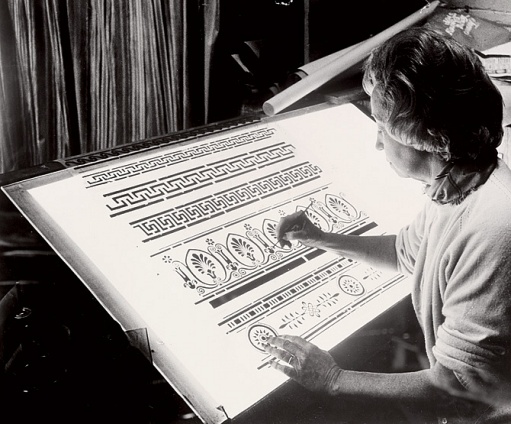
There is something amiss in the photograph above, something of which even the photographer was unaware. It is a photograph of the Australian designer Florence Broadhurst in her Sydney studio and was taken in the early 1970s. We see her sitting at her light-box in the midst of crafting her designs, designs typically made for luxury wallpaper or for fabric. She is counted as an orientalist artist - one of Australia's foremost orientalists - due to her fascination with and extensive appropriations of oriental design motifs, notably from China and Japan. She opened a design studio in Sydney in the 1960s and her designs quickly became famous both in Australia and abroad. Her fame diminished and her studio was disbanded after her death in 1977, but her designs have been advanced and championed lately - principally by her feminist admirers - and are today found in noteworthy establishments throughout the world. The one problem is - and this is the problem with the photograph referenced above - that Florence Broadhurst did not herself design her own designs but rather paid underlings to do them for her. She had extremely poor eye-sight and for this reason alone never worked on the designs produced by her studio under her name. The photograph above, like numerous others, was staged and released for public consumption in order to further the carefully crafted myth - or deception - of Florence Broadhurst, designer. The truth of it was a carefully kept secret. She employed graphic designers and they, in fact, were responsible for all the output of the workshop.


While such a deception might strike many as untoward, it is not entirely untraditional since, of course, artist workshops have been collaborative ventures since early times. It is only the modern sense of the artist as a singular genius that is offended. In reality, many great artists have been essentially entrepreneurs who employed, coordinated and took credit for the handiwork of skilled, but anonymous, workers. In our own times too, there are artists who have stepped outside the lone-artist-in-the-garret paradigm and have adopted a more industrial mode of production - the largely talentless Andy Worhol and his 'Factory' being the most famous. Moreover, for Florence Broadhurst the deception was hardly a new departure. She had spent her entire adult life engaged in often elaborate deceptions by which she would remake and reinvent herself in sundry guises; her reinvention in Sydney in the 1960s as a designer was one of a long list of masks she had created since growing up on a remote cattle station in outback Queensland. Most famously, and most notoriously - it offended the good farming folk with whom she grew up - she passed herself off as an English aristocrat for many years. Her life itself was her primary work of art, her identity her canvas. He deceptions were often brazen. When she was in her seventies she claimed to be in her forties. 


None of this is to say that the designs created by her studio were not her own inspirations. They undoubtedly reflect her own interests and influences and while others did the actual pen-to-paper work she no doubt exercised executive control over everything produced in her name. Her designs certainly reflect her oriental tastes. During the 1920s she established herself in Shanghai and opened what we would today term a 'finishing' school for young ladies, where elocution, literature, languages, ballroom dancing, music, journalism and other arts were taught. She was immersed in the lively culture and fashions of Shanghai in that era. Here is a picture of her, circa 1925:


Her designs from the 1960s and 70s, in any case, reflect the lasting impression Northern Asia had upon her sensibilities. Their often bold colours are to be explained by her poor eye-sight: she instructed her workers to produce designs she could at least see. But their dominant motifs and lines are essentially Asian. Like other orientalists she was engaged in a project to imitate and acquire aspects of oriental culture that she loved and admired. As we know, this entire project has been churlishly characterized by certain intellectuals as a nefarious colonialist and imperialist undertaking - although it seems that, as a celebrated feminist heroine, Miss Broadhurst is not deemed guilty of such crimes. Why not? Not only was she an accomplished liar, she was also an adept cultural thief who stole oriental design ideas - often from sacred contexts - and redeployed them as wallpapers for rich white elites. Critiques of orientalism are anything but consistent. 

Readers of these pages will know, of course, that the present author thinks otherwise. The over-riding consideration is that orientalist artists (and in this case designers) looked with extraordinary sympathy upon oriental cultures, and their appropriations and imitations were acts of flattery and admiration. East/west syntheses are very often sublime. The designs of the Florence Broadhurst studio are no exception. They are very fine works: a high light of Australian design. Australian culture has only rarely given due attention to the geographical proximity of the Australian continent to Asia. Australian artists have, by and large, been preoccupied with the problematic nature of Australian connections to European civilization and/or with the nature of the land and the unfamiliar and inaccessible nature of the indigenous heritage. Even today, other than an alcohol soaked misadventure in Bali, most Australians remain blissfully unaware of the fact that the great portion of the world's population lives just off the coast of Darwin. Few Australian artists have attempted an Austro/Asian synthesis. The ever-restless and creative Florence Broadhurst is one. A few of the designs bearing her good name - her studio produced over 800 designs in over 80 colours - are shown below where the adaptation of Asian motifs to a 1960s Paisley-like (sometimes psychedelic) aesthetic is apparent:


* * * 

Just as she lived an extravagant and flamboyant life, so too her death was remarkable. She was viscously murdered in her studio on the 15th of October, 1977, and to this day her murder remains unexplained. The assailant was never identified. No one was ever charged. It remains a mystery. The suspected murderer was the notorious 'Granny Killer' John Wayne Glover. An English immigrant, Glover was convicted of killing six elderly women, but police suspected him of killing numerous others. He did know Florence Broadhurst, having met her through her brother, although he did not know her well. Miss Broadhurst was found beaten to death with a lump of wood in her studio. It seems that she and the assailant had been sharing a cup of tea, and other evidence suggests the perpetrator knew his way around the premises. That is, it was almost certainly someone she knew. The motive appears to have been money. All of this points to Glover, although it was never proven and he never confessed to it. The nearest he came to a confession was an enigmatic sketch he made of two trees, one of them bearing the number nine, just before he suicided in his prison cell. It is interpreted by some to indicate that he killed nine women. 

It should be noted, though, that the six murders for which Glover was convicted were all committed in the years 1989/1990 - a good decade later than Miss Broadhurst's murder, and it is only speculation that he may have killed before that. Ostensibly, the trigger for his killing spree came in 1989 when his mother died of breast cancer and he himself contracted breast cancer - a humiliating 'female' disease - shortly afterwards. Yet there are a number of unsolved murders of elderly women in Sydney over a twenty year period, Broadhurst's being the most famous, and they all resemble the murders Glover is known to have committed. Until the case of Ivan Milat, John Wayne Glover - the Granny Killer - was Australia's most prolific serial killer. A gambler, his immediate motive was money, although he usually left his victims in a sexually exposed position. He stated at his trial - where his lawyers argued unsuccessfully for 'diminished responsibility' (the plea of insanity in Australian law) - that the crimes were committed while he was in a state of 'trance'. 


Harper McAlpine Black


Friday, 5 July 2019

The Mystery of Ma' mun's Tunnel


Ma'mun's Tunnel

Before the time of the Abbasid Caliph Ma'mun - the year 832 to be precise - it was assumed (as far as we know) that the Great Pyramid of Cheops, the pyramid attributed to the Pharaoh Khufu, was, by design, the same as the others: namely, there was a descending passageway from an entry point above ground level down to internal chambers which were themselves at or below ground level. This is the standard design of Egyptian pyramids. Consider, for example, the Khafre pyramid, or the Menkaure pyramid:


Or consider, in the same manner, the so-called Red Pyramid, a close relative of the Great Pyramid both in chronology and conception:


In all these cases, you enter from a point some way up one of the sides and then descend through a sloping passageway to reach the interior rooms. The pyramid of Khufu was regarded as no different. It was well known to classical authors, and we must assume to a host of other people, that there was an entry point up one side and a descending passage leading down to a chamber dug into the bedrock beneath the structure, thus:


People must have gone down that passage countless times over the centuries ever since the pyramid was built, and since it conformed to the design of other pyramids there was no reason to suspect that the Great Pyramid was any different.

The only mystery was that in the case of the Great Pyramid the internal chamber - the subterranean chamber cut directly into the bedrock - was not only empty but in an unfinished and very rough state. A continuing passage from the chamber led nowhere, and the whole thing is incomplete. This was (and is) indeed perplexing because the pyramid above is so magnificent and finished to such a high degree of perfection. Why build such an extraordinary pyramid - complete with its original solid gold crown - but leave its internal chamber in such a crude state of incompletion? There was no mention of other chambers in the extant literature, and no reason to suspect there to be other chambers. The Great Pyramid follows the usual design, except that the inner chamber at the end of the descending corridor is unfinished.

All of this changed following the expedition of Ma'mun. In the last year of his life the Caliph - a bookish man and sponsor of esoteric learning and alchemy - decided to look further, and it was he and his men who discovered an ascending passageway leading to a series of other hitherto unknown chambers deep in the heart of the structure. Ma'mun demonstrated that the Great Pyramid was, in fact, an extraordinary departure from the standard design. He opened up the interior of the structure such as we know it today. According to the story, he and his men tunnelled - by force - into the side of the pyramid and caused so much vibration that a lintel fell in the ascending passage. Hearing this, his men dug in that direction and at length found the juncture where the ascending passage joins the descending one. Subsequently, they explored the internal cavities, namely the so-called Queen's chamber, the so-called Grand Gallery and the so-called King's chamber. However, the story also relates that these chambers were empty and that the Caliph left empty-handed and disappointed. There was a sarcophagus in the King's chamber, but it was empty too. No mummy. No treasure. Nothing. But at least the full design of the interior was exposed. It was a radical departure from previous designs, as one might expect in such an amazingly ambitious edifice. Here is the interior plan as we have known it since this famous undertaking by the Caliph:


The story of Ma'mun, however, is anything but satisfactory and it simply cannot be true. As we have said already, the descending passage was known throughout antiquity, and so too, therefore, its entrance. So why then would Ma'mun decide to smash his way in at a point just below that entrance? Are we really to believe that Ma'mun did not know of the natural entrance? Here is an illustration with the place of Ma'mun's tunnel marked:


As readers can see, the established entrance is just a bit higher up. (Only ten courses. Ma'mun's entrance is at course seven, the official entrance at course seventeen.) Yet, we are told, Ma'mun decided to tunnel in by force. As a man of learning - especially of Greek learning - and a sponsor of the same, he would surely have known the classical accounts which described the natural entry point even if (as seems unlikely)it had become closed off or lost in Ma-mun's era. Instead of spending time finding it, are we to believe he decided to go in by force, surely a much more laborious undertaking?

Moreover, the story of the falling lintel is quite plainly a fanciful narrative device. It explains how Ma'mun knew where to dig. It is exceedingly unlikely in itself, and in any case does not explain how - given the enormity of the whole structure - Ma'mun just accidentally chose to dig in the right place in the right direction to begin with! What amazing good fortune! Even before hearing the lintel fall he was apparently digging almost directly towards the aperture of the ascending tunnel and only had to deviate slightly to find it. The story has been told so often it has become canonical, but it is assuredly a tall tale. To this day people deride Ma'mun as a type of brainless vandal who bulldozed his way into Khufu's pyramid. Yet, in fact, he was a learned and cultured man - he established the famous House of Wisdom and promoted translations of Greek and Roman texts into Arabic. No buffoon or crass treasure hunter, it is much more likely that he knew exactly what he was doing and where he was going, and so we need to give a different account of his infamous tunnel digging. Just the idea that he dug his way in, rather than take the door, makes no sense.


* * * 

But what if he didn't dig his way in? What, rather, if he dug his way out? This is the proposal - based on wholesome lateral thinking - of the modern pyramid buffs, Ellis and Foster. As they point out, a tunnel is a two-way affair: it goes not only inwards, but outwards, and they ask if, perhaps, Ma'mun had some reason to dig a tunnel out of the structure, having gone in through the usual entrance. Perhaps the tale of the falling lintel, and the whole story of Ma'mun's tunnel, is entirely apocryphal? They present a very compelling alternative to the canonical version of events. To summarize, it goes as follows:

Ma'mun, a clever fellow, with teams of even cleverer fellows at his disposal, had come to know that there were other chambers in the Great Pyramid besides the unfinished and empty subterranean chamber. There are several ways he and his scholars might have established the possibility of this, quite apart from simply noting that there are granite plugs in the limestone structures of the descending passageway, such plugs marking and sealing another passage. The canonical story has his team of diggers accidentally chancing upon these plugs at the juncture of the two passageways, but that is superfluous - he could simply have gone down the descending passage, entering through the normal doorway, found or gone around the plugs, removed them and thereby opened up the ascending passage, no digging required. He then explored the interior chambers. However, these turned out to be as empty as the subterranean chamber. The Holy of Holies, the King's chamber, was empty too, except for the sarcophagus which at that time was sealed with a stone lid. Ellis and Foster suggest that Ma'mun ordered the sarcophagus opened by force - and thus today we see it somewhat damaged in one corner. But it too was empty. Thus, the only thing not nailed down in the entire complex was the lid of the sarcophagus. Ma'mun decided to take it.


The damaged and lidless sarcophagus in the 
King's chamber of Khufu's pyramid.

This therefore explains why the broken sarcophagus today has no lid - one of the many mysteries of the King's chamber. Yet removing the lid from the pyramid proved difficult. Firstly, it was, of course, very heavy, and secondly it was too big to fit through the established exits. In particular, there was a danger it would slide down the descending passageway, and it would not fit around the juncture of the passageways. What to do? Ma'mun ordered his men to dig a tunnel out of the structure at the juncture of the passageways, so that they could remove the sarcophagus lid. This is why they needed to dig a tunnel. Not to get into the building, but to remove something too large to get through the established exit. We might suppose that Ma'mun found other things in the pyramid and simply told no one about it, but the problem we are addressing is why he dug a tunnel. What was so large and cumbersome that he needed to create a tunnel out? Ellis and Foster have established that, given its supposed dimensions, the lid - on its side - could just be squeezed out of the King's chamber, and it could easily traverse the Grand Gallery, but it could not be taken around the corner at the passage junction. Ma'mun's tunnel solves this problem precisely.

This hypothesis actually solves three riddles: the riddle of why Ma'mun dug a tunnel, the riddle of how the sarcophagus in the King's chamber came to be damaged, and the riddle of the missing lid. It is a very neat hypothesis that, on the face of it, has more going for it than the canonical story. Once we entertain the notion that Ma'mun' tunnel was made not to get into the building - a very unlikely proposition in itself - then we are left wondering why he made a tunnel at all. The obvious answer is so that he could remove something large and awkward that he had found inside. What could that be? As far as we know, there is only one thing missing from inside the pyramid - the lid to the sarcophagus in the King's chamber. The question of how the sarcophagus was placed in the pyramid has always been a problem to modern students. It is too big. It is made from a single stone, so it was not assembled. Some people suggest that the pyramid must have been constructed around it. It clearly once had a lid. There are the lugs and runners for a lid. Where did the lid go, especially since if it was too big to get into the building it must have been too big to get out? Here is a tidy solution. Ma'mun stole it. Why? Why not? There was nothing else to steal.

All of this seems to the present writer to be a solid and highly plausible case. There are, no doubt, problems that arise - what became of the sarcophagus lid? - but many other problems might be solved in the process. For example, large amounts of rubble were found at the bottom of the descending passageway by modern investigators: this would be consistent with the idea that Ma'mun's tunnel was dug from the inside out and not the other way around. The story of the Caliph strong-arming his way into the edifice, neglecting the real entrance only a few courses away, makes no sense. We need a different explanation for Ma'mun's tunnel.

Harper McAlpine Black