Showing posts with label cemetery. Show all posts

Tuesday, 5 April 2016

Views of a Chinese Graveyard


In the hilly region towards the centre of the Prince of Wales Island – or Pe Nang as it is called – is the old town of Bilak Pulau. Stranded there an entire afternoon awaiting return buses to George Town the present author wandered into the surrounding jungle and about three miles out of town encountered an old traditional Chinese cemetery. The photographs on this page are views of the cemetery, the graves and the funerary art from that site, along with a few rudimentary notes on the symbolism of Chinese graves. 


The Chinese constitute an ethnic majority in modern Pe Nang – the only area of the Malay peninsula or the Malacca Straits where they do so – and have been an established community for many centuries. Although there are a few graves from recent times, this cemetery is from an older era and is the burial place of many of the progenitors and ancestors of the illustrious Chinese clans who still populate the island. These were Chinese – mainly from southern China – who ventured to the Straits in search of fortune, or at least a better life. 

Although remote and buried in forest, the cemetery is still tended. In the photos shown on this page readers will notice the profusion of slips of paper strewn all about; this is from a recent festival in which graves are decorated with messages to the dead, as in this instance:


The remarkable thing about traditional Chinese graves is their shape. In contrast to the boxed rectilinear graves of Europeans, they are almost always semi-circular in shape, or what is often described as 'horseshoe' shaped, or else the shape of the Greek letter omega. The deceased is buried with the head at the top of this curved shape and so the "head stone" is actually where the feet are. Burial is usually quite shallow - compared to the mandatory six feet of the european grave - and so a tumulus or mound is usually shaped over the area inside the omega/horseshoe. The grave therefore is elevated above ground level.

There is much discussion about the significance and meaning of the curved burial plot, although very little of it is informative or sensible. As with nearly all things Chinese, readers will find an abundance of reports stating that the shape is regarded as "lucky" and is designed to bring "good luck" to the deceased in the afterlife. This tells us nothing. 

More useful are accounts that tell us that the shape is developed from the theories and practices of feng sui - Chinese geomancy - where it is considered beneficial for the dead to be buried in a valley or a concave formation of hills; where this is lacking then the grave itself is mounded up and shaped accordingly. This is evident in the graveyard depicted here. It is, as it happens, on a western-facing hillside that conforms in part to the feng sui requirements, and clearly individual graves have been shaped into small hills to accentuate the natural lay of the earth in an appropriate way. 


Other accounts of the omega/horseshoe grave remark upon the fact that sometimes the tumulus is decorated like a tortoise shell, and so the entire construction seems to allude to the shape of a tortoise. Why? Because, we are again told, "tortoises are good luck." Certainly, but why? The key idea is that the tortoise shell is cosmological. This is a very common symbolism found throughout Chinese cosmology (and the Chinese tradition is strongly cosmological.) The symbolism concerns an over-arching shell such as the sky is supposed to be in traditional cosmological understandings. The grave then becomes a microcosm of the world. There is, however, also the fact that tortoises, according to legend, are supposed to seek out a suitable (re: "lucky") place to die. By making the grave tortoise-like it becomes - by extension - a good place for the dead to be buried. It is, in any case, all about a suitable location. For the traditional Chinese the location of the grave is paramount. 


What most accounts of Chinese burial practices neglect to mention, though, is that - very obviously - the shape of the traditional grave is uterine. The earth is a womb. The grave is the uterus. The dead await rebirth (either by resurrection or in the Pureland - Chinese accounts of the afterlife are diverse.) The shapes and curves of the Chinese grave are, in any case, distinctly feminine. This is the deepest, most primordial and most important symbolism. Compared to the utilitarian Western burial box (coffin) the Chinese grave is distinctly anatomical and the curved shapes emphasise the idea of the earth as womb, the living earth, which is the key underlying metaphor of geomancy. Chinese burial practices are above all geomantic. This fact is on display everywhere in a traditional Chinese cemetery. We will hopefully have occasion to explore this further at a later date. 


Note the semi-circular "forecourt" in front of the grave marker and the lines of salt that families draw at various points around grounds along with offerings to the dead. 


Yours,

Harper McAlpine Black

Friday, 23 October 2015

The Mausoleum of Job Charnock


Mr. Job Charnock Esq. was the man who founded the city of Calcutta, but not according to the High Court of West Bengal. In an odious piece of spiteful revisionism in 2003 the Court, led by a submission from a team of nationalist historians, ruled, to its great discredit, that Calcutta was a major trading port prior to Charnock and that all references to Mr. Charnock as founder of the city were to be erased in perpetuity from the official documents, records and school history books. This was part of the post-colonial tantrum that led to the trivial name change from the Angloform “Calcutta” to the more indigenous sounding but hardly more informative “Kolkata”.

The case of Job Charnock is a singular instance of the type of petty and juvenile revisionism with which post-colonial intellectuals and activists concern themselves. In this instance they do so against the evidence of the known facts. The simple truth is that prior to Job Charnock this salubrious location on the Hoogley River consisted of three villages and a jungle and not much else. The location, marked especially by the Kali temple at Kalighat, was mentioned in earlier documents, to be sure, but it nevertheless consisted of three villages and jungle and not much else. It was indeed Mr. Charnock, an officer of the British East India Company, who proposed it as the location for a trading base that subsequently became Fort William. And it was through the vision of Mr. Charnock that the location was developed by the East India Company, and later the Raj, as the ‘London of the East’, a great prosperous city of Hindoostan, a safe port just up river from the Bay of Bengal. Dress it up how they may, the resentful and small-minded Anglophobes who engineered the rewriting of the city’s history cannot defy the plain truth of the matter. The Oxford Dictionary of National Biography, 2008 edition, sets the record straight:

It is mostly due to Charnock's imagination, his vision, and his commitment to what he considered was right that the English transformed three small villages on an inhospitable tract of riverbank into what was to become the premier city in India ... Of all the great cities of modern India, Calcutta it is that owes its existence to the vision and commitment of one man.

* * *

The mausoleum of Job Charnock is now in the grounds of the historic St. John’s Church near Delhousie Square in what was once the centre of Calcutta city. It is built of a local mineral named after him, Charnockite and houses the earliest European graves in Calcutta, considerably older than those graves found in the old cemetery at the south end of Park Road. (See previous post.)

The tomb of Mr. Charnock himself is marked in a beautiful Latin inscription, as follows:

D.O.M. Jobus Charnock, Armiger Anglus et nup. in hoc regno. Bengalensi dignissimum Anglorum Agens Mortalitatis suae exuvias sub hoc marmore deposuit, ut in spe beatae resurrectionis ad Christi judicis adventum obdormirent. Qui postquam in solo non-suo peregrinatus esset diu reversus est domum suae aeternitatis decimo die 10th Januarii 1692. Pariter Jacet Maria, Iobi Primogenita, Carole Eyre Anglorum hicci Praefecti. Conjux charissima. Quae Obiit 19 die Februarii A.D. 1696–97.

Translation:

In the hands of God Almighty, Job Charnock, English knight and recently the most worthy agent of the English in this Kingdom of Bengal, left his mortal remains under this marble so that he might sleep in the hope of a blessed resurrection at the coming of Christ the Judge. After he had journeyed onto foreign soil he returned after a little while to his eternal home on the 10th day of January 1692. By his side lies Mary, first-born daughter of Job, and dearest wife of Charles Eyre, the English prefect in these parts. She died on 19 February AD 1696–7.


* * *

The mausoleum also includes the notable grave of William Hamilton, the British surgeon who, famously, cured the Mughal Emperor Farrukseer of swelling in the groin. The emperor had been due to marry a princess from Jodhpur; it was Hamilton’s cure that permitted the marriage to proceed. Farrukseer was delighted. Hamilton was handsomely rewarded. The East India Company was given the right to trade duty-free out of Calcutta and Hamilton received an elephant, a horse, five thousand rupees in money, two diamond rings, a jewelled aigrette, a set of gold buttons, and models of all his instruments in gold. His plaque includes an inscription in Persian:


* * * 


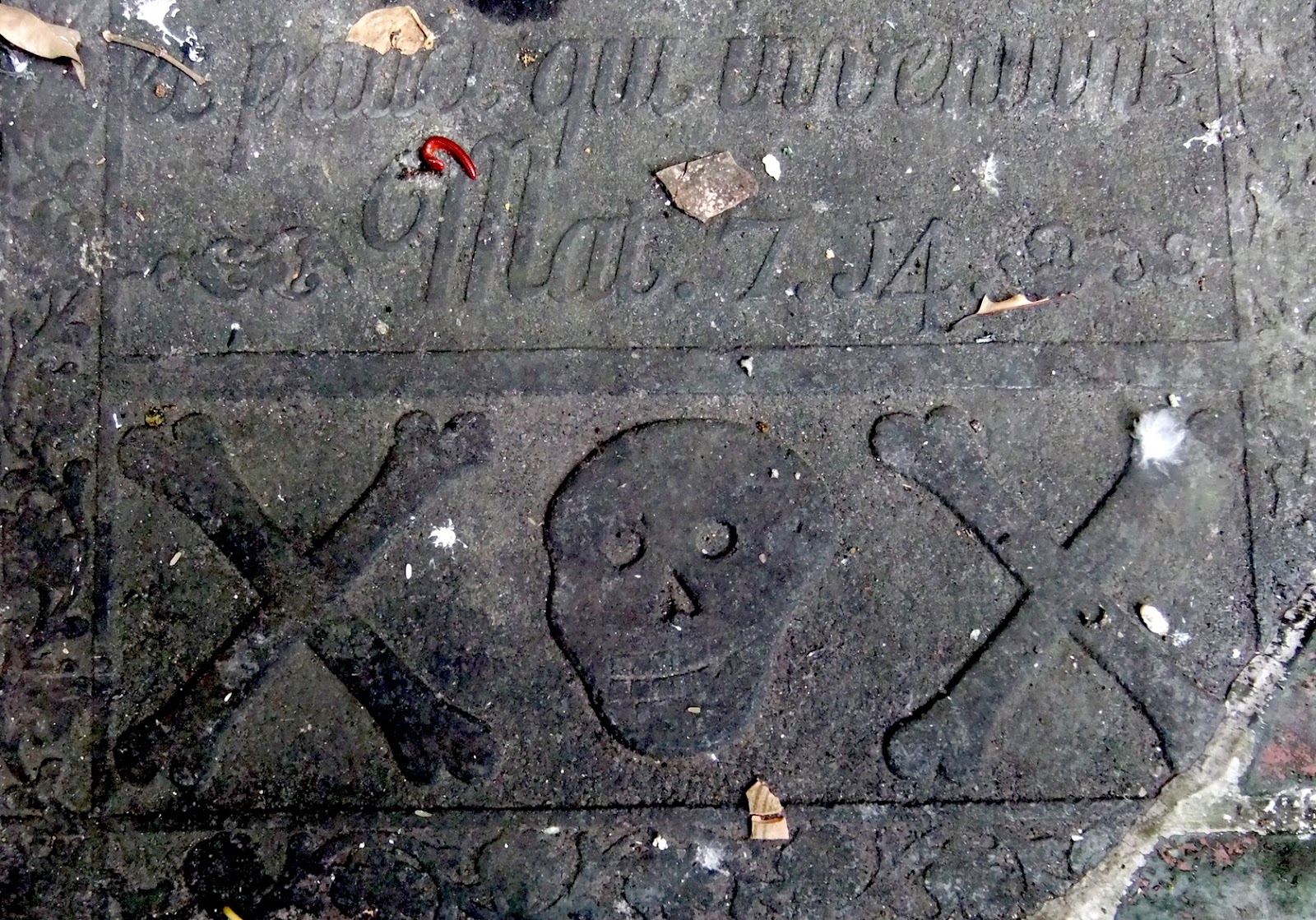
More intriguing than these notable graves are those marked in the paving around the mausoleum. In many cases they are so worn that the names, dates and inscriptions cannot be made out. These too are early graves of the men and women of the East India Company who first created a fort and trading post on the Hoogley River near the Bay of Bengal. What makes these graves intriguing is that most of them display the skull and cross bones. As with the graves in the Park Road cemetery there are no indications of Christian piety, and least of all crucifixes. Instead, in these cases, the conspicuous iconography is of the skull and crossed bones. Here are some samples:


Yours,

Harper McAlpine Black

Sunday, 18 October 2015

Park Road South Cemetery

A great treasure lies at the end of up-market Park Street, just before the Park Street Circus, in old Calcutta, namely the Park Street South Cemetery, the burial ground used by the British East India Company up until the mid 1800s. Once completely overgrown and subject to scandalous neglect in post-colonial India, it has now been cleaned up, guided by the British Association for Cemeteries in South Asia, and is open to the public. It is an oasis of calm and cool green beauty, with its monolithic tombs covered in emerald moss, an escape from the mad bustle of the modern streets. Here are some of the present author's photographs from two visits there:


Although ostensibly a Christian graveyard, it is noticeable that there are very few overtly Christian graves. There is not, for example, a single crucifix to be seen. (These, presumably, were regarded as excessively "papish" at the time.) But even the grave inscriptions rarely make reference to Christian piety. The inscription speak of the virtues of the deceased, their service, their commitment to duty, their dedication to their families, but only rarely is there a mention of their Christian beliefs or quotations from the Christian scriptures. All that is sacred is the memory of the departed. Here are a few sample inscriptions to illustrate the point:


* * * * * *

Two tombs in this remarkable graveyard stand out for special comment; that of Charles Stuart and that of Elizabeth Barwell, two of the more notable and extraordinary characters from British Calcutta in that era. 


CHARLES STUART

Charles Stuart, who travelled to India as a teenager, is better known as Hindoo Stuart and is commemorated under that appellation on his plaque. He lived in Calcutta for over fifty years. During that time he increasingly took on local customs and eventually identified himself as a Hindoo. He bathed in the Ganges every day, adopted Hindoo dress and practiced the devotions of the Hindoo religion. This in no way prevented his advancement in the army; he rose to the office of Major-General. Nor did he entirely reject the Christian faith; rather he seems to have understood Christ as an incarnation of deity alongside Krishna. He often exhorted his fellow Britishers to embrace Hindoo customs and, famously, wrote a pamphlet urging British ladies to shun European vestments and to take up comfortable Hindoo apparel. Its full title was: The Ladies Monitor, Being A Series of Letters First published in Bengal on the Subject of Female Apparel Tending to Favour a regulated adoption of Indian Costume And a rejection of Superfluous Vesture By the Ladies of this country With Incidental remarks on Hindoo Beauty, Whale-Bone Stays, Iron Busks, Indian Corsets, Man-Milliners, Idle Bachelors, Hair-Powder, Waiting Maids, And Footmen.

Stuart was buried, not cremated with his ashes cast into the Ganges according to Hindoo practice, but his grave is marked by the small Hindoo-style temple (mandir) that is one of the outstanding eccentricities of the Park Street burial ground. As a point of interest, British atheists in Calcutta, such as David Hare, were denied a tomb in "Christian ground", but this sensitivity did not extend to the "heathenism" of Hindoo Stuart.

(The present author, let it be noted, currently resides in Stuart Lane, just off Sudder Street, in central Calcutta.)


The Mandir-Style tomb of Hindoo Stuart

ELIZABETH BARWELL (Nee Sanderson)

It is reported that when young Elizabeth Sanderson arrived in Calcutta every bachelor in the city fell in love with her. She is famous for her great beauty, the Helen of British India. Young British officers and officials of the East India Company lined up for her hand. In one famous incident, she informed her suitors of her intention to attend a certain ball and let it be known what dress she would be wearing so that the young men could attire themselves in concert with her. On the occasion, no less than a dozen young men turned up at the ball all dressed in the same pea-green clothing. Eventually, she married the womaniser and gambler Richard Barwell, but tragically died of "fever" (malaria?) shortly afterwards. The tomb of Elizabeth Barwell - a huge stone pyramid - is the largest in the cemetery. 


Yours,

Harper McAlpine Black