Showing posts with label Confucianism. Show all posts

Saturday, 14 May 2016

Some Notes on Islam & the Chinese Tradition


In most translations of Mohammedan works, such as the Koran, into Chinese, the name of God, Allah, is rendered by two Chinese characters meaning "True Lord".

* * * 

THE BIFURCATION OF THE CHINESE ORDER

In several short works, but specifically the essays in Insights into Islamic Esotericism & Taoism and Confucianism, Rene Guenon applies his usual clarity to the seemingly diverse religious phenomenon of both Islamic and Chinese civilization. This is of concern to the present writer as he makes his way through South-East Asia – specifically the Chinese areas of the Malay peninsula – and heads towards western China and the far end of the silk road. It is difficult to find even slightly useful reading material on the essential features of the traditions that converge in these regions. Guenon’s essays, as usual, are remarkable for their perspicuity, precision and authoritative insights. There are shortcomings in the Guenonian perspective, sure enough – a Masonic preoccupation with initiatory organizations and secret societies, for example – but it is always a relief to encounter his stern, unadorned, mathematical prose and to appreciate his utter indifference to sociological and other profane considerations. His disdain for Boodhism is refreshing too. 

When all is said and done Guenon deals with religious traditions as though through a series of geometrical models. These are sometimes simple and sometimes complex. In the present case – Islamic esotericism, or Soofism, on the one hand and the Chinese traditions, Taoism and Confucianism, on the other – the schema is relatively simple, at least in the first instance. It is an essential feature of Guenon that religions manifest both inner and outer dimensions. There is externalism – popular forms - and then there is the inner or esoteric – hidden or secret or elite - aspect of the tradition concerned. In comparing the Mohammedans with the Chinese, he proposes that there is an all-important contrast in the way these two dimensions, inner and outer, are arranged in each case. Leaving aside all the details and whatever complexities arise, this is the key to a Guenonian study of these traditions. 

In the Guenonian perspective, the Mohammedan order is concentric with the esoteric (tariqah) within the external casing of the Law (shariah). It is a model of kernel and protective shell. Thus:


But as Guenon explains, the Chinese order does not work in this way. Rather - for reasons that we need not discuss at present - the two spiritual functions, inner and outer, have been effectively bifurcated. Taoism is the esoteric function and Confucianism the external or exoteric function. Their relationship in the Chinese case is parallel rather than concentric. Thus:


This, for Monsieur Guenon, is what is crucial to appreciate about the nature of the Chinese tradition, especially in contrast to such a tradition as Mohammedanism. We should add that this model is quite separate to and distinct from the imposition of Boodhism upon the Chinese tradition. The model described here was established and settled long before Boodhism arrived in China. Boodhism adds nothing and takes nothing away from it. Often in modern studies the Chinese tradition as a whole is described as the 'Path of Three ways' - Taoism, Confucianism, Boodhism. But Boodhism, as Guenon insists, is not integral to the Chinese order. 

* * * 


THE ANALECTS & THE HADITH

The Prophet Mohammed said, "Seek knowledge, even if it is in China." 

There are some rather obvious parallels – at least in form – between the Analects of Confucius and the Hadith of Mohammed. In both cases we have short, pithy sayings and examples of word and deed as recorded by disciples and companions. And in both cases these records act as exemplars or patterns of behavior. The Hadith are the recorded words and deeds of the Prophet – supposedly – and they function to guide and shape all the patterns of Mohammedan life. They establish Mohammedan ethics as well as manners. The Prophet is True Man, the model for all men.

In the Chinese tradition this is exactly the function of Confucius. It becomes conspicuous to anyone who spends more than a little time among the Chinese, even in this day and age, that there is a common model, a common ideal, of behavior among them, and this ideal is set by Confucius. Confucius is the exemplar, the Master, the standard of all that is proper and correct. This is especially evident in the Analects which, indeed, take a form very much like the Hadith found in the Mohammedan tradition. Confucius is the True Man, and we learn of his deeds and words through the analects recorded by his immediate followers in the form “The Master said…” or “The Master did…” Moreover, the circumstances in which he lived as well as the disciples and people around him are regarded as paradigmatic. They set examples to be emulated by everyone thereafter. Thus do the (traditional) Chinese say “Confucius says…” and cite some analect or saying in exactly the same manner as Mohammedans habitually cite the Hadith with “The Prophet said…” Chinese life is textured in this way just as is the social life of the Mohammedans. It is a close parallel between the two traditions.

Anyone familiar with any of the Hadith (traditions) of Mohammed will recognize the form, if not the content, of the following examples of the traditions of Confucius:

The Master said: “When a country is well governed, poverty and a mean condition are shameful. When a country is poorly governed, wealth and honour and shameful.”

The Master said, “One should study as though there is not enough time and still feel fear of missing the point.”

The Master said: “In the morning hear the Tao. In the evening die content.”

The Master said, “I have yet to see a man who loved virtue as much as sex.”

The Master said, “There are shoots that never come to flower, and there are flowers that never bear fruit.”

Ji Wenzi always pondered matters thrice before acting. The Master heard of this and said, “Twice is enough.”

Though the Master’s meal was only greens and vegetable congee, he inevitably offered some in sacrifice, and always in ritual reverence.

When the Master was at home in his neighborhood, he was warm and courteous, and seemed as if he found it difficult to speak. In the ancestral temples or at court, he was articulate, his speech merely showing signs of caution.

When the Master was at leisure, his manner was relaxed and easy.

When sending his greetings to someone in another state, the Master would twice bow low as he sent the messenger off.

When mounting a carriage, the Master always faced it squarely and grasped the mounting cord. Once in the carriage, he did not turn to look at those standing behind him; he did not speak rapidly; he did not point.

The Master said, “Be devoted to faithfulness and love learning; defend the good Tao until death.”

The Master said, “Extravagance leads towards disobedience; thrift leads towards uncouthness. Rather than be disobedient, it is better to be uncouth.”

When the Master slept, he did not assume the position of a corpse. When at leisure, he did not ornament his dress.

The Master was vigilant about three things: fasting, war and illness.

When the stables burnt, the Master returned from court asking, “Was anyone hurt?” He did not ask after the horses.

The Master taught by means of four things: patterns, conduct, loyalty, faithfulness.


* * * 


The concept of the One is not absent from Chinese thought. And the concept of the Nothing - a metaphysic of emptiness - is not absent from Mohammedan thought. The Confucian classics speak of “the all-pervading One” (i kuan) and Taoism refers to “holding onto the One” (shou i). The I Ching refers to “heavenly Oneness”. Unity of the absolute, in fact, is a constant theme in both Confucianism and Taoism. But, as Guenon notes, the bifurcation of functions within the Chinese order mean that the purely metaphysical and the personal never meet. Thus the Absolute is not usually presented as a “God” in the Semitic and occidental manner. The negative conception of the Tao is more like Aristotle’s unmoved mover, although in other respects it is, in function, like a creator. “The Tao produces the ten thousand things,” says the Tao Te Ching.

It is entirely possible to reconcile this with Mohammedan metaphysics. It is only externally that the Mohammedan deity is a personal god, or even a “god” at all. This is the contention of Toshihiko Izutsu’s powerful study, Sufism and Taoism, where he draws parallels between the Soofi metaphysics of Ibn Arabi and the metaphysics of the Tao. Despite Islam’s positive theology, in Soofism there are strong apophatic themes, and it is there that Mohammedanism may meet the temperamental preferences of the Far East. It is possible to read the confession of faith in an apophatic manner. The exclusive tribalism of “There is no god but (our) God” can be read, instead, as “There is no god. Only Allah.” Allah, in that case, is – like the Tao - beyond all conception, beyond personhood, too great to be any god of human understanding. The god of the externalists is an idol. Let us remember also that the Kabba in Mecca is empty. Finally, the only symbol that fits Allah – the Real - is nothingness.

* * * 

RAMADAN IN CONTEMPORARY CHINA

While Mohammedanism has a long presence in China – especially western China – the Chinese authorities are, very wisely, fully aware of its potential to disturb the equilibrium of Chinese society. Precisely because the Mohammedan model is different to that of the traditional Chinese, and there is no neat bifurcation of the religious and the social, it may – if one is not alert to the inherent dangers – operate as a political ideology under a religious cloak. In contemporary China, the authorities in Peking are understandably anxious to prevent this and are ever on guard against religious movements that act as political agents.

An acute issue amongst China’s Mohammedan communities is the fast of Ramadan. Every year the authorities are at pains to downplay and restrict the extent of the fast. This usually earns them the ire of so-called ‘human rights’ groups, but it is an entirely justifiable strategy in the context. In areas where Mohammedans obtain demographic density, the fast of Ramadan becomes a de facto political instrument. It enables the Mohammedans to completely close down an entire region, to completely disrupt the ordinary machinations of life, for an entire month. This becomes a very potent method for imposing Islamic control upon commerce and government.

Quite properly, the Chinese will have none of it. They have passed regulations insisting that all schools, transport and government services will continue as normal throughout Ramadan, and eateries and cafes must remain open too. People are free to fast if they wish – you cannot stop people from not eating or drinking – but Chinese Mohammedans will be prevented from disrupting services and normal social functions, from shutting down society, in the name of Ramadan. Far from being an abuse of ‘human rights’, this is a wise policy that should be adopted wherever pernicious and troublesome concentrations of Mohammedans exist. You can fast, but you cannot shut down civil society. The difficulty, always, when dealing with Mohammedan minorities is that the inner and the outer, the spiritual and the political, are almost impossible to separate. This, as the Guenonian model above illustrates, is in the very structure of Islam. 

Yours

Harper McAlpine Black


Wednesday, 13 April 2016

Kongsi - the Clan Houses of Penang


The Khoo Kongsi - the largest ancestral shrine in George Town and one of the largest outside of China. 

Among the Confucian virtues none is so important as filial piety, a religious sense of duty and loyalty to one’s family. It is conspicuous that exactly this virtue has declined in the modern West under the corrosive influence of liberalism where the “individual” – the rogue – is glorified and “freedom” – selfishness – comes before duty. Indeed, filial piety is one of the main things that separate societies that still retain a sense of tradition from those that have fallen into anarchic modernity. It has been very noticeable to this present author throughout his travels, first through India and Hindoostan, and now more recently through the Sino-Asiatic world. To the Indians, and to the Chinese, family is first. In Benares, for example, the author encountered a young man whose mother had become ill; he had to abandon his university studies to assist with the family business. He did so without hesitation and with no complaint. He knew that his first duty was not to pursue his own dream but to help the family, no question. Such a strong sense of family has almost disappeared from the modern West. In India, and among the Chinese, and among the Malays, the Japanese, and others too, even where modernity is fully embraced the traditional hold of family is not so eroded as it is in the West. These peoples pursue a modernity without anarchic liberalism, different models of modernity than that which has ravaged social cohesion in the West.

The centrality of family is especially underlined to the present author during his current sojourn in the old Chinese enclave of George Town, for George Town is the home to numerous clan associations or Kongsi. Upon arriving in George Town the taxi driver related that the great majority of tourists to the town nowadays are from southern China. They come here to visit the Kongsi of their ancestors. Clan, which is to say extended family grouped under one surname, remains an important feature of traditional social cohesion for the southern Chinese, even after several generations of state communist rule. In fact, there is now a strong movement among the southern Chinese to “search for roots” in order to repair the damage down by the Cultural Revolution. They travel to places such as George Town – Chinese settlements that avoided the Cultural Revolution and where traditional family organizations were strong - in order to renew their links with their past. It is called the Xungen movement - the movement to repair family lineages. There is a strong religious element involved. Family progenitors are revered and accorded sacred status. A Kongsi is not only a clan association but a religious organization. Families have their own preferred deities, along with so-called 'ancestor worship'. The Kongsi clan house acts not only as a meeting place for clan members but, most importantly, as a temple and as a place of worship. 


George Town features numerous outstanding  and illustrious traditional Kongsi. The Chinese clans have played an important role in the history of the city. There was a time when then tended to operate as secret societies, underworld fraternities, and there were several episodes of clan warfare. The British, very wisely, outlawed secret societies in the mid XIXth century and helped the clans become open, cooperative societies that made a positive contribution to the social good. In this, the clans operated as social welfare agencies, loci for trades, places of education, employment agencies, immigration offices and often as adjuncts to the judiciary and law enforcement. Clans acted to keep their members within the law and to settle disputes. On the whole, their contribution to George Town society was and continues to be extremely productive. 


In organizational terms, a Kongsi is like a cooperative or a corporation. The extended family is ruled by the elder males - the bearers of the surname (a clan is patrilineal)- and they hold property in common. They invest in worthy projects and they distribute dividends to clan members. At times of economic downturn or fraying political life members can fall back upon the clan for common support. It is, in effect, what we might call a “distributist” system that combines the best features of a de-centralised capitalism with non-state collectivism, based at every point upon blood ties and the enduring reality of family. It is an impressive and time-honoured model of social organization and remains one of the foundations of traditional Chinese life.

The pictures on this page illustrate aspects of some of the major Kongsi found in George Town.

THE CLAN ELDERS


A clan is patrilineal and its organisation patriarchal. Clans are organised under surnames. In the photograph above we see the current elders of the Khoo Kongsi in George Town (with the gentlemen dressed in traditional Changshan rather than Western business suites.) 


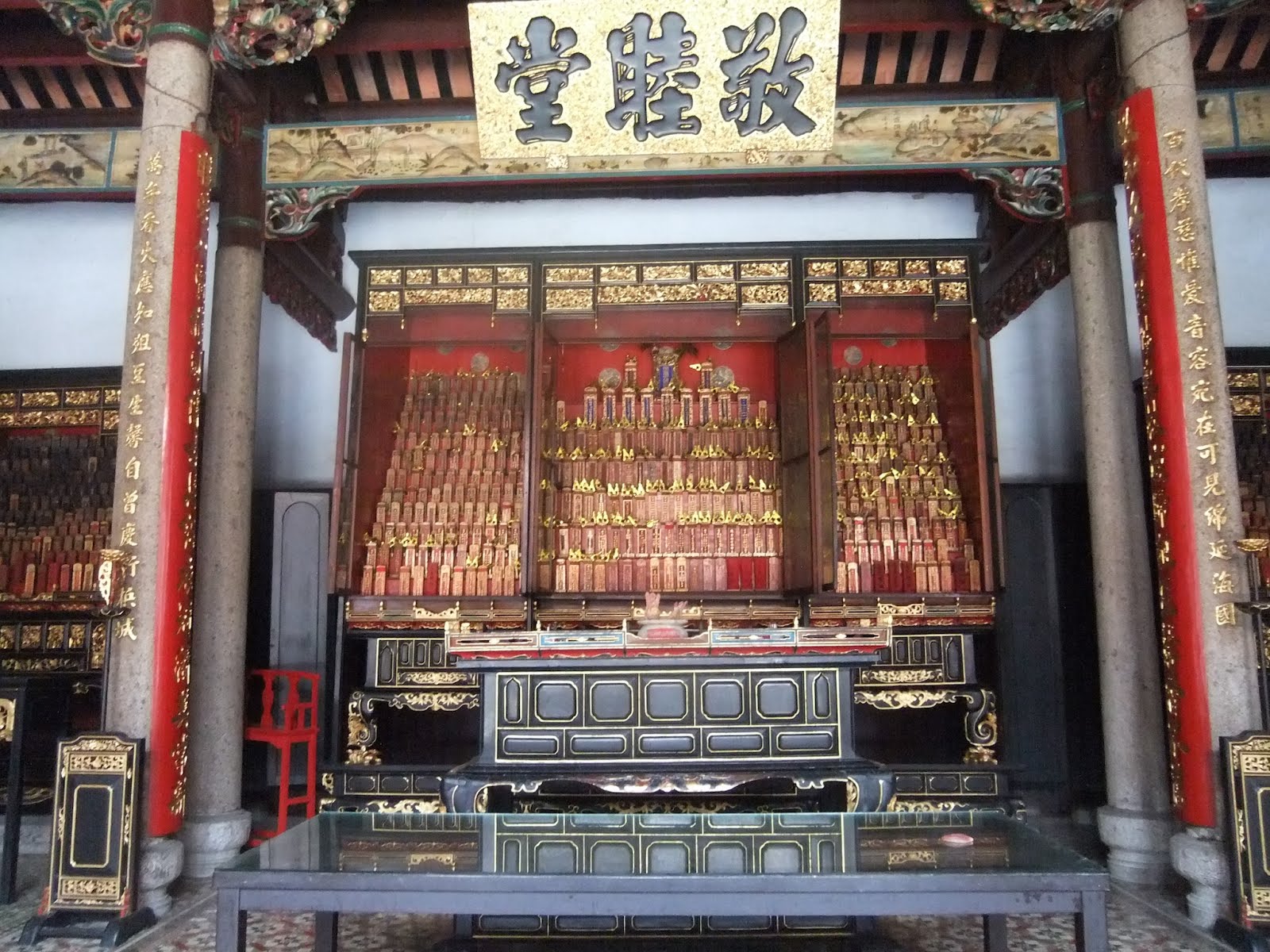
ANCESTRAL ALTAR


In each Kongsi there is an ancestral altar. The names of ancestors are recorded on bamboo slips which are displayed on the altar. Worshippers pray to and revere the ancestors with the main devotional device being the lighting and offering of joss (incense). 


In this picture, ancestors are recorded on tokens arranged in large conical pillars. 


THE CLAN GODS


As well as the altar to the ancestors there is usually a main altar devoted to the preferred deity or deities of the clan. The deities are usually from so-called 'Chinese folk religion' (Confucianism), from Taoism or from Boodhism. Worship is syncretic.


THE ZUPU


The Zupu - the genealogical book. Each clan keeps detailed geneological records in a tome called a Zupu. Tracing and recording the lineage of the clan is an important duty of the Kongsi. 

DISPLAYS OF ANCESTORS


Within each Kongsi there is usually a visual or a written display of deceased members of the clan. In some cases there are very extensive displays where visitoprs can come and search for photographs of their direct ancestors. 


The ancestral hall of the Kongsi will often include memorabilia where the clan boasts of the achievements of its members. Higher education and positions of political power are especially noted. 

VIEWS OF KONGSI


The Kongsi clan houses of George Town are beautiful examples of traditional Chinese architecture. Many of them are masterpieces of Chinese aesthetics. 


As well as places of worship, the Kongsi are also places of recreation, with kitchens and meeting halls (and in the past - up until the Second World War - opium dens.) 


THE CLAN JETTIES


In George Town several clans have settled along the waterfront, constructing their own jetties. There now remains numerous 'clan jetties' where members of the clan live in housing constructed on the jetties themselves. Much of their income now comes from tourism, but in the past it came from sea-trade and fishing. 


* * * 
Yours,

Harper McAlpine Black


Tuesday, 5 April 2016

Views of a Chinese Graveyard


In the hilly region towards the centre of the Prince of Wales Island – or Pe Nang as it is called – is the old town of Bilak Pulau. Stranded there an entire afternoon awaiting return buses to George Town the present author wandered into the surrounding jungle and about three miles out of town encountered an old traditional Chinese cemetery. The photographs on this page are views of the cemetery, the graves and the funerary art from that site, along with a few rudimentary notes on the symbolism of Chinese graves. 


The Chinese constitute an ethnic majority in modern Pe Nang – the only area of the Malay peninsula or the Malacca Straits where they do so – and have been an established community for many centuries. Although there are a few graves from recent times, this cemetery is from an older era and is the burial place of many of the progenitors and ancestors of the illustrious Chinese clans who still populate the island. These were Chinese – mainly from southern China – who ventured to the Straits in search of fortune, or at least a better life. 

Although remote and buried in forest, the cemetery is still tended. In the photos shown on this page readers will notice the profusion of slips of paper strewn all about; this is from a recent festival in which graves are decorated with messages to the dead, as in this instance:


The remarkable thing about traditional Chinese graves is their shape. In contrast to the boxed rectilinear graves of Europeans, they are almost always semi-circular in shape, or what is often described as 'horseshoe' shaped, or else the shape of the Greek letter omega. The deceased is buried with the head at the top of this curved shape and so the "head stone" is actually where the feet are. Burial is usually quite shallow - compared to the mandatory six feet of the european grave - and so a tumulus or mound is usually shaped over the area inside the omega/horseshoe. The grave therefore is elevated above ground level.

There is much discussion about the significance and meaning of the curved burial plot, although very little of it is informative or sensible. As with nearly all things Chinese, readers will find an abundance of reports stating that the shape is regarded as "lucky" and is designed to bring "good luck" to the deceased in the afterlife. This tells us nothing. 

More useful are accounts that tell us that the shape is developed from the theories and practices of feng sui - Chinese geomancy - where it is considered beneficial for the dead to be buried in a valley or a concave formation of hills; where this is lacking then the grave itself is mounded up and shaped accordingly. This is evident in the graveyard depicted here. It is, as it happens, on a western-facing hillside that conforms in part to the feng sui requirements, and clearly individual graves have been shaped into small hills to accentuate the natural lay of the earth in an appropriate way. 


Other accounts of the omega/horseshoe grave remark upon the fact that sometimes the tumulus is decorated like a tortoise shell, and so the entire construction seems to allude to the shape of a tortoise. Why? Because, we are again told, "tortoises are good luck." Certainly, but why? The key idea is that the tortoise shell is cosmological. This is a very common symbolism found throughout Chinese cosmology (and the Chinese tradition is strongly cosmological.) The symbolism concerns an over-arching shell such as the sky is supposed to be in traditional cosmological understandings. The grave then becomes a microcosm of the world. There is, however, also the fact that tortoises, according to legend, are supposed to seek out a suitable (re: "lucky") place to die. By making the grave tortoise-like it becomes - by extension - a good place for the dead to be buried. It is, in any case, all about a suitable location. For the traditional Chinese the location of the grave is paramount. 


What most accounts of Chinese burial practices neglect to mention, though, is that - very obviously - the shape of the traditional grave is uterine. The earth is a womb. The grave is the uterus. The dead await rebirth (either by resurrection or in the Pureland - Chinese accounts of the afterlife are diverse.) The shapes and curves of the Chinese grave are, in any case, distinctly feminine. This is the deepest, most primordial and most important symbolism. Compared to the utilitarian Western burial box (coffin) the Chinese grave is distinctly anatomical and the curved shapes emphasise the idea of the earth as womb, the living earth, which is the key underlying metaphor of geomancy. Chinese burial practices are above all geomantic. This fact is on display everywhere in a traditional Chinese cemetery. We will hopefully have occasion to explore this further at a later date. 


Note the semi-circular "forecourt" in front of the grave marker and the lines of salt that families draw at various points around grounds along with offerings to the dead. 


Yours,

Harper McAlpine Black

Wednesday, 30 March 2016

On Octagons


As reported in a previous post – here – the moment one ventures from the Indian world into the Chinese world one is confronted by a wash of the lucky colour red. Red, or more correctly vermillion, or cinnabar, is the colour of the Chinese and Chinese-influenced traditions. It is very conspicuous. It is everywhere. And along with it, also conspicuous, is the profusion of eight-sided figures, octagons, within the Sino-Asiatic order. They are nowhere to be seen in Hindoo temples, nor in Boodhist temples even though Boodhism features an eightfold path – this takes the form of the eight-spoked Dharma Wheel in typical Boodhist iconography. The octagon, however – the eight-sided plain figure with or without an eight-pointed star – is conspicuously Chinese. 

The author of these pages is currently resident in the old city of George Town on the Prince of Wales Island, the only city in Malaysia that boasts a Chinese majority. A feature of the old city is the beautiful temples and clan houses, some of them very extensive and sumptuous, some very old. They are among the best Taoist and Confucian temples outside of China proper. Chinese from both Formosa and the mainland travel to George Town to visit them. It is a major temple city and a major centre of traditional Chinese religion.

An immediately obvious feature of such temples, and the attending buildings, and the Chinese domestic terrace houses too, is the proliferation of octagonal forms – tile designs, floor patterns, sacred insignia, altar iconography, and so on. The Chinese “lucky colour” is vermillion. The “lucky number”, as the Chinese will tell you, is eight. Sets of eight, preferably arranged in octagonal forms, are considered auspicious. It is by far the most common geometrical motif in traditional Chinese decoration.

Below are a few examples of octagonal forms to be seen around George Town. Some of the roads feature large octagonal designs and octagonal tile designs are everywhere to be seen. The geometrical tiles themselves were originally imported from Sheffield by the British, but the Chinese were so taken by them – such is their love of the octagonal pattern - that they adopted them as a standard feature of their homes, temples and pathways. The present author has noted the tile patterns of George Town - one of the most striking and beautiful features of the old city - in a previous post here.


Octagons feature as a design on several streets in George Town old city. 


Design on the wall of the Chinese clan association building in George Town


Octagonal tile patterns found throughout George Town


What, though, is the significance of the octagon, both in principle and specifically to the Chinese? It is, of course, not exclusive to the Chinese tradition; it does feature in the symbolism of other traditional orders as well, but nowhere so extensively. In the occidental order we find it the symbolic form of baptism. Several famous baptistries, such as that in Florence, are octagonal, and – a residual continuation of the same symbolism - baptistimal fonts in Catholic and some Anglican and Lutheran churches. Amongst Christians, though, it is a form more typical of the Eastern churches where it occurs naturally with a sacred architecture featuring a dome atop of rectilinear understorey. 

This is the form appropriated from the Byzantine Christians by the Mahometans when they built the Dome of the Rock in Jerusalem – perhaps the most impressive octagonal building in the world. It was possibly from this inspiration that Emperor Frederick – who had seen the Dome of the Rock during the Crusades - built his mysterious octagonal folly, the Castel de Monte, in southern Italy. All the same, these architectural examples are exceptions. The octagon is not as conspicuous as a symbol in the occidental world as it is in the orient. It occurs naturally in Mahometan geometrical patterns, but there it is not imbued with the same symbolic value – marked as “auspiciousness” – that we find among the Chinese. 


The Castel del Monte

Basically, the symbolism of the octagon is this: it is an intermediate form between the circle (of heaven) and the square (of earth). Its primary meaning therefore is: regeneration. It signals: the square that returns to the circle. That is, it consists of two superimposed squares which are in the process of returning into a circular form. Thus the association with baptism: the rite of regeneration. In the Chinese (which is to say Taoist) context, though – and this is quite apart from its correspondences with the eight trigrams of the I Ching and other symbolic parallels such as the eight directions – the signification of regeneration is overtly alchemical. 


As with the colour red, the meaning behind the “luck” the Chinese associate with the symbol is to be understood via the strongly alchemical nature of the Chinese order. Alchemy concerns exactly this: regeneration. The regeneration of matter into spirit (if we are to describe it dualistically). The regeneration of base metals into gold. In the octagon, the square (matter, earth) is regenerating into the circle (spirit, heaven). It is for this reason that it finds such a prominent place in the Chinese tradition – it is the pre-eminent (stable) expression of the doctrine of alchemical regeneration, which is the core theme of Chinese spirituality. 


Yours,

Harper McAlpine Black