Monday, 16 March 2015

Vasily Vereshchagin - A Russian Orientalist


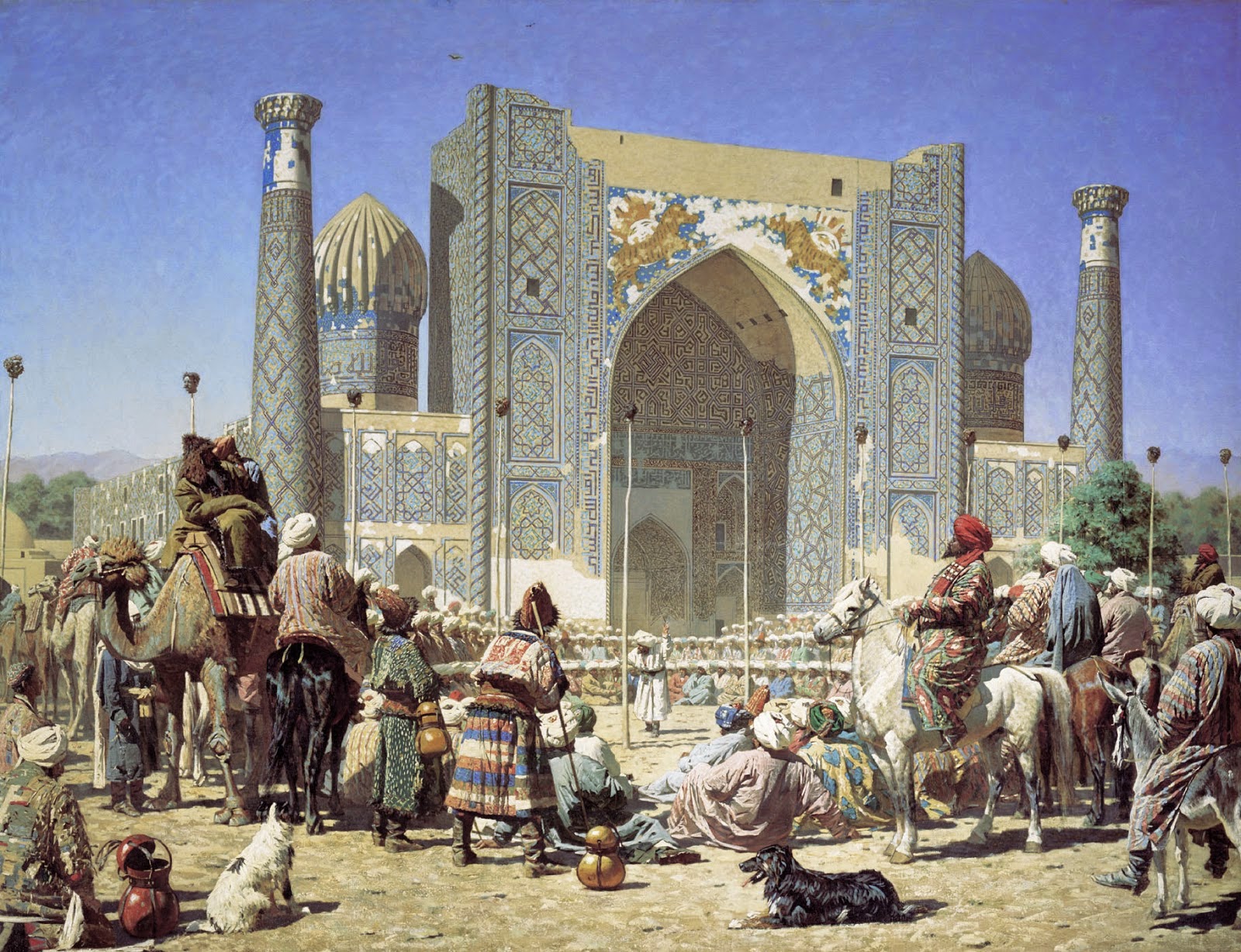
The extraordinary painting above, entitled The Apotheosis of War, is by the Russian painter Vasily Vereshchagin. Although he was one of the first Russian painters to win notoriety outside his homeland, many of his works were too graphic and controversial to ever be displayed or exhibited. His subject matter was often war, and rather than indulge in patriot glorification he tended to depict it with horrific realism. This sometimes won him enemies in the Russian political and military establishment. He was regarded as a controversial figure; he showed warfare for what it was and his paintings were often banned. He dedicated Apotheosis of War "to all conquerors, past, present and to come."He is another instance of an artist who defies the modernist myth that the academic painters and orientalists of the 19th C. served but never challenged the status quo. Here, below, is another of his works on the theme of war, this one called After Battle. 


As a witness to Russian military adventures in Central Asia and the Far East he travelled widely and painted many orientalist themes. In 1874 he undertook an extensive tour of Tibet and India. He counts as a major Russian orientalist painter. He painted the usual sights, such as the Taj Mahal, below, an undistinguished rendering:


But also more lively, interesting and engaging architectural studies, such as this painting of a mosque:


Or this picture of Darjeeling:


Or this picture of a Shinto shrine:


The present author prefers some of his pictures of the various peoples and types he met on his travels. Consider, for instance, this picture of an Indian fakir, below:


His travels in Palestine moved him to paint scenes from the New Testament, but this brought him into further controversy. It was felt that his depictions of Jesus were too "semitic". 

Today he has the rare distinction of having a planetoid named after him, Vereshchagin, discovered by Russian astronomers in 1978. 

Yours,

Harper McAlpine Black


Albert Eugene De Puyou - Eye of the Day


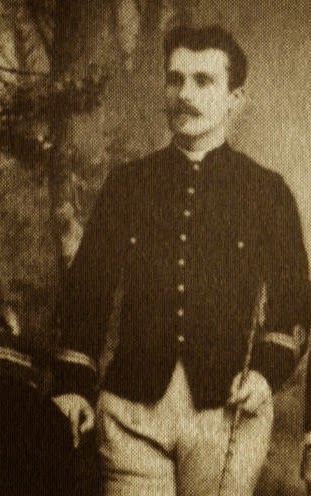
It is safe to say that few people in that benighted realm the Anglosphere have ever heard of Albert Eugene De Puyou, Count of Pouvourville. In the French speaking world there are perhaps a few more, yet today he is an obscure figure. Born in 1862 into a family with an illustrious military tradition, he joined the French foreign legion and journeyed to French Indo-China where he remained most of his life. He was, in his time, one of the great French orientalists - in the best sense of the word - and was instrumental in introducing oriental spiritual traditions and customs, especially Taoism, into Europe. His military career with distinguished, and after that he took numerous administrative positions. His real interests, however, were not in advancing French interests in Viet Nam or southern China, but in oriental esoterica. He lived for decades in Tonkin (northern Viet Nam), learnt Chinese and Vietnamese, and immersed himself in the traditions of those lands. When he returned to France he published numerous studies under the name Matgioi - "eye of the day". His most accomplished works concerned the metaphysics of Taoism with which he - in contrast to the academic orientalists of his time - had a deep and first hand acquaintance. He was an associate of the great French metaphysician Rene Guenon. 

His acquaintance with Taoism was, in fact, an initiated one. While serving in the First Regiment of the Foreign Legion where he attained the rank of lieutenant and was noted for several heroic deeds, he met a man named Tong Song Luat who initiated him into a semi-secret society and taught him the inner doctrines of Taoism. For a European of his time, and perhaps since, his knowledge of Taoism was unsurpassed. He wrote attacks upon academic and theosophical pretenders and spoke with authority upon the true teachings of the Tao and Taoist alchemy. His principle work was La Voie Métaphysique, 1905. He was a regular contributor to Guenon's journal Gnosis. 

Regrettably, little or nothing of the works of Matgioi are available in English. Here, though, is a link to a PDF of his main work in his native French, an important work on oriental metaphysics contrasted with those of the West. It includes a profound account of the I Ching and the symbolism of its hexagrams:


His other claim to fame was his lifelong addiction to opium. He would take to the opium pipe every day. Here is a poem he wrote on the subject, translated into English by R.E.André III.

Opium

Mild regret of the morning, sweet smile of the evening,
Indifferent to praise and scorner of blame,
Gilded opium, silent counselor, nurturer
Of all of the refined pleasures that we each loved,

Director of knowledge, power, will,
Creature of concepts, fire-starter,
Older brother of sleep, father of nonchalance,
Ruler of sense, poison of hearts, sustainer of souls,

Comfort of the dreamer, hope of the continent,
Luller of cares, golden mouth of legends,
Stimulator of the fingers, titillator of glands,
Invisible emperor of hallucinatory dream,

Wine of the contrite brain and bread of the starved soul,
Black companion, secret kiss, immanent master
Come, my friend, come, my mistress, come, smoke.

[Translation from French by R.E.André III]


L’Opium

Doux regret du matin, doux sourire du soir,
Indifférent du los et mépriseur des blâmes,
Opium doré, muet conseiller, amorçoir
De tous le raffinés plaisirs que nous aimâmes,

Directeur du savoir, du pouvoir, du vouloir,
Créature de concepts, générateur de flammes,
Frère ainé du sommeil, père du nonchaloir,
Règle des sens, poison des cœurs, soutien des âmes,

Réconfort du songeur, espoir du continent,
Endormeur des soucis, bouche d’or des légendes,
Excitateur des doigts, titillateur des glandes,
Invisible empereur du rêve hallucinant,

Vin du cerveau contrit, pain de l’âme affamée,
Noir compagnon, baiser secret, maître immanent,
Viens, mon ami ; viens, ma maîtresse ; viens, fumée.

MATGIOI (Albert de Pouvourville) 'Rimes Chinoises', 1904.

Yours,

Harper McAlpine Black


Saturday, 14 March 2015

The Travels of Harper McAlpine Black


The above map - readers will excuse the indulgence of old cartography - gives a rough indication of the journeys of the current author over the last thirty or so years. Admittedly, not all of these journeys have been physical - some have been intellectual or even spiritual - but there have, nevertheless, been whole continents and worlds traversed. His travels have been, by and large, eastwards, beginning in the United Kingdom and Europe and ending, most recently, in Japan.

Some places, people and interests along the way, more or less in their chronological sequence, one thing leading on to another:

*Anglicanism and Celtic Christianity
*Stonehenge and Pre-Christian British Isles
*Isle of Mann - Anglo-Saxon Paganism
*Zurich - Jung
*W.B. Yeats - A Vision
*London - The Golden Dawn and ceremonial magic
*Paris - MacGregor Mathers
*Freemasonry
*Theosophy
*Dornach - Rudolf Steiner and Anthroposophy
*Gnostic Christianity
*Jerusalem - Hebrew Kabbalah
*Athens - Plato
*Istanbul - Turkish Islaam
*Konya - Mevlevi Soofism
*Dawoodia Soofism
*Cairo - Rene Guenon and Perennialism
*Tehran - Corbin and the Mundus Imaginalis
*Lahore - Shia Islaam and Illuminationism
*Lucknow
*Delhi - Sankara and Advaita vedanta
*Hyderabad
*Mircea Eliade - Alchemy
*Singapore - Complete Reality Taoism
*Kyoto - Zen Buddhism

Many of these topics are covered or reflected in these pages. The above map provides at least some measure of coherence to an otherwise eclectic assortment of interests. 

Yours,

Harper McAlpine Black

Chang the Chinese Giant

Below, some photographs from the author's collection of pictures of old China (or old pictures of China, if you prefer) - pictures of Chang the Chinese Giant, once a very famous name. 


Chang the Chinese Giant, 1870. 

His stage name was Chang Woo Gow. His real name was Zhan Shichai. Son of a Confucian scholar. He toured the world, including Australia, earned a good salary of over $500 US a month, received a good education and learnt ten languages. He married a woman named Catherine Santley whom he met in Sydney. When he died his coffin was 8 feet 6 inches long.


Here he is, quite young, with a stage midget named Chung Mow (less than 3 feet tall). The picture is from the Glasgow Herald, 1865, reprinted in a work entitled The Adventures of a Travelling Musician in Australia, China & Japan, by Marquis Chisholm. 

Finally, here is Chang in European clothes - this picture from the National Portrait Gallery in Canberra. 


Yours,

Harper McAlpine Black


Friday, 16 January 2015

I Ching Probabilities

Nature does not hurry, yet everything is accomplished. - Lao Tze

Life moves in circles; sometimes big ones. Over thirty years ago I sat down with a copy of the Richard Whilhelm translation of the Chinese Book of Changes, the I Ching, and I did myself some maths. Unique among the sacred books of the world, the I Ching is profoundly mathematical. It consists of a set of 64 hexagrams generated from a binary system of broken and unbroken lines, yin and yang. It has been a source of endless fascination for many people including Leibniz who, it is said, used it as a source of inspiration in his pioneering mathematical studies. It can be used as a book of divination, and is commonly consulted using a set of three Chinese coins. Thus:


More traditionally, it is consulted using a complex ritual manipulating a set of fifty yarrow stalks, thus:


The coin method is a relatively modern innovation. The yarrow stalk ritual can take over half an hour. The coins streamline this to a few minutes. It satisfies the modern need for instant gratification. But is it the same thing? That was the question with which I was concerned. I did endless hours of investigation into this question back then. I was not primarily interested in the Book of Changes as a vehicle of divination or fortune-telling. It was a mathematical conundrum.

Consequently, in more recent times, I was very fortunate to teach the I Ching to undergraduates as a module in a unit on sacred texts in a Religious Studies course. This kept me up to speed with the great Chinese classic, or at least it meant I had to revisit it every second semester and explain its history and complexities to young minds. It has therefore never been very far away from me and I remain quite fascinated by it. It is certainly one of the oldest sacred texts in the world, one of the most mysterious and yet one of the most enduring. 

Just recently - a few days ago - I found some of my notes on the I Ching from over 30 years ago. Some of them are now incomprehensible, as you might expect, but amidst my ramblings there was at least one  pearl: my mathematical calculations of the probabilities of coins versus yarrow stalks. Readers really need to have some familiarity with how the Book of Changes is consulted in order to appreciate this, but I think I should set out my figures here and share them with others, just for the sake of it. It is not earth-shattering by any means, but there are, I think, many ramifications for those who dabble with the Ching. 

The coins, you see, have exactly even probabilities. You toss three coins in the air and there are even chances of them falling in any one of several combinations: three heads, three tails, two head/one tail, two tails/one head. Three heads is no more likely than three tails, and so on. Consulting the I Ching, three heads yields a solid (unbroken) line and three tails a broken line. One is yang and one is yin. This is how the oracle is consulted. You toss the coins six times to give you six lines = one of the 64 hexagrams. Then you look up the result in the book. Here are the sixty-four combinations of six lines.


The stalks, however, are another story. The fifty yarrow stalks are divided according to a quite complex ritual pattern that is, by all accounts, very ancient. What are the probabilities involved? I worked it out. The possibilities are not even, as with the coins. Not at all. On the contrary, the probabilities are as follows:

Unbroken line (Unchanging yang) = 5/16ths. 
Broken line (unchanging yin) = 7/16ths
Unbroken line (yang changing) = 3/16ths
Broken line (yin changing) = 1/16th

To put this into the terminology of the coins:

Two heads/one tail = 5/16ths. 
Two tails/one head = 7/16ths
Three heads = 3/16ths
Three tails = 1/16th

That is, using the stalks, there is only a one in sixteen chance of three tails but a three in sixteen chance of three heads. As I say, the coins give exactly even probabilities. Not so the stalks. With the coins you have even chances of throwing three heads or three tails. But the stalks yield a very different set of probabilities. This means that the two methods are not interchangeable. If you use the coins to consult the oracle you will get quite different results than if you use the stalks. If you use the stalks then the extreme yin line (three tails) - or "changing yin" as it is called - is the least likely result of all. The most likely result is the unchanging yin line - seven times out of every sixteen. 

I hope this is clear. Probably not. Or not unless you are familiar with the Book of Changes. But it is worth putting in writing and posting all the same. 

What might it mean in practice? Try this:

Take sixteen pieces of paper, tiles, whatever.
On five of them write "Unchanging yang"
On seven of them write "Unchanging yin"
On three of them write "Changing yang"
On one of them write "Changing Yin"
Now put them all in a hat and draw out six of them one at a time. 

That will give you a hexagram of the same probabilities as the yarrow stalks. The modern coin method is a bastardisation and will not give you accurate results. Better still, learn the yarrow stalk ritual. It is, after all, a meditation.

I'm sure this has all been noted before. The Book of Changes is some 3000+ years old and has been studied in meticulous detail. Modern people, though, are terribly lazy. Thus they use the coin method. A simple study of probabilities reveals that the coin method is defective.

The maths, by the way, is the same maths as the so-called "Knight's tour" in chess, the chess board having sixty-four squares.

Using the Yarrow Stalks


Yours,

Harper McAlpine Black 


Saturday, 25 October 2014

What does a moderate Muslim look like?


What would a moderate Muslim look like?

A moderate Muslim:

*Retains the narrative of one God and multiple prophets but regards most of the rest of contemporary  Islam as abhorent claptrap.

*Reads the Quran in its historical context and understands its claim to be Divine Speech not literally but as ‘Logos’ through an intelligent metaphysics.

*Does not detect even the slightest reference to modern technology in the Quran.

*Has an agnostic view of the life of the Prophet (Sira).

*Is sceptical of the entire Hadith literature and especially of ridiculous claims made for the veracity of al-Bukhari.

*Has a healthy contempt for religious scholars.

*Regards the entire Wahhabi sect as a noxious poison.

*Regards the building programs undertaken by the Saudis in Mecca and the Holy Places as damnable desecrations and a blasphemous destruction of the Islamic heritage.

*Thinks that the Sharia is a barbaric concoction of desert desperadoes in the late Dark Ages.

*Does not have an infantile desire to ape every item of trivia from fictional medieval accounts of the Prophet’s personal life.

*Admits that the expulsion of philosophy and rational methods of analysis from Islamic intellectual life in the late Middle Ages was a catastrophe.

*Thinks that the history of the four schools of Sunni law in which reasoning by analogy plays less and less a role is nothing less than a long slow lobotomy.

*Appreciates the Sufi traditions as the core of Islam transcending the limitations of the religion’s ossified outer forms.

*Demands that the doors of Ijtihad be opened.

*Loves the richness of the Islamic cultural tradition and sees the best of Islam in the Islamic Arts and Humanities.

*Does not believe that unthinking piety will restore Islam to its days of glory.

*Has separated religion from terriory and no longer thinks in terms of “Dar as Salam’ and the nexus between Islam and land.

*Rejects restorationism as a way forward for contemporary Islam.

*Shuns the post-colonial leftist conspiracy theory view of the world that attributes the derelect state of the entire Islamic world to the Americans.

*Never uses the moronic word "Islamophobia". 

*Doesn’t indulge in self-pitying victim narratives.

*Gave up on the Palestinians years ago.

*Thinks that the oft-quoted hadith about the best of ummahs is nothing less than risible.

*Thinks that halal food certification is an extortion racket.

*Wears tasteful contemporary clothing rather than dressing like a 6th C. camel driver. 

That, at least, is a good start towards a moderate Muslim. 

- Harper McAlpine Black

Wednesday, 15 October 2014

Jules Guerin's Egypt

One of the most sublime realisations of orientalist Egypt is found in the illustrations of American artist Jules Vallee Guerin in the book Egypt & Its Monuments text by Robert Hitchens. Guerin was best known as a muralist and architectural illustrator based in Chicago, but he travelled the Near East with Hitchens between 1909 and 1911. See a selection of his Egyptian illustrations below.

I have had the opportunity to peruse an original copy of this book. The text is undistinguished, but the illustrations by Guerin are wonderful. He captures the epic timelessness of Egypt.

Guerin learned his art by painting theatre backdrops. He was a major American muralist - his works include a mural in the Lincoln Memorial.


Yours,

Harper McAlpine Black

Sunday, 12 October 2014

The Triumph of Nominalism


A convergence of articles and ideas that came to my attention last week together convinced me that what we are witnessing in the mushy world of contemporary liberalism is nothing less than the triumph of nominalism. This - nominalism - is the antithesis of Platonic realism and states that there are no "realities", per se, and hence no "nature" but merely names or labels that we habitually dress up as realities or natures, usually for the purposes of obtaining or exercising power. The nominalist/realist debate was all the rage in the Middle Ages. Since then, the realist position has been in decline and the nominalists have gone from strength to strength. To explain: nominalists claim that God has no attributes. The attributes we claim for God are merely labels that we hang on Him for our own purposes. This has huge implications. Finally, it means that there is no such thing as human nature either, and, more directly, there are no such things as fixed identities. Whatever identities we claim for ourselves are not intrinsic but are merely conventions (names).

Here is an interesting example. Professional stirrer Andrew Bolt - Australian conservative commentator - was taken to court, and lost, when he wrote against certain Australians who claimed to be indigenous (aborigines). They were, in fact, whiter than white to all appearances, but they claimed that on the basis of a 1/100th ancestral lineage they were aborigines and therefore entitled to various government support schemes to assist aborigines. Bolt claimed they had no right to claim to be aborigines and were in fact rorting the system. The court, however, ruled that the white guys in question did have a legitimate claim to aboriginality and, moreover, had no choice in the matter - they had been born into aboriginality, regardless of how Anglo-saxon they may appear to the eye.

You see, this is a debate about identities. What are realities and what are merely labels? Are these people *really* aborigines or have they merely adopted that label?

Last week, I read an account of this case that put it in a different perspective. Against the judge, and against Bolt, a liberal academic argued that - as he put it - the "bedrock of contemporary ethics" is that all identities are matters of personal choice. He agreed that Bolt was out of line, but he also disagreed that the "victims" had no choice in their aboriginality. The judge said they were born that way, but this academic argued that the bedrock of contemporary ethics is that no one is prisoner to how they were born. Identity is a matter of choice. And it is always so. As he wrote, a person might identify as something a thousand times, but they must always be free to change their mind and call themselves something else. This is the essence of "freedom". Thus, the "victims" in the Bolt case should always be free to deny aboriginality, and the judge, no less than Bolt, had denied them their freedom. Again: identity is a matter of choice. It is never a matter of birth.

Thus, for example, gender - in so-called "contemporary ethics"- is a matter of choice and not a reality. You and I might think that being a man or a woman is a matter determined by birth, but not so. It is merely a choice we make. Thus the realism/nominalism divide. Gender is not a reality, it is merely a label, a name. And no matter how many times I identify as a man, I remain free to change my label and identify as a woman. This is the philosophical basis of transgenderism. It is a form of nominalism. It denies there is any such thing as human nature. A free being is free to make of itself what it will. It is the whole basis of contemporary liberalism. Liberals hate and despise any category that supposedly traps someone into the circumstances of their birth. Freedom, by definition, belongs to the self-creating, self-determining being.

It is an ideal philosophy for a consumerist/industrial society. It espouses mobility as an inherent good. Platonic realism supposes that we have a distinct, intrinsic nature and that the richness of life consists in developing that nature to its fullest potential. It supposes, for example, that some people are born to be carpenters, and they find fulfilment through being carpenters. Liberals find this idea repugnant. Instead, liberals champion as heroes those individuals who, though born into a family of carpenters, defy their parents and their heritage in order to become ballet dancers instead. Or, better still, who decide not to be anything, but are carpenters one day, ballet dancers another, and dabble in a bit of plumbing as well, as their mood takes them. They have no fixed identity. This suits industrial labour markets perfectly, whereas the Platonic idea that we have inherent vocations is utterly medieval. Similarly, free agents who can call themselves and be whatever they like whenever they like are the best sort of consumers. Old fashioned realists are not easily convinced to take up new fads and new identities at the whims of advertising.

At the core of the nominalist outlook, then, is the abstract individual just as the core of nominalist theology is the abstract God. In nominalism, God has no attributes, and therefore, neither do I. This sense of "I" is perfectly empty.

At this point, it all starts to smell a bit like Buddhism, doesn't it? And you'd be right to suppose so, for Buddhism is precisely a hyper-nominalist approach to religion. The Supreme Reality is not a reality at all, but merely an empty convention. The thing that we hang identities upon is, in fact, a Void. It has no attributes whatsoever. We can only say what it is not.

Applied to sociology, though, it leads to odd conclusions. So, apparently, I can call myself an aboriginal if I so choose, and apply for government support schemes on that basis. It doesn't matter if I don't look like an aborigine, or even if I have a single drop of aboriginal blood - if I say I'm an aborigine then I bloody-well am, and if you say otherwise you are oppressing me. It gets very Monty Python. You'll remember the sketch where Stan wants to be called Loretta. He wants to be a woman and he wants to have babies. John Cleese objects on the basis that "He hasn't got a womb. Where are they going to gestate? Are you gonna keep them in a cardboard box?" To which Stan says: "Don't you oppress me." They agree in the end to support Stan's struggle to have babies, which Cleese characterizes as Stan's struggle against reality. Note the word "reality". Cleese, in this sketch, thinks there is a reality to which we must conform. The others, however, see this reality (namely Stan's lack of a womb) as an obstacle to be overcome. We fulfil ourselves by overcoming the obstacles of reality.

The Monty Python sketch goes back a way now. Today, the Cleese view is politically incorrect, or worse. Indeed, transgenderism is the new cause-of-the-day. It soon becomes illegal to label children boys or girls. This is to deny them the choice of free abstract individuals. Gender is not a reality but a label - devised purely for nefarious reasons of power and privilege - and to impose gender upon children is to do violence to them. This world-view is well advanced in ultra-liberal societies such as the Scandanavian democracies, but it has taken root throughout the Western world.

It is even rearing its head in the Vatican. The latest stir there is the philosophy of a certain Cardinal Kasper, hence Kasperism. The Kasperists hope to apply a nominalist theology to the question of divorce. At present, divorcees are very often denied the Eucharist in Catholicism because their subsequent marriages are officially deemed improper and therefore sinful. The contemporary Church wants to get around this impasse and to open the Church to this expanding demographic. Kasper proposes doing in this way: he deems the married state to be a mere label that is not, in fact, a reality. It is just a name. The only reality is phenomenonlogical; that is, the subjective experience of the individual concerned. It doesn't matter how often the Church says I am still married to my first wife, the fact is that emotionally and otherwise I have moved on and so has she. That marriage only exists on paper. It is not a reality. The reality is what I identity as my reality, namely my new marriage and my new post-divorce life. Nominalism. Kasperism is nominalism by another name.

So we see nominalism advancing at every turn. Some people want to take it as far nationalities. These are the multiculturalists and open-border advocates. Just because you were born in Vietnam should not lock you into being Vietnamese. Why shouldn't you just decide to become a Canadian instead? Open-border advocates resent the restrictions imposed by birth. Why shouldn't gypsy Romanians migrate en masse to southern England, or west Africans make their way to Italy by boat? Why should someone be geographically constrained by where they were born? Why not open the borders - dissolve the borders - and make the whole thing open slather? If I want to live in China, I go and live in China. The existing restrictions of nation states are artificial constructs posing as realities purely in order to keep some people rich and others poor. So the argument goes. The only fair system is the melting pot. Be whatever you want, wherever you want. That's freedom.

Conservatives, as I say, subscribe to the opposite view, namely that there are realities and that nominalist ideas of freedom are spurious and finally reduce human beings to undifferentiated sludge. Instead, by birth and circumstance, we are given certain resources which are realities and we find fulfilment through actualizing them, not through denying them. Rather than seeing my gender as a curse or a straight-jacket imposed by odious oppressors, I can see it as a beautiful thing, a gift, and take delight in it and strive to make the best of it. Thus too my racial and ethnic identity. Instead of spending my life cringing and apologizing for being a white guy, I can accept the reality of my genetics and ancestry and be proud of it and find fulfilment through it, as far as it might be relevant to fulfilment. I can lead a rich life enjoying being an Australian rather than pretending to be an Arab.

These are the markers of this endless debate. The nominalists are winning, no doubt. The drift of our times is towards a triumphant nominalism. I would point out, though, that the debate is intractable and there will be reactions.

Finally, in my view, it is a corrosive debate built upon a false dichotomy. Surely, both points of view are true, and it remains to be debated as to where we draw the distinctions. The nominalist/realist divide tends to be all-or-nothing. It is really a matter of both. I remember discussing this with my friend, the late Lithuanian scholar Algis Uzdavinys, who pointed out to me that the nominalist/realist issue is treated by Plotinus as a continuum, a sliding scale, and not as an either-or duality. Indeed. That is how I see it. I think the pinkos are nuts. They can't grasp realities because their brains are made of spineless jello. Of course you can't call yourself an African American just because you feel like it! There has to be some basis to the claim - a basis in reality.

On the other hand, there are those (the so-called far right) who over-state the claim. Not content to be white guys - as born - they want to suppose that being white is better than being anything else (i.e. white supremacy). They claim inherent attributes of superiority just as they suppose that non-whites are inferior and no amount of education or welfare will lift them out of their inherently subordinate state. That type of philosophical realism, as we know, ends in Nazism and monstrous consequences.

As with other issues, therefore, the truth lies between two exaggerations, both of them evil. As social creatures we are always in a process of negotiating positions between these two extremes. This is true of the Catholic Church too, if it comes to that. It is a forum for these big debates that swing one way and then another. At present, under Pope Francis, a liberal nominalism is asserting itself. It is surely true that defunct marriages are defunct and that the new lives of divorcees are real - but at the same time surely a marriage has to make claims upon people if it is to be a serious thing and not just an empty convention that people can trash and walk away from at a whim? Regardless of what the "bedrock of contemporary ethics" might be, surely the fact you don't have a womb is a relevant reality pertaining to your desire to give birth to children, isn't it? And surely you can't just call yourself an aborigine in order to get preferential accommodation at a University campus or a $3000 higher education bonus, can you?

- Harper McAlpine Black

Friday, 1 August 2014

Raja Ravi Varma - Indian painter

Orientalism was not a one way street. Typically, we think of it as a situation where European artists depicted oriental subjects. Some of the more interesting cases, however, are where oriental artists adopted European conventions and practices and joined the fun. This again undercuts the simplistic (Saidean) characterization of orientalist art as exploitative. The fact is, rather, that many artists in the colonial era admired and aspired to European standards. One particularly stunning example of this is the great Indian artist Raja Ravi Varma (1848-1906). Here we have an Indian artist living under the British Raj who admired and then acquired the skills of European (orientalist) painting and then applied those skills to subjects from Indian (Hindu) mythology.

 Ravi Varma's works have now become the classical depictions of Hindu mythology in modern times. They are copied and reproduced and you will find them not only in books but in many Indian homes. They have had a profound impact upon the Indian imagination - when Hindus think of scenes from their mythology do tend to do so through the filter of Ravi Varma's idealised depictions. Here below are some examples of his work, including perhaps his most famous and copied work 'Dhamayanthi and the Swan'.


The Sandhurst Coffee Palace - some local history

This article has been hoisted from another of my ill-fated blogs. As I discontinue that blog, bits I deem worth saving will migrate here. This is one such bit. 


The picture above shows the Sandhurst Coffee Palace, Bendigo, 1890s. You might suspect that the coffee was fairly ordinary in those days; it is hard to imagine that you'd get a decent coffee in a dusty goldmining town in far away southern Australia. But you'd be wrong.

Local coffee production began in Australia in the northern parts of Queensland in the 1880s. Australian soils produced a good flavoured coffee bean with distinct caramel qualities. The venture was so successful that Australian grown coffee won awards in Europe in the late 1880s. The industry prospered and supplied high quality beans to food stores throughout Australia until the coffee growing region was hit by a tsunami in the early 1900s. By then there was a lack of labour needed to rebuild and coffee growing - and coffee drinking - went into decline in Australia.

But our photograph is from 1890s, before the death of the industry. And it is in Bendigo, then one of the wealthiest cities in the country. We can therefore assume that the coffee served at this illustrious establishment was probably quite good. The usual practice was to roast and grind beans on the premises. These would have been Queensland-grown beans which were world-class.

We tend to think that coffee drinking is a relatively new trend in Australia. In the post-war period, certainly, tea-drinking was the norm in working class and middle class Australia. There was instant coffee, but more sophisticated versions of the beverage were associated with Italians and other post-war migrants ("wogs"). Coffee drinking and a coffee culture has only emerged from the 1980s onwards, that is in the last few decades. But actually, there was a thirty year period, from about 1880 to 1910, when coffee drinking (with good beans) was popular in Australia. Our photograph is evidence of it. The Sandhurst Coffee Palace is as big as a hotel. It is a picture of coffee drinking on a grand scale. It is not a shop, not a cafe, it's a "palace"!

How was the coffee prepared? Microfoaming wasn't developed until the second half of the twentieth century, so any frothing, either of coffee (for creme) or of milk would have been done by hand whisks or by drawing air between cups, a method you can still see being done in India and other ploaces today. Sugar was plentiful in Australia, also being grown in Queensland, so we can gather that coffee was drunk with sugar to taste. Or perhaps it was only consumed black? It is hard to establish what modes of coffee were available to the paying customer. The large number of Germans in Bendigo, suggests that the Viennese ways of enjoying coffee were probably preferred.

Another point to note: Coffee drinking in this period was a distinctly "Orientalist" activity. Coffee drinking was first developed in the Islamic world, initially among the Sufi brotherhoods. In the 1890s, the time of our photograph, Europeans had a sympathetic fascination with the "Orient". We can see this in the art produced and collected at this time which is still on display in the Bendigo Art Gallery; orientalist paintings. At this time, coffee drinking would have been a part of that aesthetic.

In the second wave of coffee drinking - the contemporary wave - coffee has been associated with "multiculturalism" and post-war immigration Australia, not with the "orientalism" of the British Empire. This is the important difference between the two waves. To schematize it, there are several styles or schools of coffee drinking. There are oriental styles (like Turkish coffee) and then there are the European appropriations, specifically through Vienna and through Italy (Venice). Coffee in Australia today is predominantly of the Italian school. If you train as a barista, it is Italian coffee making you learn. The cappuccino, espresso, machiato – these are all italian. In the 1890s, though, the oriental styles and the Viennese appropriations would have been in vogue. Or so we can surmise.

The Sandurst Coffee Palace is long gone. Australia and the world at large have changed. Thankfully, though, Sandhurst is now Bendigo and Bendigo is once more a place where enthusiasts and aficionados can again enjoy a decent cup of coffee, the so-called “wine of Islam”, the world’s most popular drug.

Sunday, 6 April 2014

Presidential paintings


Who can say that this portrait of Mr Putin is not without insight? Look at that right eye. 

Over the last week it has emerged that former US President, George W. Bush has been dabbling in portrait painting. Samples of his work have been appearing on news services, generally being treated as a novelty story. Left-wing news services and their seemingly endless parade of professional "commentators" and "experts" have been trying to make mileage from it, with article after article condemning his work as unsophisticated and banal. For the Left, of course, Bush is an object of enduring hatred and ridicule - how easy then to tip buckets of bile upon his admittedly amateur art work. As if pre-programmed, social media chimed in too, with streams of vicious abuse, mockery and derision punctuating the usual treadmill of Save-the-World "memes" and pictures of cats. 

Once more I find myself out of phase. Not because I am in any way of fan of Mr Bush - I'm not. And not because I am or ever was a supporter of the Iraq war or any other policy or action of the United States during his presidency. As a matter of fact, I regard the invasion of Iraq as a crime and the conduct of the war that followed an even greater crime. But, to be perfectly objective about it, I don't mind the paintings. I disagree with the Leftist reviews I have read which describe them as inept, childish, lacking in insight or just plain embarrassing. Such reviews, I feel, have taken the paintings as an excuse to take cheap shots at an unpopular President. There's the usual smug self-righteousness and elitism that is so characteristic of leftist intellectuals, but there is very little real engagement with the paintings themselves. Nearly all critics I've read have not been able to distance themselves from their feelings about the painter. In a case like this, though, that is the first thing any critic or reviewer must do. 


They are not great paintings, but frankly, they are not bad, and they are considerably better than I would have guessed. Mr Bush reports that he has only been painting for two years. "Yes, it shows!" one critic ranted. I am less unkind. I think that for someone who has been painting for such a short period of time, and taking up a brush late in life, they show considerable talent. I sometimes venture down to the local Easter Art show, or a YMCA painting exhibition, and by any measure the paintings of Mr Bush are better than most amateur efforts. They are not without insight, or humour, and his self-portraits in the bathtub reveal a streak of self-mockery that I find endearing and refreshing. He is not a man who takes himself too seriously. His detractors will say he is an imbecile, but the naivety in his paintings is genuine. He is not pretentious. (Compare this to 99% of contemporary art!) 

I, at least, am quite capable of appreciating these paintings independent of my views about the Bush presidency, and I think they are not without virtue. I do not feel any compulsion to be snide and bitter and cheap about them, anyway. Some of them are quite interesting. I like their flatness and - to use a word that Bush himself used in reference to them - their "joy". What makes them interesting is a type of celebratory innocence, devoid of any attempt to psychologize the subject. He's obviously not a deep man, Mr Bush; he quietly celebrates ordinariness and the way the ordinary man refrains from being judgmental. This homely lack of pretentiousness is probably the quality that accounts most for his electoral popularity amongst Americans. These are not intellectual paintings, that is to say, but nor are they anti-intellectual. They are just what they are - an ordinary vision free of cant. The idea of painting a series of portraits of the world leaders he encountered while President is quite legitimate, an unaffected inspiration. 

* * * 

Some news reports feel it necessary to compare Mr Bush with that other notable leader/artist Winston Churchill. In one particularly spiteful, paranoid and idiotic article the writer suggested that both men had deliberately turned to painting as a way of "softening" their evil image, as if painting was something they took up on recommendation from the Ministry of Propaganda, rather than being just an innocent pastime. I don't find it a revealing comparison, but while we're at it, let me say that Churchill was, in fact, a very good painter, a serious painter. Bush will never be that, but he is not, at least, awful. Here below are two paintings by Churchill. See! He was a very good painter, a worthy member of an English (orientalist) tradition. Mr Bush's paintings are not nearly as accomplished, but they are not deserving of the scorn and contempt that has been heaped upon them. The inability of "progressive" commentators to put aside their loathing for the ex-President and to consider the paintings as paintings (albeit amateur paintings) is really quite juvenile but not unexpected. Hatred is a stain. The real objection from most Leftist commentators has been that these paintings might help humanize Mr Bush after the Left have spent so long and worked so hard demonizing him. Well, that's just the nature of art.