Showing posts with label Crowley. Show all posts

Thursday, 2 June 2016

Three Painters: Evola, Crowley, Schuon

There are serious painters – artists – and then there are dabblers, those who paint as an aside to their major occupation, and it is often the dabblers who are more interesting than the bona fide artists. A previous posting to these pages (see here) concerned the watercolours of three notable amateurs, Prince Charles, Winston Churchill and Chancellor Herr Hitler. The present posting follows much the same format, but we will be contrasting the paintings of three purported spiritual luminaries: Baron Julius Evola, hero of Right-wing perennialism, Frithjof Schuon, touted by his followers as the ‘Messenger of the Religio Perennis’, and the English occultist Aleister Crowley, the self-declared ‘Master Therion’, Prophet of the Aeon of Horus. All three of these characters - men of spiritual pretensions - took to the canvas at certain junctures in their lives, and as well as the writings for which they are better known left behind a legacy of visual art. Largely, such works are of concern only to devotees, but all three conducted official exhibitions during their lifetime and in all three cases their work continues to be exhibited and can command healthy prices whenever they go to market. They are assuredly very different thinkers, and accordingly very different artists, as we shall see:


* * *


BARON JULIUS EVOLA

In his misspent youth, before he had discovered the writings of Rene Guenon and realized his vocation as a spokesman for political perennialism, Baron Evola dabbled in Dada. In fact, he was a major force in bringing the Dada avante guard to Italy in the 1920s. He exhibited in Rome and caused a stir with his brash radicalism. His paintings, however, now appear to be quite ordinary examples of Dadist abstraction, though here and there we find hints of symbols and motifs that foreshadow the esoteric interests to which the Baron later devoted himself with distinction. 


In truth, though, many of his paintings are beneath ordinary and fall into the category of horrible. It is only die-hard Evola enthusiasts who find much in them that is redeeming. The present author, in any case, only likes one or two – indicated below – even though he is a reader of Evola’s writings and has a high regard for them. Indeed, Baron Evola’s books and essays become more prescient and relevant every day; they are worthy of every attention. But the paintings? No. And the Baron recognized this himself and, to his credit, later dismissed Dada as decadence. His paintings, unfortunately, are ill-matched to his written ouevre. He dabbled in poetry as well - equally undistinguished. 


Senza titolo 1921


Composition No. 3.


Paesaggio interiore

For whatever reason, this is the Evola painting that takes the present author's fancy. Colour, composition, intensity. It is not entirely successful, but it is, all the same, almost musical. 


Nudo di donna (afroditica) - a painting with no redeeming qualities at all!


La libra s’infiamma e le piramidi


In this work we see the appearance of the alchemical symbol for sulphur. The painting itself has no great qualities. It is a completely undistinguished attempt at Dada abstraction. But it was in this period that Baron Evola began delving into esoteric symbolism. Thankfully, he turned away from painting and embraced esotericism instead. 


A Bunch of Flowers, 1918. There is, perhaps, something to be said for this composition. Lyricism, like Kandinsky. 


Paesaggio interire, aperture del diaframma 
(“Interior landscape, the opening of the diaphragm”


“Piccola tavola (vista superiore)” (“Small table (upper surface)”) 1920


Dadist composition (1920s)

There is perhaps something to be said for this composition as well. 


Portrait cubiste de femme, 1919-20


This is a genuinely horrid painting. Many of Evola's paintings are bland or contrived but some, such as this, are manifestly ugly. 


Abstraction


The Generator of the Universe. (What can one say about this? It is hard to believe that any follower of Rene Guenon could ever have painted such a thing!)

* * * 

ALEISTER CROWLEY

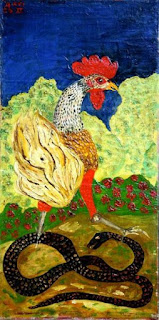
Numerous posts to these pages feature or make mention of Mr Crowley, often in unflattering terms. The present author is clearly not a Thelemite (follower of Crowley’s ‘Law of Thelema’) and in fact has a suitable disdain for every effort Mr Crowley made to concoct a religion around himself. His so-called ‘Book of the Law’ is bunk and his creed of ‘Do what thou wilt’ is libertarian nonsense dressed up as ancient Egyptian profundity. Moreover, Crowley – diametrically contrary to his own inflated regard for himself - must rate as one of the worst poets in the English language. W. B. Yeats – one of the best – once quipped that Crowley had managed to write maybe three or four lines of decent verse. This is to be generous. Although, he was a very fine – and always entertaining – prose writer and his edifice of occultism can be seen as a remarkable creative endeavour in toto. He also turned his hand to painting, adopting a sort of expressionist style. Examples can be seen below. And, in fact, they are rather good. Of recent times they have attracted the attention of the art cognoscenti, and rightly so for they are quirky, mysterious, potent, raw, amongst other qualities. They illustrate the strength and power of Mr Crowley’s personality and his unique, though always dark, vision. 


Landscape with Coral & Jade Pagodas. One of Crowley's better paintings. 


May Morning. A typically macabre theme. Crowley wrote: "The painting represents the dawning of the day following a witches' celebration as described in Faust. The witch is hanged, as she deserves, and the satyr looks out from behind a tree."


The moon, study for the tarot. It is a great pity that Crowley did not complete a set of images for tarot designs. He later employed the services of Lady Freda Harris and instructed her to design his tarot cards, subsequently published as the 'Thoth' deck. Although Lady Harris' designs are widely admired, the present author finds them typical of a type of turgid modernism that is not to his taste. Crowley's own tarot paintings are somewhat more interesting and would have revealed much more of his magickal personality. 


Van Gogh-like expressionism. Despite being derivative, it is nonetheless a potent painting, a vision driven by the overtly phallic-solar cultus that Mr Crowley constructed around himself.


Self-Portrait. Like most self-depictions, this flatters him. He was actually a flabby Englishman wiuth beady eyes and a whiney high-pitched voice - here depicted as a phallic-headed hero from another dimension. 

Ladies of the Liberal Club


Crowley's vicious satires of middle-class respectability are always entertaining and incisive. (Read, for example, his short work entitled 'How to Fake Horoscopes'). He shows a piercing ability to stare into the empty pit of blank souls. In that respect, there is something to be said for this portrait of 'Ladies of the Liberal Club'. Such ladies populate liberal clubs to this day! 


The BABALON door. Many of Crowley's paintings remain on the doors and walls at his so-called 'Abbey of Thelema' in Cefalu, Sicily, which is today dilapidated and ramshackle. It is a pity - and quite remarkable - that no great effort has been made to preserve these works. 


* * * 

FRITHJOF SCHUON

The Swiss-French Soofi religionist Monsieur Schuon was a trained fabric designer by profession, and so he brought a degree of artistic expertise to his painting lacking in the case of the two other completely amateur artists considered above. His work is more polished and technically competent, but also far less revealing for all of that. It is steady and controlled, iconographic rather than expressive. Schuon relocated to Bloomington Indiana in the 1980s to take up residence as pontificating guru to a community of well-to-do Americans. But he had always felt a strong affinity for the American native traditions, and the relocation brought him into contact with representatives of the Plains Indians. This becomes the central preoccupation of his paintings, with a particular emphasis on naked Indian girls rationalized as a metaphysical concern for the ‘Divine Feminine’. 

Schuon penchant for nudism led him into morally dangerous terrain, however, and he was, late in the piece, investigated for inappropriate dealings with minors. All charges were dismissed, but critics maintain that his well-to-do clientele used their wealth to rescue him from legal proceedings. There are, even so, photographs circulating privately on the Internet – always subject to legal threats by the same wealthy followers – of Monsieur Schuon and his various wives (vertical and horizontal) involved in some odd naked antics which suggest at very least that things became quite strange down there in Bloomington towards the end of his life. There is a stolid dignity in his paintings – a quality the present author admires – although it must be admitted that it is, all up, just a passable imitation of Gaugin (who also had a thing for the exotic flesh of native girls.) Some of the more explicit paintings of Schuon, which the present author has seen, and which betray a somewhat lurid eye are not easily found on the Internet (again because his followers keep a very tight control upon his legacy.) He is, finally, a painter of quasi-Amer-Indian icons with New Age appeal. 

It is surprising that there is so little Mohammadan content in his work, but it underlines the fact that, once in Bloomington, the interests of the self-initiated ‘Sheihk Jesus’ shifted increasingly to a neo-paganism of his own invention, complete with quasi-Indian rituals and pow-wows, and drifted further and further from any mainstream version of Soofism. The present author has been a reader of Schuon's works, and values them in many respects, and admires many of his paintings too. Like Evola and Crowley as well, Schuon fancied himself as a poet. Like them, his poems are terrible. 


The flatness and above all the silence of these works - well-rendered, it must be said - is strongly reminiscent of the works of Gaugin (with both artists showing a strong philosophical debt to Rousseau's "noble savage" ideology.)


Although not obvious in this work, Schuon's depictions of the horned elk are conceived as types of self-portraits. He took the elk as a "totem" in the Indian manner and the proud male elk guarding the females and young of the herd was Schuon's fantasy of his role as leader of his followers in Bloomington. There is a series of such works with this sub-text. 


Laylat al-Qadr. The Night of Power. One of the few overtly Mohammadan paintings in the oeuvre of Monsieur Schuon. He spent time in the company of Soofis in North Africa and through those associations later promoted himself as "Shayk Isa (Jesus)", although his credentials and claims to a genuine Soofi lineage are widely disputed. 


The Virgin Mary meets Pocahontas - a quintessentially Schuonian conflation. 


Schuon was a lover of the feminine, and should not be faulted for that. His depictions of the female form show great insight into feminine archetypes and the contemplative nature of female beauty. This, more than the "noble savage" theme, is one of the strongest recommendations for Schuon's paintings in the opinion of the present writer. 


* * * 


Yours,

Harper McAlpine Black

Wednesday, 20 January 2016

Liber L. vel Bogus


Two recent events have struck damaging but no doubt not fatal blows to the modern spermaphagic cult of Thelema, also known, not inaccurately, as Crowleyanity. One was an act of God and one was an act of mischief.

The act of God was an electrical fire that destroyed the Scottish manor house of Boleskine on the banks of Loch Ness. This property was once owned by the would-be magus Mr. Aleister Crowley – the ‘Master Therion’ - who purchased it specifically to perform the rites of demonic invocation detailed in the notorious late medieval manual The Sacred Magic of Abramelin the Mage. As it happened, though, Mr. Crowley – the self-styled ‘Laird of Boleskine’ - only managed to complete a portion of these rites before he scuttled off to Paris on more urgent business, but he later nominated Boleskine as his central magical residence and made it the ‘qibla’ (direction of prayer) for his followers (Thelamites). To this day, Thelamites turn towards Boleskine in the performance of Thelemic rites and the altar in Thelemic rituals such as the so-called Gnostic Mass is oriented to that location. Unfortunately, the ancient manor is now gutted and the Thelemic qibla is nothing but smoldering ruins. We might assume, or hope, that the purifying potency of fire exorcized the residues of Mr. Crowley’s many stray demons in the process.

The second blow to Thelemic piety was the recent publication of Richard Cole’s long-awaited expose, Liber L. vel Bogus, of Mr. Crowley’s fabrications regarding his so-called Book of the Law. For those not familiar with basic Freemasonry, at the front of a Masonic lodge there sits the ‘Book of the Law’ which may be – in theory – either Bible, Torah, Koran, or other sacred text. Mr. Crowley’s Western esoteric concoctions, to wit the system of ‘Thelema’, inevitably took quasi-masonic forms, and at their centre is Crowley’s own holy writ, Liber AL vel Legis, the Book of the Law, said by Crowley to have been revealed to him by a “praeterhuman intelligence” named ‘Aiwass’ in 1904. In the snazzily titled Liber L. vel Bogus, Mr. Cole details his investigations into Crowley’s account of how and when he, Crowley, received this new sacred scripture.

Crowley put together a carefully crafted, yet remarkably ambiguous and typically vague, myth of his reception of this supposedly holy work. According to this account, the delivery of Liber AL vel Legis through Crowley’s prophetic agency is nothing less than the single-most important event in human history since the discovery of the wheel. It was given to him by direct voice communication by this ‘Aiwass” (there are various spellings and pronunciations but it is usually consonant with the English “I was”) on three days, between noon and 1pm, on April 8th, 9th and 10th in Cairo in 1904. Crowley sat patiently in his ‘temple ‘ – a ground-floor flat in the European quarter of the city – and Aiwass (a “messenger from the forces ruling this planet”) directed him what to write verbatim. This was proceeded by various signs and omens, including premonitions given to Crowley’s new bride, the unfortunate Rose Kelly. Thelemites, by definition, accept the divine provenance of this text and regard it as the definitive guide to the ‘New Aeon of Horus’, a new law for a new era, with Mr. Crowley playing Mahomet to this neo Koran.

Unfortunately, as Mr. Cole documents, virtually no aspect of Crowley’s account of his Book of the Law, stands up to scrutiny. Crowley claims, for instance, that he and Rose stayed in the King’s Chamber of the Great Pyramid and that Rose received premonitions that “They [the gods] are waiting for you.” Crowley interrogated her and even though, he says, she knew nothing about magic or mysticism, [itself a lie] she was able to give uncannily accurate answers to questions about Egyptian god forms. Cole establishes that this account of the interrogation of Rose was most likely a complete fabrication. After that, moreover, Crowley says that they went to the Bulaq Museum in Cairo where Rose identified Horus on the stele of Ankh-ef-en-Khonsu – exhibit number 666. This stele became the ‘Stele of Revealing’ – the sacred icon of Thelemites which is placed on the altar during the Gnostic Mass. Yet, as Cole notes, the Bulaq Museum in Cairo was closed some two years before these supposed events. So it is quite impossible for the events Crowley describes to have taken place. 


The so-called 'Stele of Revealing'

More damning is the physical evidence of the extant manuscripts of the text in question. Upon close examination, Cole has established, the manuscripts bearing Crowley’s handwriting and which are reproduced with all official publications of the Book of the Law, bear an unmistakable watermark that can be dated to no earlier than 1905. It is thus impossible for the Book of the Law to have been “received” by Crowley in 1904 as he so often stated. There have been attempts to hide this fact, Cole claims, but the evidence is clear. The very physical evidence of the case is against Crowley’s account. The story, almost in toto, is bogus.

Instead, what does seem to be the case is that Crowley composed what became his Book of the Law as an off-hand example of automatic writing – then popular among occultists (W.B. Yeats’ A Vision being an example of the same). At the time Mr. Crowley discarded it and neglected it, buried in his prodigious but very uneven flow of so-called poetry and prose, until, at a certain point in his meglamaniacal career, he decided to elevate it to the status of scripture – and thus himself to the status of World-Prophet - and in doing so he fabricated a back-story of its reception from an “Aiwass” in Cairo. By this time poor much-abused Rose was a hopeless drunkard and other points of the tale could not be verified or refuted either way. It became the centre-piece of Crowley’s new religion, based, of course, upon himself.

As reviewers of Mr. Cole’s book have pointed out, much of this has already been known for some time – even in Crowley’s own lifetime. Yet Liber L. vel Bogus brings together the evidence of Crowley’s fraud in a new, cogent and complete form, albeit written in a repetitive and a trifle whiney style. It strikes a savage blow to the very heart of the Thelemic mythos. Thelemites, therefore, must today adjust to not just the demise of their ‘qibla’, the burning of Boleskine manor – and the cremation of the Laird of Boleskine's ghost - but also, and more substantially, to the certainty that their sacred text, Liber AL vel Legis, is not what the Master Therion, prophet of the Aeon of Horus, said it is. 


All the same, it is not clear what Mr. Cole’s motives for these revelations about the Crowley revelation might be. He seems intent on exposing Crowley as a colossal fraud and, in other parts of Liber L. vel Bogus, as a certifiable five-star real-deal psychopath. (He was, it seems, every bit as loopy and self-delusional as Wynn Westcott of 'Golden Dawn' Secret Chiefs fame.) At the same time, though, he seems in admiration of the man. Cole is probably best described as a Thelemic heretic with questionable motives – standard stuff in the mirky and ego-plagued realm of Crowley-admiring occultism. 


The present writer – let it be made clear – is not in the least in the Crowley-admiring category. But he does have a professional interest in the Great Beast as a (perverse) manifestation of the Orientalist spirit in the late 19th and early 20th centuries. There is much about Crowley that is unpleasant, and much more that is altogether nauseating. There is also much that is amusing, and there are, amidst it all, a few strokes of genius. The poetry - bad imitations of Swinburne - is truly aweful. The Simon Iff detective stories are fun. The Book of Lies is a self-mocking romp. Magick in Theory in Practice is a stylistic gem. Liber AL vel Legis, though, is a tiresome quasi-Egyptian paean to self-indulgent individualism – Ayn Rand meets Wallace Budge. 'Do what thou wilt shall be the whole of the Law.' And Thelema as a whole – that is, as a religion - is a joke (if indeed it was not intended to be one from the outset and the world just hasn’t caught on yet.) 

What can one say? If, in all seriousness, you turn your face to Scotland - Scotland! - to make your daily devotions, your religious compass is drastically astray! It is good to see this pseudo-religious relic of the counter-culture knocked out of its smug New Aeon more-evil-than-thou complacency. 

Yours,

Harper McAlpine Black

Sunday, 1 November 2015

The Beast of Kanchenjunga


When men loose their heads on mountains they lose them very completely. 

- Aleister Crowley, Confessions

For a man who devoted much of his life to the pursuit of vice, degradation and depravity, along with black magic, it is surprising that a single incident in the history of mountaineering is so often cited as evidence of the moral decrepitude of Mr. Aleister Crowley. Although better known as an occultist, he was in fact one of the most highly talented mountaineers of his generation, a student and protégé of the pioneering climber Oscar Eckenstein. In 1905 he led an ambitious expedition to climb the Himalayan peak Mount Kangchenjunga, the third tallest mountain in the world. The expedition ended in disaster with a climber named Pache, along with several coolies, losing their lives. Subsequently, Crowley was excoriated by the British Alpine Club and disowned by the British mountaineering establishment who accused him of fatal cowardice. Crowley never climbed again but defended himself in writing, most notably in his Confessions, as well as conducting a life-long campaign of vitriol against the hostile dignitaries of the Alpine Club. In most biographies of the man, even where his other aberrations are excused, the failed attempt on Kangchenjunga is cited as the one occasion where his true colours were revealed. 


A painting of Kangchenjunga by Hermann von Schlagintweit, 1855

This infamous incident comes to mind to the present writer because he is temporarily situated in Darjeeling, only fifty or so miles from Kangchenjunga, and the place from where the Crowley expedition set out, and he can see the imposing snow-capped outline of the mountain on the horizon. The Crowley expedition almost made it to the summit before disaster struck. They set up a camp (Camp 5) at over 21,000 feet, which established a world record until the late 1930s. But Crowley and the second leader of the expedition, a Swiss doctor named Jacob Guillarmod, whom Crowley referred to by the name Tartarin, quarrelled and actually came to blows after Tartarin attempted to usurp Crowley’s leadership. Tartarin then led a group of mutineers back to a lower camp but they were struck by an avalanche. When they called for help Crowley failed to respond. Thereafter, the expedition was abandoned and they all made their way back to Darjeeling where they squabbled over money. 


Crowley the mountaineer. 
Crowley is the seated figure in the centre.

According to the standard accounts of the incident, Crowley was at fault. He provided poor leadership, it is said, and – most dastardly – refused to assist fellow climbers in an emergency. As Tartarin and the others called for help Crowley ignored them, cuddled up in his sleeping bag and callously slept until the next morning. This made Crowley’s name anathema to the British mountaineering community. His biographers, such as Kenneth Grant, cite it as an occasion where his moral fibre failed. He was, they say, either paralysed by fear or else his actions were simply evil. There are those who deem Crowley psychopathic, and they note his profound lack of empathy for other human beings: his behaviour on the Kangchenjunga expedition is given as a prime example of this.

There are, however, new and more objective assessments of the incident, and they present a far more sympathetic account of Crowley’s actions. In retrospect, his conduct was not altogether blameworthy, and the attacks he suffered afterwards from the Alpine Club probably had more to do with his acidic writing than his behaviour on Kangchenjunga. It must be said that Crowley invoked attacks upon his own reputation. Often he delighted in them. He wore the label, “The Great Beast 666”, with pride, after all. Who was going to believe that the man who identified himself as the Anti-Christ was innocent of misdeeds on an ill-fated mountaineering expedition? Mountaineers today are somewhat more inclined to trust his version of events, rather than that of the Alpine Club. It is, of course, difficult to establish the whole truth at this distance, but the expedition was fully recorded in proper reports at every step and it can be compared in all its details to modern mountaineering practice. 


This present writer has been reading Crowley’s account in the Confessions – his prose writing, let it be said, is always very entertaining! - along with articles by contemporary mountaineers in an attempt to make sense of what happened. What really occurred? The following conclusions can be drawn:

* The expedition was poorly manned. Only Crowley had the requisite expertise. The other climbers were inexperienced or else had no experience whatsoever. This was no doubt Crowley’s fault. He should not have agreed to climb with such a team. In part, this can be put down to his own perversity. He thought Tartarin was an amusing fool and enjoyed his company – but that is a different matter than climbing a mountain with him. Crowley admits this in his Confessions. One of the party, de Righi, was nothing more than a hotel manager Crowley met in Darjeeling. It was completely inappropriate for him to be on the climb. In this sense, the expedition was doomed from the start.

* Always a pompous boor, Crowley strode ahead and demanded the others followed. This was contrary to common practice whereby an expedition leader was expected to play more of a planning role. Crowley was a hands-on leader, leading from the front. This is more in keeping with modern mountaineering, and in fact it was climbers such as Crowley and Eckenstein who pioneered this style of “guideless”, adventurous (as opposed to “gentlemanly”) climbing. In retrospect, criticism of Crowley for this by the Alpine Club and others was unwarranted. But his leadership style did create friction within his team. Tartarin soon resented it. They clashed.

* Crowley was criticized for his cruel treatment of the coolies on the expedition. This is because he demanded they march in the early mornings. Accordingly, they suffered from the cold. This was the main argument Tartarin made for proposing a mutiny against Crowley’s leadership. But, in fact, Crowley was correct. His reason for marching in the mornings was for safety. The chance of avalanche was much greater later in the day after the sun had been on the ice. To wait until the sun was up and conditions were warmer was flirting with danger. In the end, this is exactly what happened – avalanche.

* The incident: Crowley and another climber, Reymond, climbed to Camp 5 and were waiting for supplies from below. Tartarin, de Righi and Pache arrived without supplies and instead Tartarin demanded that he assume leadership of the expedition. There was an altercation. The Tartarin party then went back down to the lower camp but encountered an avalanche. Tartarin and de Righi rode the avalanche. Pache and several coolies were buried alive.

* Fact: Crowley strongly advised Tartarin and co. from descending at that time and warned them of the danger of avalanche. It was late afternoon. The ice had softened. As Crowley notes, the area was stable earlier in the day, but at that time of the day there was the danger of avalanche, which was precisely why he made the coolies march in the early morning, cold or not. Tartarin ignored this warning. Crowley notes in his Confessions: "I should have broken his leg with an axe..."

* Fact: Crowley did not ignore calls for help. He had taken off his boots and retired when he and Reymond heard calls from below. As Crowley notes, Tartarin and the others were forever calling out, and so there was nothing unusual in that. All the same, since Reymond still had his boots on, Crowley instructed him to go and see what had happened and to return if Crowley was needed. Reymond descended but since Tartarin and de Righi were safe and the others dead, there was nothing to be done. He did not go back for Crowley. Quite properly, Crowley settled down for the night and went back in the morning. It is not true to say that Crowley turned his back on his fellow climbers. What is true is that he wrote some injudicious things about the incident afterwards, to the effect that he had no sympathy for people who died in such preventable mountaineering "accidents" and thus to the effect that they deserved their fate. This was interpreted as a callous disregard for his fellow climbers.


A map of Kangchenjunga, 1903. The map used by the Crowley expedition. In his Confessions Crowley complains of its inaccuracies. 


***
 
The present writer is very enamoured of Darjeeling and its views of Kangchenjunga. It is a beautiful, charming place, and a great relief from the heat and bustle of the cities and towns of the Indian plain. The skies are clear, apart from rolling mists, and the people - Hindoos, Nepalese, Ghorkas - are friendly. Mr. Crowley was considerably less impressed in 1905. Here, from the Confessions, is his account of the hill station:


CROWLEY ON DARJEELING

Darjeeling is a standing or rather steaming example of official ineptitude. Sir Joseph Hooker, one of the few men of brains who have explored these parts, made an extended survey of the district and recommended Chumbi as a hill station. "Oh well," they say, "Darjeeling is forty miles nearer than Chumbi. It will do rather better." So Darjeeling it was. The difference happens to be that Chumbi has a rainfall of some forty inches a year; Darjeeling some two hundred odd. The town is perched on so steep a ridge that there is practically no level road anywhere and one gets from one house to another by staircases as steep as ladders.

The whole town stinks of mildew. One's room is covered with mildew afresh every morning. India being the last hope of the unmarriageable shabby-genteel, Darjeeling is lousy with young ladies whose only idea of getting a husband is to practise the piano. In such a climate it is of course impossible to keep a piano in tune for five minutes, even if one could get it into that condition. The food itself is as mildewed as the maidens. The hotels extort outrageous rates which they attempt to justify by describing the meals in bad French. To be reminded of Paillard is adding insult to injury, for what the dishes are made of I never did discover. Almost the whole time I was there I was suffering from sore throat, arthritis, every plague that pertains to chronic soddenness. Do I like Darjeeling? I do not!


Yours,


Harper McAlpine Black

Tuesday, 7 July 2015

Aleister Crowley and the Occult Orient


Crowley of Arabia. 

In the recent annals of Western occultism one figure looms large: Mr. Aleister Crowley. There is no need to rehearse his credentials here; of all the figures who embraced the occult revival of the late 19th C. he, more than anyone else, took it by the horns and pursued it with a life-long dedication. He was endowed with both a small fortune to spend and a very considerable and creative intellect to apply to the task. Raised by Plymouth Brethren Puritans, he devoted his adult life to the tireless exploration of occultism and magic, both white and black, and at length created his own religious edifice - "Crowleyanity" as some have called it - the cultus of Thelema, advanced by several organisations of Mr. Crowley's creation such as the O.T.O. (Order of the Templars of the Orient) and the A.A. (The Silver Star). Today, Mr. Crowley retains a wide and growing following having long been a darling of the counter-culture who were impressed by his libertine bisexuality, his endless indulgence of drugs and his personal war on Christian morality.

All of this is well documented. What is less well understood and has received less commentary is the extent to which Mr. Crowley falls into the category of 'Orientalist' and, indeed, the extent to which the so-called 'occultism' to which he was dedicated was and is an essentially orientalist enterprise. That is to say, it consists of appropriations from the real or imagined 'East'. Especially the imagined. In the case of Crowley his orientalism is easy to demonstrate. While ostensibly an exponent of the 'Western' path and a Master of occidental magic, the whole content of his doctrine is oriental in origin. For a start, the central structure of his teaching is an adaptation of the Hebrew Cabala based, largely, upon the alphanumerics of the Hebrew alphabet. To this he has added elements of yoga (via his teacher, a Mr. Allan Bennet) and a liberal dose of Taoism (very largely via the I Ching). This is all then incorporated into the distinctly quasi-Mahometan Masonic structures of the O.T.O. (Knights of the Orient) with, above all, a supposed sacred text called the Book of the Law which was written by this Mr. Crowley in Cairo in 1904. The 'Book of the Law' is nothing less than a pastiche of the Koran dressed up in Egypto-magickal clothing. Endlessly restless, Crowley travelled to India, journeyed across China and toured North Africa and the French Levant in search of his own variety of enlightenment. His journeys to Russia and his work as a British spy are less well documented.


Crowley dressed as a Chinaman. 


Crowley trekking in the Himalayas. 

It is very noticeable that there is little or no truly occidental content in this mixture. Like other Victorians, Crowley looked eastwards. In particular, when he needed a model for his system he looked to Mahometan models and to Soofism. Very few sources give full credit to this fact. The clues are all there, though, in books such as Mr. Israel Regardie's The Eye in the Triangle. Mr. Regardie notes that Crowley had immersed himself in the study of Mahometanism and had learnt to recite portions of the Koran just prior to the "revelations" of 1904. According to Crowley's own account (he is notoriously unreliable in accounts regarding himself, it should be observed) he and his poor wife Rose were living in Cairo when he, Crowley, was contacted by a "praeta-human intelligence" named "Aiwass" who appointed him Holy Prophet of the New Aeon and dictated the Book of the Law to him. That this is a carbon-copy of the story of the Prophet Mahomet having the new law of the Koran dictated to him by the Angel Jibreel is all too obvious. It is remarkable that more people have not commented upon it. In setting himself up as "Prophet" Mr. Crowley has modelled himself upon the Prophet of Islaam. It is a very obvious appropriation. There are stylistic and other parallels too. Those the new prophet deputised in his new religion he named "Caliph", among other strongly Mahometan gestures. While he was a vicious and embittered enemy of Christianity, Aleister Crowley wrote approvingly of many aspects of Islaam and adopted the prophetic structures of Islaam in his self-made quest for illumination.

The debt of Crowley to Masonic-Soofism and to Mahotemism more generally deserves to be the subject of a major study, or at least it deserves to be among the issues considered in a broader study of the "occult" as an orientalist phenomenon. We might start, for example, by noting that the magickal cypher ABRAHADABRA - one of the keys to Mr. Crowley's cryptic Cabala - is, like most "barbarous names" and "magical formulae" - just a European corruption of Arabic words. This is true of European occultism in general. It is a fringe phenomenon - a dabbling with the Other. (The Occult-as-Other and, conversely, the Other-as-Occult.) Aleister (his real name was Alexander) Crowley is a particularly transparent case. He was indeed a very English and very Victorian adventurer who became fascinated by the Orient, but in his case by the Orient as source of the mysterious, the occult (which is to say 'hidden') and, by extension, as source of the Sinister. It is a very persistent and very deep theme in European culture - Islaam as the Hidden, the Dark. Crowley devoted his life - brutish and coarse and grossly self-indulgent as it was - to exploring exactly that. It makes him one of the most interesting and colourful characters in this genre and a worthy focus for any study of the general topic, Mahometanism as the source of the occult.

Amongst other things the case of Crowley underlines what we might call the arena of shadows on the borderlands between European and Mahometan (Occidental and Oriental) civilisation. Think of the Occident and the Orient as being like tectonic plates. Where they meet there are fissures, eruptions, tremors, earthquakes. What is called the "occult" in the West is, very often, if not usually, a manifestation of those borderlands. The present writer proposes this as a general thesis. No consideration of Islaamic/West relations can be complete without some address to this borderland of shadows. There are deep and dark forces in that borderland. It is impossible - and very unwise - to consider Islaam/West relations without taking such forces into account. Arguably, as the two civilisations intermingle in the contemporary blending of 'globalism' and the supposedly 'post-colonial era' many of such forces are now loosed upon the world.


Yours,

Harper McAlpine Black